What are the most important aviation acronyms for beginners? The aviation industry is full of specialized terms, codes, and abbreviations that every aspiring professional should know. Understanding aviation acronyms for beginners—like FAA, ICAO, IATA, DGCA, and EASA—is fundamental for anyone starting a career in aviation. At Royale Concorde Aviation Academy in Bangalore, these essentials are part of the robust foundation we provide to our students to prepare them for both domestic and international aviation careers.
Why are aviation acronyms for beginners essential?
Aviation acronyms for beginners are more than just jargon; they are the language of safety, efficiency, and professionalism in the airline industry. Whether you’re training to become a cabin crew member, airport operations specialist, or aviation hospitality expert, mastering these acronyms provides clarity and confidence from day one.
- Facilitates clear communication with global aviation bodies and colleagues
- Ensures understanding of regulatory aviation terms and procedures
- Boosts employability in both Indian and international airlines
- Helps in exam preparation and interview readiness
What are the top 15 aviation acronyms every beginner should know?
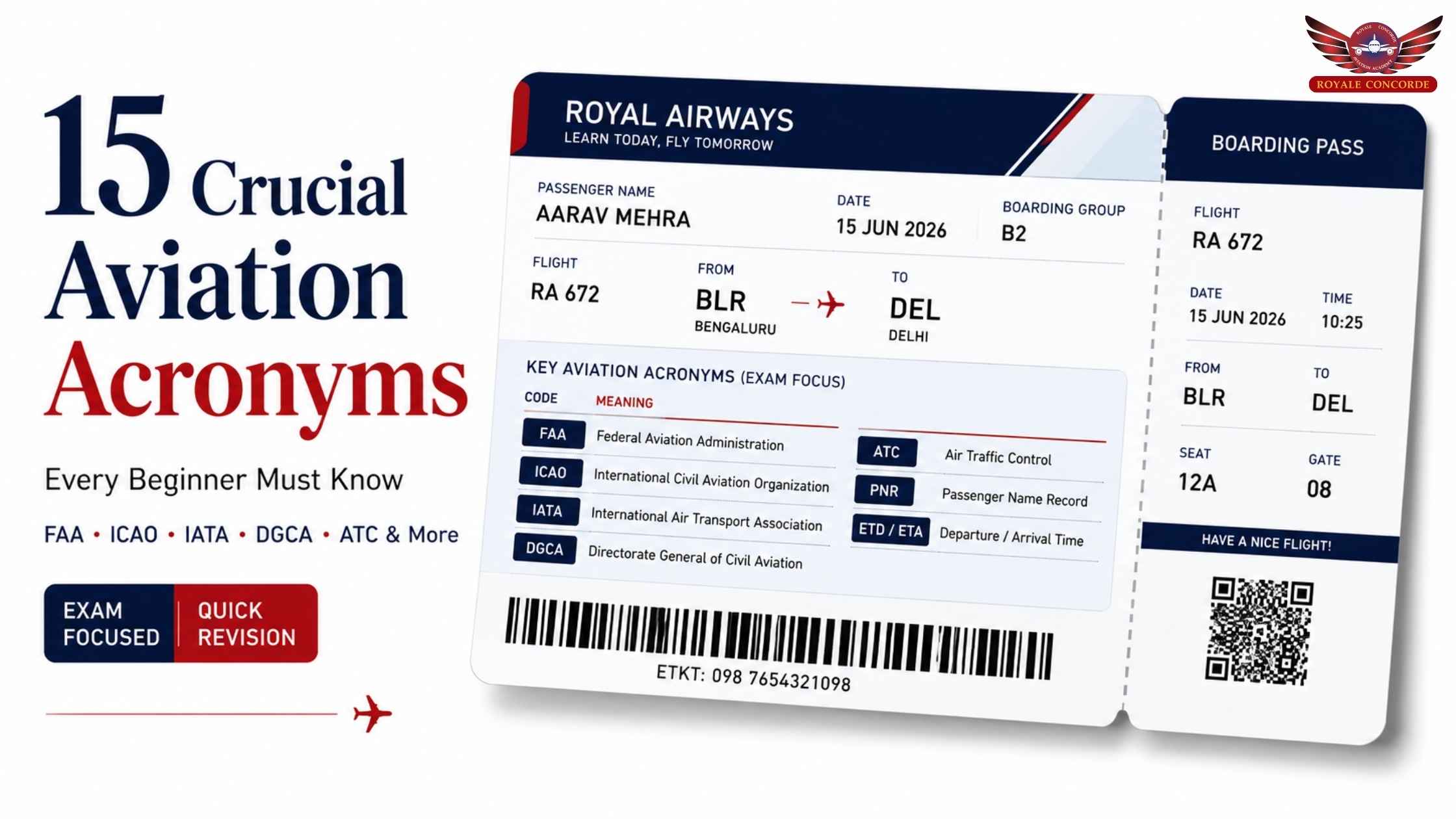
Below is a curated list of the 15 most crucial aviation acronyms for beginners. At Royale Concorde Aviation Academy, we integrate these into our core curriculum, blending theory with real-world application through simulated training, workshops, and industry exposure.
| Acronym | Full Form | Role in Aviation |
|---|---|---|
| FAA | Federal Aviation Administration | US civil aviation authority, sets and enforces aviation regulations and safety standards worldwide. |
| ICAO | International Civil Aviation Organization | UN specialized agency, standardizes international air navigation and regulatory aviation terms. |
| IATA | International Air Transport Association | Governs airline operations, codes, and commercial standards among global aviation organizations. |
| DGCA | Directorate General of Civil Aviation | India’s regulatory authority, oversees licensing, safety, and compliance in Indian aviation. |
| EASA | European Union Aviation Safety Agency | Sets aviation safety standards and certification for EU member states. |
| ATC | Air Traffic Control | Manages the safe and orderly flow of aircraft in the sky and at airports. |
| CPL | Commercial Pilot Licence | Certification required for pilots to fly commercial aircraft. |
| PPL | Private Pilot Licence | Permits individuals to fly private aircraft for non-commercial purposes. |
| METAR | Meteorological Aerodrome Report | Real-time weather report crucial for flight operations and safety. |
| AIP | Aeronautical Information Publication | Official document containing detailed information essential for air navigation. |
| NOTAM | Notice to Airmen | Alerts pilots to potential hazards or changes in airport or airspace conditions. |
| FBO | Fixed-Base Operator | Private service providers at airports offering fueling, maintenance, and support. |
| SOP | Standard Operating Procedure | Detailed instructions that ensure consistency and safety in aviation operations. |
| VFR | Visual Flight Rules | Rules governing flight operations in clear weather conditions. |
| IFR | Instrument Flight Rules | Rules for operating aircraft in poor visibility or weather using instruments. |
How do these acronyms impact your aviation training and career?
Understanding these terms unlocks deeper insights into aviation operations, safety protocols, and international standards. For instance, knowing what DGCA or EASA stands for is crucial for licensing and compliance, while IATA and ICAO set global benchmarks every aviation professional must follow. At Royale Concorde Aviation Academy, our curriculum ensures that students not only memorize these aviation abbreviations but also apply them in mock drills, simulations, and industry case studies.
What is the difference between ICAO, IATA, FAA, DGCA, and EASA?
ICAO (International Civil Aviation Organization) is a UN body that sets international aviation safety and operational standards. IATA (International Air Transport Association) is a trade association for airlines, focusing on commercial and operational guidelines. FAA (Federal Aviation Administration) is the US aviation regulatory agency, while DGCA (Directorate General of Civil Aviation) is India’s counterpart. EASA (European Union Aviation Safety Agency) oversees aviation safety for EU countries. These civil aviation authorities and aviation organizations collectively shape the rules, certifications, and standards that define the aviation industry.
Quick comparison table: Regulatory aviation terms
| Acronym | Region | Focus Area |
|---|---|---|
| FAA | USA | Regulation, safety, certification |
| DGCA | India | Licensing, compliance, safety |
| ICAO | Global (UN) | International standards, air navigation |
| IATA | Global | Commercial operations, airline codes, ticketing |
| EASA | Europe | Safety, certification |
How do aviation abbreviations and acronyms support real-world operations?
Aviation abbreviations serve as shorthand in everything from cockpit communication to airport operations and regulatory documentation. For instance:
- Cabin crew use SOPs (Standard Operating Procedures) during emergencies.
- Pilots receive METAR reports and NOTAMs before flights.
- Ground staff coordinate with ATC and FBOs for smooth aircraft turnaround.
- Flight crew must understand VFR and IFR rules for safe navigation.
At Royale Concorde Aviation Academy, practical training modules immerse students in scenarios where mastery of these acronyms is vital for safety, efficiency, and professional conduct.
Why do regulatory aviation terms matter for beginners?
Regulatory aviation terms are the backbone of compliance and global collaboration in the aviation industry. For beginners, understanding these terms is key to:
- Clearing aviation theory and regulatory exams
- Understanding flight documentation and procedures
- Meeting airline and airport hiring standards
- Ensuring passenger safety and operational integrity
At Royale Concorde Aviation Academy, students gain in-depth exposure to regulatory frameworks set by civil aviation authorities like FAA, DGCA, EASA, and learn how these impact daily airline operations.
Which aviation organizations set the standard for the industry?
The aviation sector is governed by several key aviation organizations. These include:
- ICAO: Sets international safety, security, and environmental standards.
- IATA: Establishes airline coding, ticketing, and operational protocols.
- DGCA: Regulates Indian aviation licensing and safety.
- FAA & EASA: Set standards for the US and Europe, influencing global best practices.
Royale Concorde Aviation Academy ensures all training aligns with the expectations of these aviation organizations, providing students with a global perspective and employability edge.
How do civil aviation authorities impact your career in India and abroad?
Civil aviation authorities like DGCA (India), FAA (USA), and EASA (Europe) set the licensing, safety, and operational requirements for aviation professionals. Their standards affect:
- Eligibility for pilot and cabin crew roles
- Recognition of qualifications internationally
- Access to global career opportunities
- Compliance with safety and quality standards
At Royale Concorde Aviation Academy, our courses are designed to meet both national and international regulatory requirements, giving graduates the flexibility to pursue careers in India or abroad.
How does Royale Concorde Aviation Academy support your journey?
Royale Concorde Aviation Academy is Bangalore’s premier aviation training institute, renowned for its women-led leadership, industry-experienced faculty, and international-standard curriculum. By emphasizing the importance of aviation acronyms for beginners, regulatory aviation terms, and practical industry exposure, RCAA prepares students for:
- Cabin crew and air hostess positions
- Airport ground operations
- Aviation hospitality roles
- Corporate and private aviation careers
Students benefit from simulated cabin environments, safety drills, communication labs, and grooming studios—ensuring they are not just knowledgeable, but confident and industry-ready.
Why does learning aviation abbreviations boost your employability?
Mastering aviation abbreviations signals to employers that you are serious, detail-oriented, and ready for a professional environment. Airlines and airports value candidates who can seamlessly communicate using industry terminology, making it a pivotal skill for interviews and on-the-job performance.
About Royale Concorde Aviation Academy
Royale Concorde Aviation Academy (RCAA) is a leading aviation training institute based in Bangalore, Karnataka. With a mission to nurture talent and empower students with technical knowledge, personality development, and practical exposure, RCAA is dedicated to building the next generation of aviation professionals. Our women-led leadership, industry-aligned curriculum, and robust placement support distinguish us as a premier destination for cabin crew, air hostess, airport operations, and aviation hospitality training in India.
Contact: mail@royaleconcordeaviation.com | +91 7204805777 / +91 7204806777
Location: Bangalore, Karnataka, India
Website: https://royaleconcordeaviation.com/
Conclusion: Your first step in aviation starts here
Understanding aviation acronyms for beginners is more than an academic exercise—it is your entry ticket to the world of professional aviation. From regulatory aviation terms like FAA, ICAO, IATA, EASA, and DGCA to essential operational abbreviations, every term you learn at Royale Concorde Aviation Academy advances your confidence, competence, and career prospects. Start your journey with the right knowledge and the best mentors in Bangalore—choose Royale Concorde Aviation Academy.
Frequently Asked Questions
What are the most important aviation acronyms for beginners to know?
Some of the most crucial aviation acronyms for beginners include FAA (Federal Aviation Administration), ICAO (International Civil Aviation Organization), IATA (International Air Transport Association), DGCA (Directorate General of Civil Aviation), EASA (European Union Aviation Safety Agency), ATC (Air Traffic Control), and VFR/IFR (Visual/Instrument Flight Rules). Understanding these aviation abbreviations helps newcomers navigate industry communication and regulatory requirements.
What does ICAO stand for and why is it important in aviation?
ICAO stands for the International Civil Aviation Organization. It is a specialized agency of the United Nations that develops global standards and regulations for civil aviation safety, security, efficiency, and environmental protection. ICAO plays a critical role by coordinating international cooperation and ensuring that civil aviation authorities across countries follow common regulatory aviation terms and practices.
How does IATA differ from ICAO in the aviation industry?
IATA, or the International Air Transport Association, represents airlines and focuses on promoting safe, reliable, and economical air transport for passengers and cargo. While ICAO sets international standards and regulations for aviation, IATA works closely with airlines and aviation organizations to implement these standards and facilitate cooperation, simplifying processes like ticketing, baggage handling, and fare calculations.
What is the role of the FAA in global aviation?
The FAA, or Federal Aviation Administration, is the primary regulatory body for civil aviation in the United States. It creates and enforces safety standards, certifies pilots and aircraft, manages air traffic control, and oversees airport operations. The FAA’s regulations often influence global aviation organizations and set benchmarks for regulatory aviation terms internationally.
What does DGCA do and who needs to interact with this authority?
DGCA, or Directorate General of Civil Aviation, is India’s civil aviation regulatory body. It oversees safety, licensing, and regulation of civil aviation authorities within India. Anyone pursuing a career in aviation in India, such as pilots, engineers, and airline operators, will need to interact with DGCA for certifications, approvals, and compliance with aviation abbreviations and regulations.
How does EASA impact pilots and airlines in Europe?
EASA, the European Union Aviation Safety Agency, sets aviation safety standards for all EU member states. Pilots, airlines, and maintenance organizations must comply with EASA regulations for licensing, aircraft certification, and operational safety. EASA harmonizes rules across Europe, making it easier for aviation professionals to work across different countries under unified regulatory aviation terms.
Why are regulatory aviation terms critical for students and professionals?
Regulatory aviation terms are crucial because they standardize communication, ensure legal compliance, and enhance safety in the industry. Whether you’re a student, pilot, or maintenance engineer, understanding these terms allows you to interpret procedures correctly and interact effectively with civil aviation authorities, manufacturers, and aviation organizations worldwide.
How does Royale Concorde Aviation help beginners understand aviation acronyms and abbreviations?
Royale Concorde Aviation offers comprehensive training programs and workshops designed for beginners, where students are introduced to key aviation acronyms for beginners and aviation abbreviations. Through interactive sessions, study materials, and real-world case studies, learners gain a solid grasp of industry terminology and the roles of major aviation organizations, making their transition into aviation smoother and more confident.
Can understanding aviation organizations and acronyms help with international aviation careers?
Absolutely. Recognizing the functions of aviation organizations like ICAO, IATA, DGCA, FAA, and EASA, along with their associated acronyms, is essential for professionals aiming for international aviation careers. Royale Concorde Aviation ensures that its students master these concepts, enabling them to confidently work with global civil aviation authorities and adapt to diverse regulatory environments.