
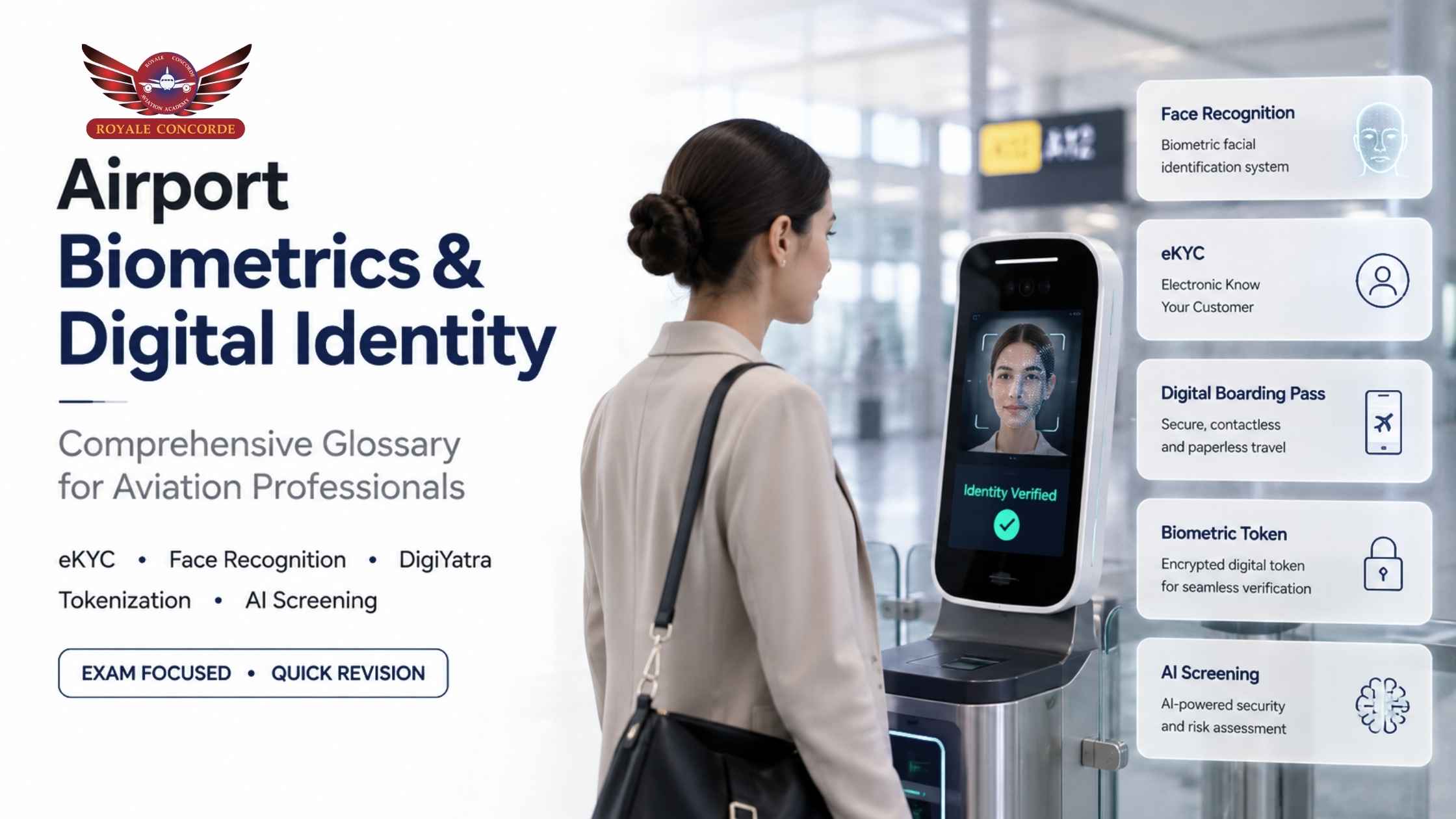
Royale Concorde Aviation Academy in Bangalore is empowering India’s future aviation professionals with advanced knowledge of airport biometrics terms, digital identity aviation, and next-generation passenger facilitation technologies.
What Is Airport Biometrics And Digital Identity In Aviation?
Airport biometrics and digital identity solutions are revolutionizing the aviation industry by introducing secure, contactless, and efficient ways to verify passenger identities. At Royale Concorde Aviation Academy, we provide students with a practical and theoretical foundation in these cutting-edge technologies, preparing them for roles in modern airports and airlines.
- Airport biometrics uses unique physical characteristics (like faces, fingerprints, or irises) for identity verification.
- Digital identity aviation leverages digital credentials and data to streamline travel, enhance security, and enable seamless passenger journeys.
This glossary answers the most common questions about key terms and concepts in airport biometrics and digital identity, ensuring that future aviation professionals are industry-ready.
What Are The Essential Airport Biometrics Terms?
Understanding airport biometrics terms is crucial for anyone aspiring to work in aviation security, passenger handling, or ground operations. Here’s a detailed explanation of the most significant terms:
| Term | Definition | Importance in Aviation |
|---|---|---|
| Biometric Authentication | Verification of identity using unique biological traits (face, fingerprint, iris). | Securely matches passengers to travel documents and enhances border security. |
| Enrollment | Process of capturing and registering a traveler’s biometric data for future use. | Creates a digital profile enabling contactless and automated processing. |
| Template | Digitally stored mathematical representation of a biometric feature. | Used for rapid, automated identity matching at checkpoints. |
| Match/No-Match | Result of a biometric system’s attempt to verify identity. | Determines if a passenger can proceed or needs further screening. |
Royale Concorde Aviation Academy ensures that students master these airport biometrics terms through simulation-based training and real-world case studies.
How Is Digital Identity Aviation Transforming Passenger Journeys?
Digital identity aviation refers to the use of digital credentials and biometrics to simplify and secure the passenger journey from check-in to boarding. This technology is at the heart of contactless travel—a priority in the post-pandemic aviation landscape.
- Digital identity aviation enables passengers to store travel credentials securely on a mobile device or in the cloud for instant verification.
- Airlines and airports can rapidly verify passenger identities, reducing queues and manual checks.
- Enhanced privacy and security, as data is encrypted and shared only with authorized parties.
Royale Concorde Aviation Academy integrates digital identity aviation concepts into its curriculum, preparing students for roles that require digital competence and operational expertise.
What Is E-Gate Vocabulary In The Context Of Airports?
E-gate vocabulary includes the specific terms related to automated gates that use biometrics for identity verification at airport entry, exit, or boarding points.
- E-gates are automated barriers equipped with biometric scanners (face or fingerprint) and document readers.
- Throughput refers to the number of passengers processed per hour—critical for airport efficiency.
- Self-boarding allows passengers to board aircraft by verifying their identity at the gate without human staff.
- Access control ensures only authorized travelers enter secure zones.
Mastery of e-gate vocabulary is essential for airport ground staff, security personnel, and technology managers—core career paths offered at Royale Concorde Aviation Academy.
How Does Facial Recognition Airport Technology Work?
Facial recognition airport systems use cameras and AI algorithms to match a traveler’s face to their ID or passport photo. This provides a fast, contactless, and secure method of verifying identity at check-in, bag drop, security, and boarding.
- Passenger’s face is scanned at a designated checkpoint.
- Facial features are compared to the stored image in the digital travel credential or government database.
- System grants access or flags inconsistencies for secondary checks.
At Royale Concorde Aviation Academy, students learn the operational, ethical, and privacy considerations of facial recognition airport solutions through hands-on labs and expert lectures.
What Is One ID And Why Is It Important In Modern Aviation?
One ID is an initiative by the International Air Transport Association (IATA) aiming to streamline passenger identification using a single, interoperable digital identity across all airport touchpoints.
- Eliminates repetitive document checks at multiple stages (check-in, security, boarding).
- Improves passenger experience and reduces wait times.
- Enhances security and fraud prevention.
Royale Concorde Aviation Academy prepares future aviation professionals to implement and manage One ID systems, ensuring graduates are ready for tomorrow’s digital airports.
What Is A Digital Travel Credential?
A digital travel credential is a secure, electronic version of a travel document (like a passport or visa) that contains biometric and personal data. It can be stored on a smart device or in a secure cloud environment and used for seamless, contactless verification at airports.
- Meets international security standards (such as ICAO specifications).
- Reduces reliance on paper documents and manual checks.
- Enables faster, paperless border crossings and check-ins.
Royale Concorde Aviation Academy trains students in the practical use and management of digital travel credentials, a skill highly valued by global airlines.
How Does Automated Border Control Enhance Security?
Automated border control refers to the use of self-service kiosks and e-gates that verify a traveler’s identity using biometrics—minimizing human error and speeding up the process.
- Passengers scan their travel documents and biometrics at automated stations.
- Systems cross-check data against international watchlists and databases.
- Only verified travelers are allowed to proceed, reducing the risk of unauthorized entry.
Students at Royale Concorde Aviation Academy learn about the design, operation, and security protocols of automated border control, positioning them for success in airport security roles.
What Is Contactless Travel And Why Is It The Future?
Contactless travel is the process where passengers use digital and biometric technologies to move through airport checkpoints with minimal physical interaction with staff or equipment.
- Reduces the risk of disease transmission.
- Speeds up passenger flows and minimizes queues.
- Improves passenger satisfaction and operational efficiency.
As contactless travel becomes the industry’s gold standard, Royale Concorde Aviation Academy is at the forefront of preparing the next generation of aviation staff to manage and optimize these systems.
Why Choose Royale Concorde Aviation Academy For Airport Biometrics And Digital Identity Training?
Royale Concorde Aviation Academy (RCAA) in Bangalore is India’s premier aviation career institute, combining industry-leading curriculum with practical exposure in biometric and digital identity technologies.
- Industry-aligned training covering all airport biometrics terms and digital identity aviation concepts.
- Practical exposure to e-gate vocabulary, facial recognition airport systems, automated border control, and digital travel credential management.
- Simulation-based learning, professional grooming, and placement assistance to ensure employability in top airlines and airports.
- Experienced faculty with real-world airline and airport backgrounds.
Royale Concorde Aviation Academy empowers students to become future-ready professionals capable of excelling in contactless travel environments and digital aviation operations.
About Royale Concorde Aviation Academy
Royale Concorde Aviation Academy is a premier aviation training institute based in Bangalore, Karnataka, India. Founded by Shri L. R. Shivarame Gowda and led by a team of visionary women leaders, the academy is committed to shaping the next generation of aviation professionals through a blend of technical education, practical exposure, personality development, and industry mentoring.
- Comprehensive training in cabin crew, air hostess programs, airport ground operations, and aviation hospitality.
- State-of-the-art facilities, simulated aircraft cabin, and industry-relevant curriculum.
- Focus on employability, professional grooming, communication, and global service standards.
- Strategic location in Bangalore, India’s aviation and technology hub.
To learn more, visit royaleconcordeaviation.com or contact us at mail@royaleconcordeaviation.com.
Frequently Asked Questions
What are the most important airport biometrics terms travelers should know?
Some key airport biometrics terms include facial recognition, iris scan, biometric token, and liveness detection. These refer to different technologies and processes used to identify travelers quickly and securely at various airport checkpoints. Royale Concorde Aviation uses these terms throughout its solutions to help clients understand industry standards and best practices.
How does digital identity aviation transform the passenger journey?
Digital identity aviation leverages secure digital profiles to streamline passenger verification and authentication at every touchpoint. Royale Concorde Aviation offers platforms that enable seamless, real-time identity validation, reducing wait times and enhancing security from check-in to boarding.
What is e-gate vocabulary, and why is it relevant for modern airports?
E-gate vocabulary refers to the specific terms and technologies associated with automated electronic gates used at border control and boarding points. Understanding this vocabulary is essential for airports and airlines adopting Royale Concorde Aviation’s e-gate solutions, as it helps ensure clear communication and smooth implementation.
How is facial recognition airport technology improving security and convenience?
Facial recognition airport technology automates identity checks, reducing human error and speeding up processes like boarding and immigration. Royale Concorde Aviation integrates advanced facial recognition to boost both security and passenger convenience, ensuring compliance with international standards.
What does One ID mean in the context of airport biometrics?
One ID is an IATA initiative advocating for a single, reusable digital identity for passengers, enabling a contactless journey through the airport. Royale Concorde Aviation’s One ID-compliant solutions help airports and airlines deliver frictionless travel experiences while maintaining robust security.
How does a digital travel credential work, and what are its benefits?
A digital travel credential is a secure, electronic version of a traveler’s identity and travel documents, used for automated checks. With Royale Concorde Aviation’s solutions, digital travel credentials help facilitate faster, paperless processing, reducing physical contact and enhancing data privacy.
What is automated border control, and how does Royale Concorde Aviation support it?
Automated border control uses biometric and digital identity technologies to process travelers at border checkpoints without manual intervention. Royale Concorde Aviation provides turnkey automated border control solutions that ensure compliance, efficiency, and enhanced security at international airports.
How does contactless travel benefit passengers and airports?
Contactless travel minimizes physical touchpoints by using biometrics and digital identity systems for authentication and access. Royale Concorde Aviation’s platforms support contactless travel, resulting in faster processes, improved hygiene, and a more seamless passenger experience.
How does Royale Concorde Aviation ensure the privacy and security of biometric data?
Royale Concorde Aviation adheres to strict data privacy regulations and implements end-to-end encryption, secure storage, and regular audits. Their systems are designed to protect biometric and digital identity data, ensuring trust and safety for both travelers and airport stakeholders.