Royale Concorde Aviation Academy, Bangalore — India’s premier aviation training institute, equipping aviation professionals with industry-ready expertise.
What Are Airline Ticket Codes and Why Are They Important for Ground Agents?
Airline ticket codes are specialized alphanumeric identifiers embedded throughout the flight booking and ticketing process. For ground agents, mastering airline ticket codes explained is crucial because these codes influence everything from passenger verification to baggage handling, seat assignment, and disruption management.
Quick answer: Airline ticket codes are industry-standard notations found on tickets and boarding passes that communicate vital information about the passenger’s journey, payment, eligibility, and operational requirements. Understanding these is essential for accurate check-in, troubleshooting, and customer service.
- Ensure seamless passenger experiences
- Minimize errors during check-in operations
- Improve efficiency in handling airline reservations and disruptions
- Meet regulatory and safety standards
At Royale Concorde Aviation Academy, future ground staff are trained to decode, interpret, and act on these codes as part of holistic aviation operations training, blending theory and hands-on simulations.
What Is PNR Meaning and How Does It Affect Airline Operations?
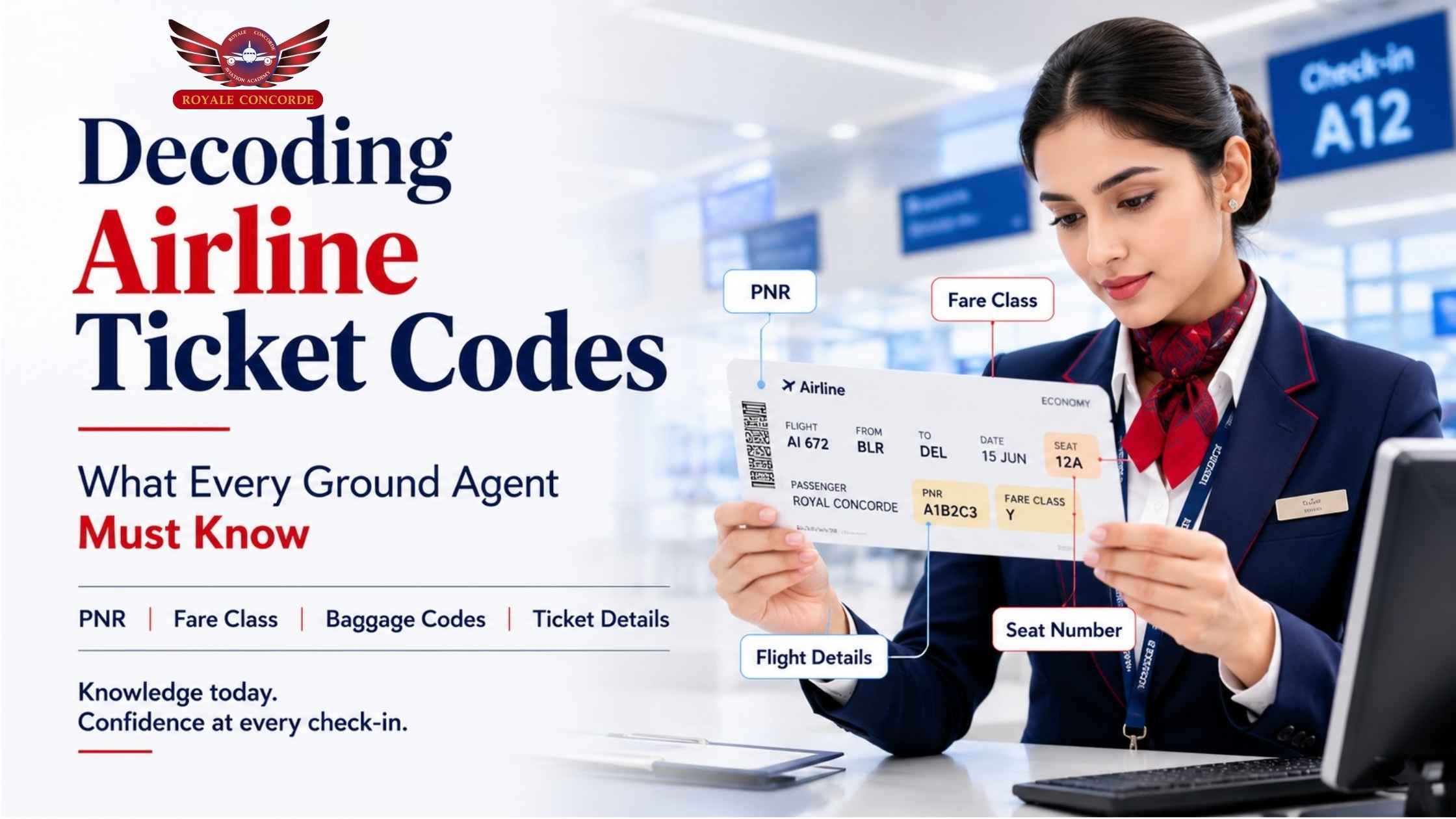
Quick answer: PNR meaning stands for Passenger Name Record—a digital record in the airline’s reservation system containing all essential travel details of a passenger or group. Ground agents refer to the PNR for check-in, baggage, security, and customer service.
Each PNR is a unique identifier that links together information such as:
- Passenger names and contact details
- Flight segments and dates
- Fare basis code and ticket status
- Special service requests (SSR), such as meals or wheelchairs
- Frequent flyer details
In Practice: When a passenger approaches the check-in counter, the ground agent retrieves the booking by entering the PNR. Any discrepancy or missing information in the PNR can cause delays, making accuracy vital.
Royale Concorde Aviation Academy emphasizes the importance of PNR management as part of its check-in operations modules, empowering future professionals to handle real-world airline scenarios with confidence.
How to Understand and Use Fare Basis Code in Airline Ticketing
Quick answer: The fare basis code is a string of letters and numbers that defines the rules, restrictions, and price of an airline ticket. It determines eligibility for upgrades, refunds, baggage allowance, and more.
| Fare Basis Code | Class | Refundable? | Changeable? | Baggage |
|---|---|---|---|---|
| Y | Economy (Full Fare) | Yes | Yes | Standard |
| KX7NR | Economy (Promo) | No | With Fee | Reduced |
| B2APX | Business Saver | No | With Fee | Extra |
For ground agents, recognizing fare basis code is key to providing accurate information about ticket flexibility, upgrade possibilities, and service entitlements, ultimately improving customer satisfaction and compliance.
What Are the Most Common Ticketing Abbreviations Every Ground Agent Should Know?
Quick answer: Ticketing abbreviations are shorthand codes used on tickets, boarding passes, and airline systems to indicate ticket status, type, and associated services. Ground agents must be fluent in these codes to avoid misinterpretation and errors.
- OK: Confirmed booking
- RQ: Waitlisted
- ST: Standby
- INF: Infant
- CHD: Child
- ADT: Adult
- FQTV: Frequent Flyer
- SSR: Special Service Request
- OSI: Other Service Information
- NO-SHOW: Passenger did not report for flight
Royale Concorde Aviation Academy’s curriculum covers ticketing abbreviations in depth, ensuring trainees can read, interpret, and act on codes during live check-in operations and irregularity handling.
What Is Codeshare and How Does It Affect Airline Reservations?
Quick answer: Codeshare refers to an arrangement where two or more airlines share the same flight, meaning a passenger may book with one airline but fly on another’s aircraft. This can complicate airline reservations and check-in operations.
For ground agents, codeshare flights require special attention:
- Check which airline is operating the flight versus which is selling the ticket
- Coordinate with both airlines’ systems for PNR, baggage, and boarding
- Inform passengers about codeshare specifics (lounge access, frequent flyer miles, etc.)
At Royale Concorde Aviation Academy, students gain hands-on exposure to codeshare procedures, preparing them to manage these complex scenarios in real airline environments.
What Is an Open-Jaw Ticket and When Is It Used?
Quick answer: An open-jaw ticket allows a passenger to fly into one city and depart from another, or return from a different city than the original departure point. It’s frequently used for multi-city business or leisure trips.
- Example: Bengaluru → Delhi (fly), Mumbai → Bengaluru (return)
Understanding open-jaw tickets is vital for ground agents because they must ensure proper ticket validation, baggage routing, and coordinate with the correct airport teams for each leg of the journey.
How Do Ground Agents Handle No-Show Passengers?
Quick answer: A no-show passenger is someone who fails to arrive for their scheduled flight. For ground staff, timely identification of no-show status is essential for seat release, baggage reconciliation, and compliance with airline and security protocols.
- Flag the PNR as no-show in the system
- Initiate seat release for standby or waitlisted passengers
- Ensure no baggage is loaded without the passenger (security compliance)
- Update airline reservations system to reflect new seat availability
Royale Concorde Aviation Academy’s practical training modules simulate no-show scenarios, preparing students to respond swiftly and accurately during peak operations.
What Is an E-Ticket and How Has It Changed the Check-In Process?
Quick answer: An e-ticket (electronic ticket) is a digital version of a paper ticket, now the global standard in airline reservations. E-tickets streamline check-in operations, reduce fraud, and enhance passenger convenience.
- Passengers check in using PNR or e-ticket number
- Boarding passes can be issued electronically or printed on demand
- All ticket data is stored securely in the airline’s GDS
Mastery of e-ticket processes is a core part of Royale Concorde Aviation Academy’s training, ensuring students are ready for today’s digital-first aviation environment.
What Is GDS and Its Role in Modern Airline Operations?
Quick answer: GDS (Global Distribution System) is a computerized reservation network used by airlines, travel agents, and ground staff to manage airline reservations, ticket issuance, fare pricing, and seat inventory in real time.
- Popular GDS platforms: Amadeus, Sabre, Galileo, Travelport
- Centralizes booking and ticketing across multiple airlines and agents
- Essential for codeshare, interline, and multi-segment itineraries
Ground staff trained in GDS proficiency can handle complex itineraries, resolve issues quickly, and deliver superior customer service—skills emphasized in Royale Concorde Aviation Academy’s curriculum.
How to Master Airline Reservations and Check-In Operations
Quick answer: Airline reservations refer to the process of booking, confirming, and managing passenger travel, while check-in operations involve verifying identity, assigning seats, and preparing passengers for boarding. Both require precision, customer focus, and up-to-date technical knowledge.
- Retrieve and verify PNR details using GDS
- Check fare basis code for entitlements and restrictions
- Confirm codeshare or open-jaw arrangements, if any
- Issue boarding pass and tag baggage as per ticketing abbreviations
- Handle no-show, waitlisted, or special service requests
- Update records in real time to ensure compliance and efficiency
Through hands-on training and simulated check-in operations at Royale Concorde Aviation Academy, students develop the technical and soft skills needed to excel in high-pressure airport environments.
Why Royale Concorde Aviation Academy Is Your Best Choice for Ticketing and Ground Staff Training
Royale Concorde Aviation Academy in Bangalore stands out as a premier aviation career institute, offering specialized training in airline ticket codes explained, PNR meaning, fare basis code, ticketing abbreviations, and all major aspects of airline and airport operations.
- Industry-aligned curriculum developed by experienced airline professionals
- Practical, simulation-based learning with real-world GDS and check-in system modules
- Expert faculty with global and domestic airline experience
- Dedicated placement assistance and career mentoring
- Located in Bangalore, India’s aviation and technology hub
RCAA’s commitment to excellence, professionalism, and world-class standards ensures that every graduate is airline-ready, confident, and equipped for a successful career.
About Royale Concorde Aviation Academy
Royale Concorde Aviation Academy (RCAA) is a leading aviation training institute in Bangalore, Karnataka, focused on shaping the next generation of cabin crew, air hostesses, and ground operations professionals. Founded by Shri L. R. Shivarame Gowda and led by a dynamic team of women mentors, RCAA combines industry-relevant curriculum, practical exposure, and holistic personality development for successful aviation careers.
Contact: +91 7204805777, mail@royaleconcordeaviation.com
Website: royaleconcordeaviation.com
Frequently Asked Questions
What does ‘airline ticket codes explained’ mean for ground agents?
‘Airline ticket codes explained’ refers to the practice of decoding the various abbreviations and alphanumeric codes found on airline tickets. For ground agents, understanding these codes is essential for verifying ticket validity, routing, fare conditions, and eligibility for services. Royale Concorde Aviation provides comprehensive training and quick-reference tools to ensure ground agents can interpret these codes accurately and efficiently during check-in operations and other passenger service tasks.
What is the PNR meaning and why is it important in airline reservations?
PNR meaning stands for Passenger Name Record. It is a unique identifier that holds details of a passenger’s booking, including itinerary, ticket information, and contact details. In airline reservations, the PNR is crucial for tracking, modifying, and managing bookings. Royale Concorde Aviation’s ground agent support services ensure that staff are adept at retrieving, interpreting, and updating PNRs using various GDS platforms for seamless passenger processing.
Can you explain what a fare basis code is and how it affects ticketing?
A fare basis code is an alphanumeric string found on tickets that identifies the rules, restrictions, and price level of a fare. It affects changes, refunds, upgrades, and even baggage allowances. Royale Concorde Aviation educates ground agents on how to interpret fare basis codes so they can advise passengers correctly and handle exceptions or reissues according to airline policies.
What are the most common ticketing abbreviations every ground agent should know?
Common ticketing abbreviations include OW (one-way), RT (round-trip), NS (no-show), OJ (open-jaw), INF (infant), and CHD (child). Mastering these abbreviations is vital for accurate check-in operations and ticket validation. Royale Concorde Aviation provides quick-access guides and resources to make sure agents can quickly decipher these abbreviations at the counter.
How do codeshare flights impact ticket handling at the airport?
Codeshare flights involve two or more airlines sharing the same flight, often with different flight numbers. Ground agents must verify the operating carrier and ensure correct check-in and baggage handling. Royale Concorde Aviation’s training includes hands-on simulations for managing codeshare complexities, so agents can deliver a seamless experience for travelers flying on shared routes.
What is an open-jaw ticket and how should it be processed?
An open-jaw ticket allows a passenger to fly into one city and depart from another, with the segment between those cities not included in the ticket. For ground agents, recognizing open-jaw itineraries is essential for correct baggage tagging and check-in operations. Royale Concorde Aviation provides scenario-based learning to help agents confidently process these less common but important ticket types.
How are no-show passengers managed and what do the codes indicate?
A no-show passenger is someone who fails to check in or board their booked flight. Ticket codes like NS or NO-SHOW help agents identify such cases. Royale Concorde Aviation ensures ground agents understand the implications for fare forfeiture, rebooking, and reporting, and provides guidance on how to handle no-show scenarios in the GDS and at the airport.
What is an e-ticket and how does it differ from a paper ticket?
An e-ticket, or electronic ticket, is a digital record of a passenger’s travel details stored in the airline’s reservation system. Unlike paper tickets, e-tickets streamline check-in operations and reduce risks of loss or damage. Royale Concorde Aviation’s solutions help ground agents manage e-ticket verification, reissuance, and troubleshooting using advanced GDS tools.
How do GDS platforms support airline reservations and ticket code management?
GDS (Global Distribution System) platforms like Amadeus, Sabre, and Galileo are the backbone of airline reservations and ticket management. They store, retrieve, and process all ticketing data, including fare basis code, PNR, and ticketing abbreviations. Royale Concorde Aviation’s agent training covers GDS navigation and troubleshooting to ensure accurate, real-time updates for all passenger transactions.