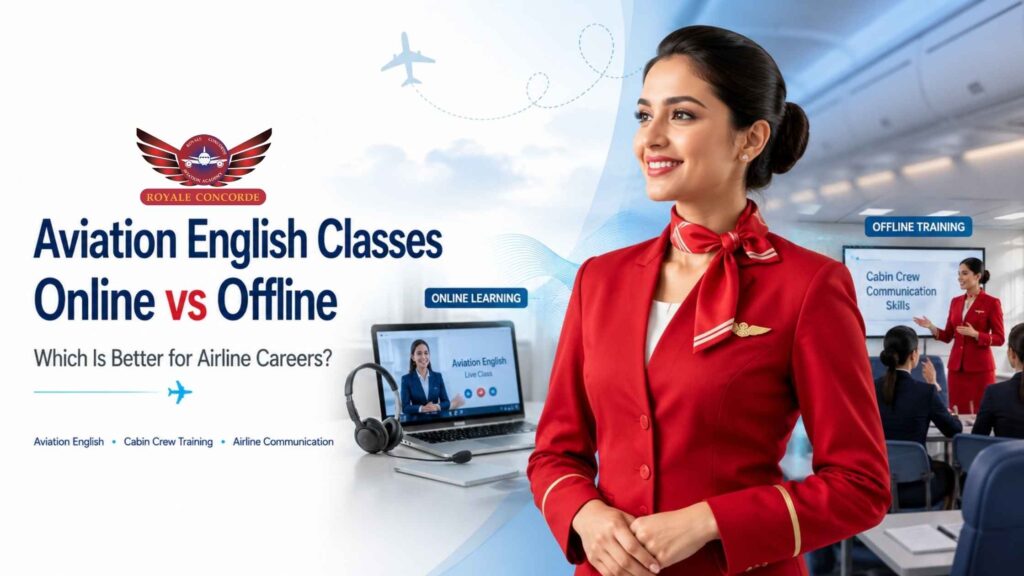
The short answer: Both online and offline learning methods can help aviation aspirants develop professional communication skills, but the best choice depends on your learning style, career goals, schedule flexibility, and the level of practical exposure you need. While digital learning offers convenience and accessibility, classroom-based aviation communication training often provides stronger real-world interaction, role-play exercises, and airline interview preparation.
For aspiring cabin crew members, airport professionals, and aviation hospitality candidates, effective communication is not just a desirable skill—it is a core requirement. Airlines across the world prioritize candidates who can communicate confidently, clearly, and professionally with passengers, crew members, and aviation stakeholders. This is why Aviation English Classes have become an essential component of aviation career preparation.
At Royale Concorde Aviation Academy (RCAA), students receive industry-focused communication training designed to meet modern airline expectations. Whether students choose a digital learning pathway or classroom-based instruction, understanding the advantages and limitations of each format is crucial before making a decision.
What is aviation English and why is it important for airline careers?
Aviation English refers to the specialized communication skills used throughout the aviation industry. It combines standard English proficiency with aviation terminology, professional etiquette, passenger communication, emergency communication procedures, and intercultural interaction skills.
Strong aviation communication skills help professionals:
- Interact confidently with passengers.
- Handle customer service situations professionally.
- Participate effectively in airline interviews.
- Understand aviation terminology.
- Communicate during safety and emergency situations.
- Meet international airline communication standards.
- Enhance employability in global aviation markets.
For aspiring cabin crew professionals, communication abilities often influence recruitment outcomes as much as grooming and personality presentation.
What are Aviation English Classes?
Aviation English Classes are specialized communication programs designed to help aviation professionals master industry-specific English language skills. These programs go beyond conventional language learning by focusing on aviation terminology, passenger interaction, interview communication, pronunciation improvement, confidence building, and professional presentation.
Leading aviation academies such as Royale Concorde Aviation Academy integrate communication development into broader aviation training programs to create airline-ready candidates.
How does an online aviation English course work?
An online aviation English course allows students to learn remotely through digital platforms. Lessons are delivered using virtual classrooms, video conferencing tools, learning management systems, recorded sessions, interactive assignments, and online assessments.
Most online programs include:
- Live instructor-led sessions.
- Recorded lecture access.
- Vocabulary development exercises.
- Pronunciation practice.
- Aviation terminology modules.
- Online communication assessments.
- Virtual interview preparation.
This format has become increasingly popular among working professionals and students who require flexibility in scheduling.
Advantages of online learning
- Learn from any location.
- Flexible scheduling options.
- Reduced travel costs.
- Easy access to recorded content.
- Suitable for busy students and professionals.
- Convenient for learners outside major aviation hubs.
Limitations of online learning
- Limited face-to-face interaction.
- Reduced opportunities for physical role-play exercises.
- Potential internet connectivity challenges.
- Less immersive learning environment.
- Fewer opportunities to observe professional body language in person.
How does offline aviation English training work?
offline aviation English training takes place within a structured classroom environment where students interact directly with instructors and peers. This traditional learning model enables real-time feedback, practical communication exercises, and immersive training experiences.
At Royale Concorde Aviation Academy, classroom learning is enhanced through practical simulations, personality development workshops, aviation hospitality training, grooming sessions, and interview preparation modules.
Advantages of offline learning
- Direct interaction with trainers.
- Immediate correction and feedback.
- Enhanced communication confidence.
- Real-world role-playing opportunities.
- Improved teamwork and collaboration.
- Stronger networking opportunities.
- Hands-on practical learning experiences.
Limitations of offline learning
- Fixed schedules.
- Travel requirements.
- Less flexibility compared to digital learning.
- May not be ideal for working professionals with demanding schedules.
Online vs offline learning: Which is better for airline careers?
The answer depends on what stage of career preparation a student is currently in. Both learning models offer unique advantages.
| Factor | Online Learning | Offline Learning |
|---|---|---|
| Flexibility | Excellent | Moderate |
| Practical Exposure | Limited | Excellent |
| Interaction Level | Moderate | High |
| Interview Preparation | Good | Excellent |
| Networking Opportunities | Limited | High |
| Confidence Building | Good | Excellent |
| Accessibility | Excellent | Location Dependent |
For candidates pursuing airline careers, classroom-based learning often provides a stronger overall preparation experience because airline recruitment focuses heavily on face-to-face communication, personality presentation, teamwork, and customer interaction skills.
Why do airlines value communication skills so highly?
Communication directly impacts passenger safety, customer satisfaction, and operational efficiency. Cabin crew members serve as the primary link between airlines and passengers, making communication one of the most critical competencies evaluated during recruitment.
Airlines frequently assess:
- Fluency.
- Pronunciation.
- Listening skills.
- Confidence.
- Professional vocabulary.
- Body language.
- Problem-solving communication.
- Passenger handling abilities.
Because these competencies are often demonstrated in person, classroom learning environments provide valuable opportunities for realistic practice.
Can an ICAO preparation course improve career opportunities?
Yes. An ICAO preparation course helps aviation professionals develop communication competencies aligned with international aviation standards established by the International Civil Aviation Organization (ICAO).
Although ICAO communication standards are particularly important for pilots and air traffic professionals, aviation communication training also benefits cabin crew candidates by strengthening their professional language capabilities.
An effective ICAO preparation course may include:
- Pronunciation improvement.
- Aviation phraseology.
- Listening comprehension.
- Operational communication practice.
- Emergency communication exercises.
- Vocabulary enhancement.
How do aviation speaking classes improve employability?
aviation speaking classes focus specifically on verbal communication skills that are essential in airline recruitment and workplace performance.
These classes help candidates:
- Speak confidently during interviews.
- Improve pronunciation and clarity.
- Handle passenger interactions professionally.
- Develop customer service communication skills.
- Strengthen presentation abilities.
- Build confidence in multicultural environments.
Many airline recruiters evaluate a candidate’s ability to communicate naturally and confidently before considering technical qualifications.
Which learning format is best for cabin crew aspirants?
For most cabin crew candidates, a blended learning model often produces the strongest results. Students can leverage the flexibility of digital learning while benefiting from the practical exposure available through classroom training.
A balanced approach may include:
- Online theory modules.
- Classroom communication workshops.
- Practical passenger handling simulations.
- Interview preparation sessions.
- Group discussion exercises.
- Grooming and personality development training.
This combination helps students build both technical knowledge and real-world communication confidence.
Why choose Royale Concorde Aviation Academy for aviation communication training?
Royale Concorde Aviation Academy is a premier aviation training institution based in Bangalore, Karnataka, focused on preparing students for successful careers in the aviation industry. The academy specializes in cabin crew training, aviation hospitality, airport operations, communication development, grooming, and career readiness programs.
Students benefit from:
- Industry-aligned curriculum.
- Practical simulation-based training.
- Communication and personality development modules.
- Airline interview preparation.
- Professional grooming guidance.
- Aviation hospitality education.
- Career-oriented learning methodology.
- Placement support and career guidance.
The academy’s learning environment is specifically designed to bridge the gap between classroom learning and airline recruitment expectations.
What should students consider before choosing a learning format?
Before selecting between online and offline training, students should evaluate:
- Career goals.
- Learning preferences.
- Budget considerations.
- Schedule flexibility.
- Need for practical exposure.
- Access to training facilities.
- Interview preparation requirements.
- Confidence-building needs.
Students targeting cabin crew and airline-facing roles generally benefit from greater in-person interaction because airline careers involve extensive communication with passengers and colleagues.
Final verdict: Online or offline aviation English training?
Both learning models offer value, but for airline career preparation, offline classroom-based training often delivers a stronger advantage because it combines communication development with practical simulations, personality enhancement, and real-world interaction. However, learners seeking flexibility may find an online aviation English course highly effective when paired with practical workshops and guided speaking practice.
The most successful aviation professionals are those who continuously improve their communication skills, confidence, and professional presentation regardless of the learning format they choose. By selecting a quality aviation training institution such as Royale Concorde Aviation Academy, students gain access to industry-relevant guidance that supports long-term success in the competitive aviation sector.
About Royale Concorde Aviation Academy
Royale Concorde Aviation Academy (RCAA) is a leading aviation training institute in Bangalore, Karnataka, dedicated to preparing aspiring aviation professionals for careers in domestic and international airlines. Founded under the leadership of Shri L. R. Shivarame Gowda, the academy offers specialized training in cabin crew operations, aviation hospitality, airport ground services, communication skills, safety procedures, grooming, and personality development.
With a strong focus on practical learning, industry relevance, and career readiness, Royale Concorde Aviation Academy helps students develop the confidence, professionalism, and skills required to excel in the global aviation industry.
Contact Information
Phone: +91 7204805777 / +91 7204806777
Email: mail@royaleconcordeaviation.com
Location: Bangalore, Karnataka, India
Frequently Asked Questions
Are online or offline Aviation English Classes better for airline careers?
Both learning formats can be effective, but the best choice depends on your goals, schedule, and learning style. Online learning offers flexibility and convenience, while classroom-based training provides structured interaction and immediate instructor feedback. At Royale Concorde Aviation, students can choose a learning path that supports their airline career objectives while building the communication skills required by airlines, airports, and aviation organizations worldwide.
Who should choose an online aviation English course?
An online aviation English course is ideal for working professionals, college students, cabin crew aspirants, and individuals living far from aviation training centers. It allows learners to study from anywhere while maintaining their academic or professional commitments. Royale Concorde Aviation incorporates practical aviation communication scenarios, helping learners improve confidence and language proficiency without compromising flexibility.
What are the advantages of offline aviation English training?
Offline aviation English training offers face-to-face interaction, real-time speaking practice, classroom discussions, and direct mentorship from trainers. Many students find classroom environments beneficial because they encourage participation and provide opportunities for group exercises that closely resemble airline and airport communication situations. Royale Concorde Aviation’s classroom sessions are designed to create an immersive aviation-focused learning experience.
How important is English proficiency for airline jobs?
English proficiency is one of the most important skills for aviation professionals. Pilots, cabin crew members, ground staff, and air traffic personnel regularly communicate with passengers and colleagues from different countries. Strong communication skills improve operational efficiency, customer service quality, safety awareness, and career advancement opportunities within the aviation industry.
Does Royale Concorde Aviation provide ICAO-focused preparation?
Yes. Royale Concorde Aviation offers guidance through an ICAO preparation course designed to help learners understand aviation terminology, improve listening and speaking skills, and become familiar with international communication standards. The training focuses on practical language usage that supports professional aviation communication requirements.
Do speaking skills matter as much as grammar in aviation communication?
Absolutely. While grammar is important, aviation professionals must also communicate clearly, confidently, and accurately under various operational conditions. Aviation speaking classes help learners improve pronunciation, fluency, comprehension, and response speed, all of which are essential when interacting with passengers, crew members, and aviation personnel.
Can aviation English training improve cabin crew interview performance?
Yes. Aviation English training strengthens verbal communication, confidence, and professional presentation skills. Students learn how to answer interview questions effectively, communicate with clarity, and demonstrate customer-service-oriented language skills that airlines often evaluate during recruitment and assessment processes.
Why choose Royale Concorde Aviation for aviation English training?
Royale Concorde Aviation combines industry-focused instruction, practical communication exercises, experienced trainers, and career-oriented guidance. Whether students prefer online or classroom learning, the institute focuses on helping aspiring aviation professionals develop the language skills needed for airline recruitment, customer interaction, international communication, and long-term career growth within the aviation sector.