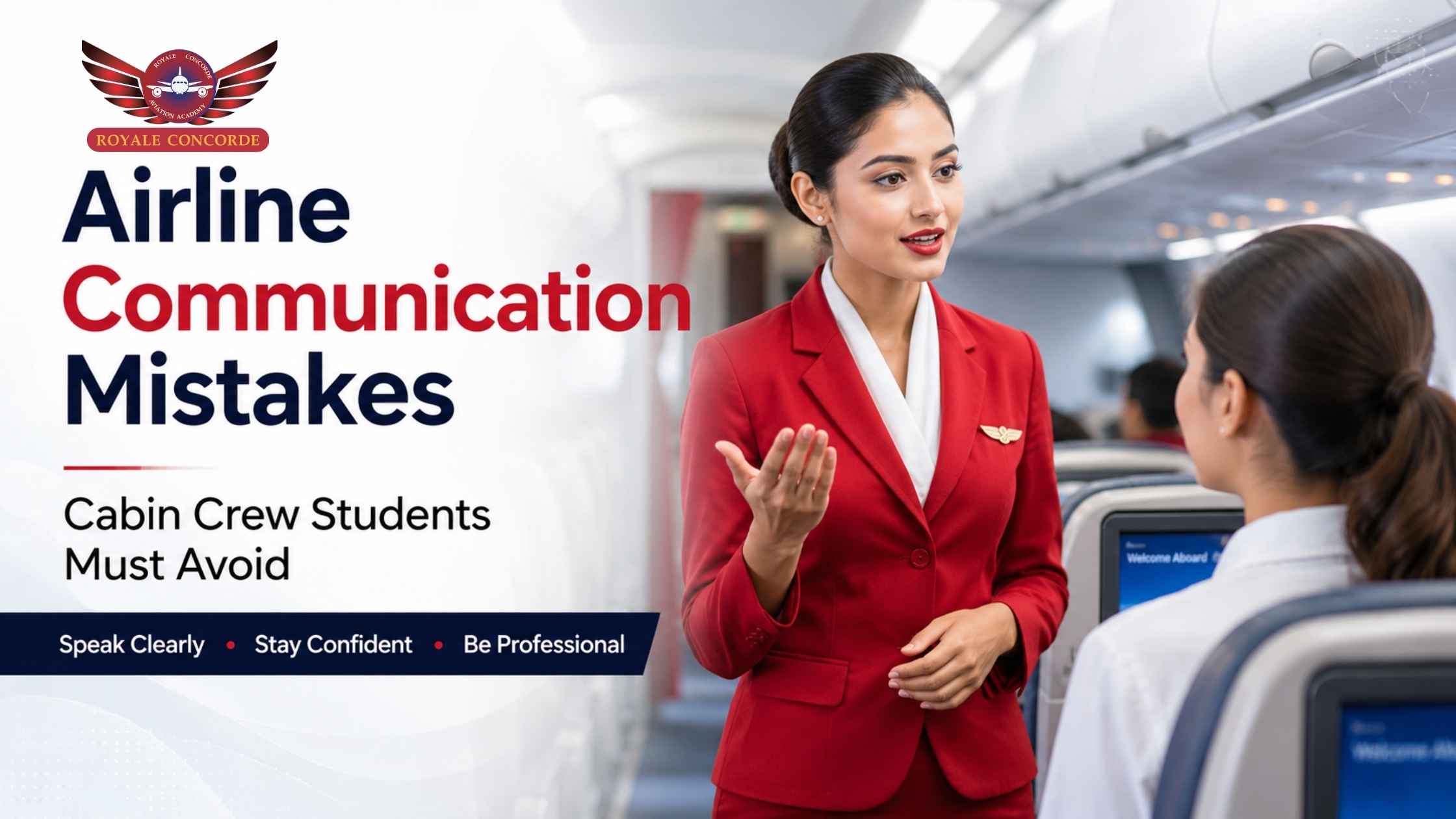
Airline Communication Mistakes can significantly impact passenger satisfaction, safety, teamwork, and career growth in the aviation industry. Cabin crew professionals are expected to communicate with clarity, confidence, professionalism, and empathy at every stage of a flight. For aspiring cabin crew members, understanding and avoiding common communication pitfalls is essential to meeting airline recruitment standards and delivering exceptional onboard service.
At Royale Concorde Aviation Academy, Bangalore, students are trained to develop industry-ready communication abilities through practical simulations, aviation-focused personality development, grooming sessions, customer service training, and real-world airline scenarios. The academy emphasizes communication excellence because airlines increasingly seek professionals who can effectively engage with passengers, coordinate with crew members, and manage challenging situations while maintaining professionalism.
What are the most common airline communication mistakes made by cabin crew students?
Some of the most common communication mistakes include unclear speech, poor listening skills, inappropriate body language, lack of empathy, failure to adapt communication styles for diverse passengers, and inadequate coordination with colleagues. These mistakes can affect passenger experience, safety compliance, and overall service quality.
Many students entering aviation training programs possess enthusiasm and ambition but often underestimate how critical communication is in daily airline operations. Airlines expect cabin crew members to handle hundreds of passenger interactions during every flight while maintaining calmness, professionalism, and efficiency.
| Communication Area | Common Mistake | Potential Impact |
|---|---|---|
| Passenger Interaction | Using unclear language | Misunderstandings and dissatisfaction |
| Safety Announcements | Poor articulation | Passenger confusion during emergencies |
| Team Communication | Incomplete information sharing | Operational inefficiencies |
| Conflict Resolution | Lack of empathy | Escalated passenger complaints |
| Professional Conduct | Negative body language | Reduced passenger confidence |
Why is communication considered a core skill for cabin crew professionals?
Communication serves as the foundation of every cabin crew responsibility. From delivering safety briefings to assisting anxious passengers and coordinating with pilots, effective communication directly influences operational success.
A modern flight environment requires crew members to interact with people from diverse cultural, linguistic, and professional backgrounds. Cabin crew professionals must therefore possess the ability to communicate clearly regardless of circumstances.
- Enhances passenger satisfaction
- Improves safety compliance
- Supports emergency management
- Strengthens teamwork
- Builds trust and confidence
- Promotes airline brand reputation
How do aviation communication errors affect airline careers?
aviation communication errors can hinder professional growth, negatively impact passenger experiences, and create operational challenges. Airlines evaluate communication skills during recruitment because effective interaction is directly linked to service quality and safety.
For cabin crew students, repeated communication mistakes can affect interview performance, customer service delivery, and onboard confidence. Poor communication may result in misunderstandings, delayed responses, and reduced passenger trust.
At Royale Concorde Aviation Academy, students participate in structured communication development programs that simulate realistic airline situations. This practical exposure helps future aviation professionals identify weaknesses and improve their communication effectiveness before entering the industry.
What passenger handling mistakes should aspiring cabin crew avoid?
passenger handling mistakes often occur when students focus solely on procedures and overlook the emotional needs of passengers. Successful cabin crew members understand that communication is not just about providing information—it is also about creating reassurance and comfort.
Passengers may experience stress, anxiety, language barriers, travel fatigue, or special assistance requirements. Cabin crew members who fail to communicate appropriately may unintentionally worsen these situations.
Common passenger interaction mistakes
- Interrupting passengers before they finish speaking
- Using aviation jargon passengers cannot understand
- Failing to acknowledge concerns promptly
- Showing impatience during complaints
- Providing incomplete information
- Ignoring non-verbal passenger cues
Royale Concorde Aviation Academy trains students through role-playing exercises, customer service simulations, and hospitality-focused modules that prepare them for diverse passenger interactions.
How can airline etiquette mistakes damage professional image?
airline etiquette mistakes can undermine professionalism and create a negative impression among passengers, colleagues, and recruiters. Etiquette is closely connected to communication because behavior, tone, and presentation all influence how messages are received.
Professional etiquette extends beyond appearance. It includes verbal courtesy, respectful interactions, punctuality, attentiveness, and maintaining composure under pressure.
Examples of airline etiquette mistakes
- Using informal language in professional settings
- Speaking loudly in passenger areas
- Displaying frustration visibly
- Failing to greet passengers appropriately
- Ignoring cultural sensitivities
- Using mobile devices inappropriately during duty
Royale Concorde Aviation Academy incorporates aviation hospitality, grooming, global etiquette, and professional conduct training into its curriculum to help students meet international airline expectations.
Why is active listening essential for cabin crew success?
Active listening enables cabin crew professionals to understand passenger needs accurately, resolve issues efficiently, and maintain high service standards. Listening is often more important than speaking in customer-facing aviation roles.
Many communication failures occur because individuals focus on preparing responses rather than understanding the message being conveyed. Active listening demonstrates respect and professionalism.
Characteristics of active listening
- Maintaining eye contact
- Avoiding interruptions
- Asking clarifying questions
- Confirming understanding
- Showing empathy through verbal responses
- Observing body language cues
What role does body language play in airline communication?
Body language often communicates more than words. Passengers form impressions within seconds, making non-verbal communication a critical aspect of cabin crew professionalism.
Positive body language contributes to passenger comfort, while negative signals can create perceptions of indifference or hostility.
Positive body language techniques
- Warm and genuine smile
- Professional posture
- Appropriate eye contact
- Controlled gestures
- Attentive facial expressions
- Open and welcoming stance
Royale Concorde Aviation Academy dedicates substantial training time to personality development and professional presentation because airlines assess these factors extensively during interviews.
How do aviation soft skills gaps affect employability?
aviation soft skills gaps can significantly reduce a candidate’s competitiveness during airline recruitment. While technical knowledge is important, airlines prioritize individuals who can interact effectively with passengers and colleagues.
Soft skills influence nearly every aspect of cabin crew performance, including conflict resolution, teamwork, customer service, adaptability, and leadership.
Key aviation soft skills airlines expect
- Communication excellence
- Emotional intelligence
- Problem-solving abilities
- Team collaboration
- Customer service orientation
- Adaptability under pressure
- Professional confidence
Royale Concorde Aviation Academy bridges these competency gaps through structured personality development modules, mock assessments, interview preparation sessions, and practical aviation training.
How can cabin crew students improve communication skills before airline interviews?
The most effective approach involves continuous practice, professional feedback, and exposure to realistic aviation scenarios. Communication development should become a daily habit rather than a last-minute preparation strategy.
Practical improvement strategies
- Practice speaking clearly and confidently.
- Improve English communication proficiency.
- Participate in mock interview sessions.
- Study aviation terminology.
- Develop active listening habits.
- Observe professional airline communication standards.
- Enhance body language and presentation skills.
- Seek regular instructor feedback.
Why does practical simulation training improve communication performance?
Simulation-based learning allows students to experience realistic airline situations before entering the workforce. This approach builds confidence and prepares students for the challenges of actual passenger interactions.
Royale Concorde Aviation Academy utilizes simulated aircraft cabin environments, emergency response exercises, customer service role plays, and airline interview preparation modules to help students develop practical communication competence.
These simulations expose learners to real-world scenarios such as handling complaints, managing special assistance requests, addressing passenger concerns, and coordinating with crew members under operational pressures.
What communication qualities do airlines look for during recruitment?
Airlines seek candidates who demonstrate professionalism, confidence, empathy, clarity, adaptability, and customer service excellence. Recruiters evaluate both verbal and non-verbal communication throughout the selection process.
- Professional speaking style
- Positive attitude
- Strong interpersonal skills
- Excellent listening abilities
- Clear pronunciation
- Problem-solving capability
- Emotional intelligence
- Team-oriented mindset
About Royale Concorde Aviation Academy
Royale Concorde Aviation Academy (RCAA) is a premier aviation training institute in Bangalore, Karnataka, specializing in cabin crew training, air hostess programs, aviation hospitality education, airport ground operations training, personality development, and aviation communication enhancement. Founded under the leadership of Shri L. R. Shivarame Gowda, the academy focuses on transforming aspiring aviation professionals into airline-ready candidates through practical training, simulation-based learning, grooming expertise, and industry-relevant curriculum.
Students benefit from modern training facilities, simulated aircraft cabin environments, emergency management modules, communication skills development, interview preparation, and career guidance support designed to align with domestic and international airline hiring expectations.
Contact Information
Royale Concorde Aviation Academy
Bangalore, Karnataka, India
Phone: +91 7204805777 / +91 7204806777
Email: mail@royaleconcordeaviation.com
Conclusion
Successful aviation careers depend heavily on communication excellence. By understanding and avoiding common Airline Communication Mistakes, aspiring cabin crew professionals can improve passenger experiences, strengthen teamwork, enhance safety compliance, and increase their employability. Through comprehensive training programs, practical simulations, personality development modules, and aviation-focused communication coaching, Royale Concorde Aviation Academy equips students with the confidence and skills required to excel in competitive airline environments.
Frequently Asked Questions
What are the most common Airline Communication Mistakes made by cabin crew students?
Some of the most common Airline Communication Mistakes include speaking too quickly, using unclear language, failing to listen actively, interrupting passengers, and giving incomplete instructions. Many aspiring cabin crew professionals focus heavily on grooming and interview preparation but underestimate the importance of clear and professional communication. These mistakes can affect passenger confidence, service quality, and overall cabin operations. Royale Concorde Aviation helps students build strong communication habits through practical role-plays, customer service simulations, and aviation-focused language training.
How can aviation communication errors impact a cabin crew career?
aviation communication errors can lead to misunderstandings with passengers, ineffective teamwork among crew members, and challenges during emergency situations. Airlines value candidates who can communicate confidently, accurately, and professionally under pressure. At Royale Concorde Aviation, students receive structured training that focuses on verbal clarity, active listening, confidence building, and industry-standard communication techniques to reduce these risks and improve employability.
Why is passenger communication considered a critical cabin crew skill?
Cabin crew members interact with hundreds of passengers from different backgrounds and cultures. Effective communication helps create a positive travel experience, resolve concerns quickly, and maintain safety onboard. Clear announcements, courteous responses, and empathetic interactions contribute significantly to passenger satisfaction. Royale Concorde Aviation trains students to adapt their communication style to different passenger situations while maintaining professionalism and airline service standards.
What airline etiquette mistakes should aspiring cabin crew avoid?
airline etiquette mistakes often include using informal language, displaying negative body language, neglecting proper greetings, failing to maintain professionalism during difficult interactions, and not following established service protocols. These behaviors can leave a poor impression on passengers and recruiters. Royale Concorde Aviation emphasizes professional etiquette, customer service excellence, and industry expectations through practical training sessions designed for airline careers.
How can students avoid passenger handling mistakes during customer interactions?
passenger handling mistakes often occur when students react emotionally, fail to listen carefully, provide inaccurate information, or struggle with conflict resolution. Avoiding these issues requires patience, empathy, problem-solving skills, and confidence. Royale Concorde Aviation incorporates real-world passenger service scenarios into its training programs, helping students learn how to manage complaints, special requests, and challenging situations effectively.
What role do aviation soft skills gaps play in cabin crew recruitment?
aviation soft skills gaps can significantly affect a candidate’s chances of being selected by an airline. Recruiters assess communication ability, teamwork, adaptability, emotional intelligence, and customer service orientation alongside technical knowledge. Even candidates with strong academic backgrounds may struggle if their soft skills are underdeveloped. Royale Concorde Aviation addresses these areas through personality development sessions, communication workshops, and mock airline assessments.
How does Royale Concorde Aviation help students improve professional communication?
Royale Concorde Aviation provides comprehensive training that combines classroom learning with practical exercises. Students participate in communication drills, public speaking activities, mock interviews, group discussions, and customer service simulations. This approach helps them build confidence, improve fluency, strengthen interpersonal skills, and develop the professional communication standards expected by leading domestic and international airlines.
Why should cabin crew students focus on communication skills before airline interviews?
Communication skills are often evaluated throughout every stage of the airline recruitment process. Interviewers assess how candidates express themselves, respond to questions, handle pressure, and interact with others. Strong communication creates a professional impression and demonstrates readiness for customer-facing responsibilities. By developing these skills through the specialized training offered by Royale Concorde Aviation, students can approach airline interviews with greater confidence and a stronger competitive advantage.