What are the key inflight medical emergency terms and how do commercial airlines and private jets differ in their protocols? Inflight medical emergencies can occur without warning, and the ability to respond effectively hinges on a deep understanding of inflight medical emergency terminology, the right equipment, and robust protocols. While commercial airlines and private jets both prioritize passenger safety, there are significant differences in their medical emergency procedures, equipment, and terminology. This guide, provided by Royale Concorde Aviation Academy in Bangalore, explores these differences in detail, preparing aspiring aviation professionals for real-world excellence.
What is inflight medical emergency terminology and why is it important?
Inflight medical emergency terminology refers to the standardized language, codes, and definitions used by aviation professionals to communicate, document, and respond to medical situations during a flight. Mastery of this terminology is essential for cabin crew, pilots, and support staff to ensure quick, accurate, and coordinated action during emergencies.
- Clear communication: Reduces misunderstandings and ensures everyone on board understands the situation.
- Standardized response: Promotes consistency in handling medical events, regardless of the type of aircraft.
- Regulatory compliance: Ensures actions align with international aviation safety standards and protocols.
At Royale Concorde Aviation Academy, understanding inflight medical emergency terminology is a core part of the curriculum for all cabin crew and aviation safety trainees.
How do first aid aviation terms differ between commercial airlines and private jets?
First aid aviation terms are specialized words and codes used to describe first response actions, equipment, and procedures in the unique context of aviation. On commercial airlines, first aid aviation terms are standardized globally due to high passenger volumes and strict international regulations. Private jets, while maintaining high safety standards, may adapt these terms for smaller crew sizes and less formal operational structures.
| Term | Commercial Airlines | Private Jets |
|---|---|---|
| First Aid Kit | Extensively stocked, regulated by aviation authorities | Customizable based on operator and passenger needs |
| EMK (Emergency Medical Kit) | Mandatory, with advanced supplies and medications | May be available on larger jets, not always mandatory |
| Doctor on Board Protocol | Standardized announcement and procedures | Handled case-by-case, with crew often contacting ground medical support |
Royale Concorde Aviation Academy ensures trainees are proficient in both sets of terms, preparing them for diverse aviation careers.
What is the doctor on board protocol and how is it applied?
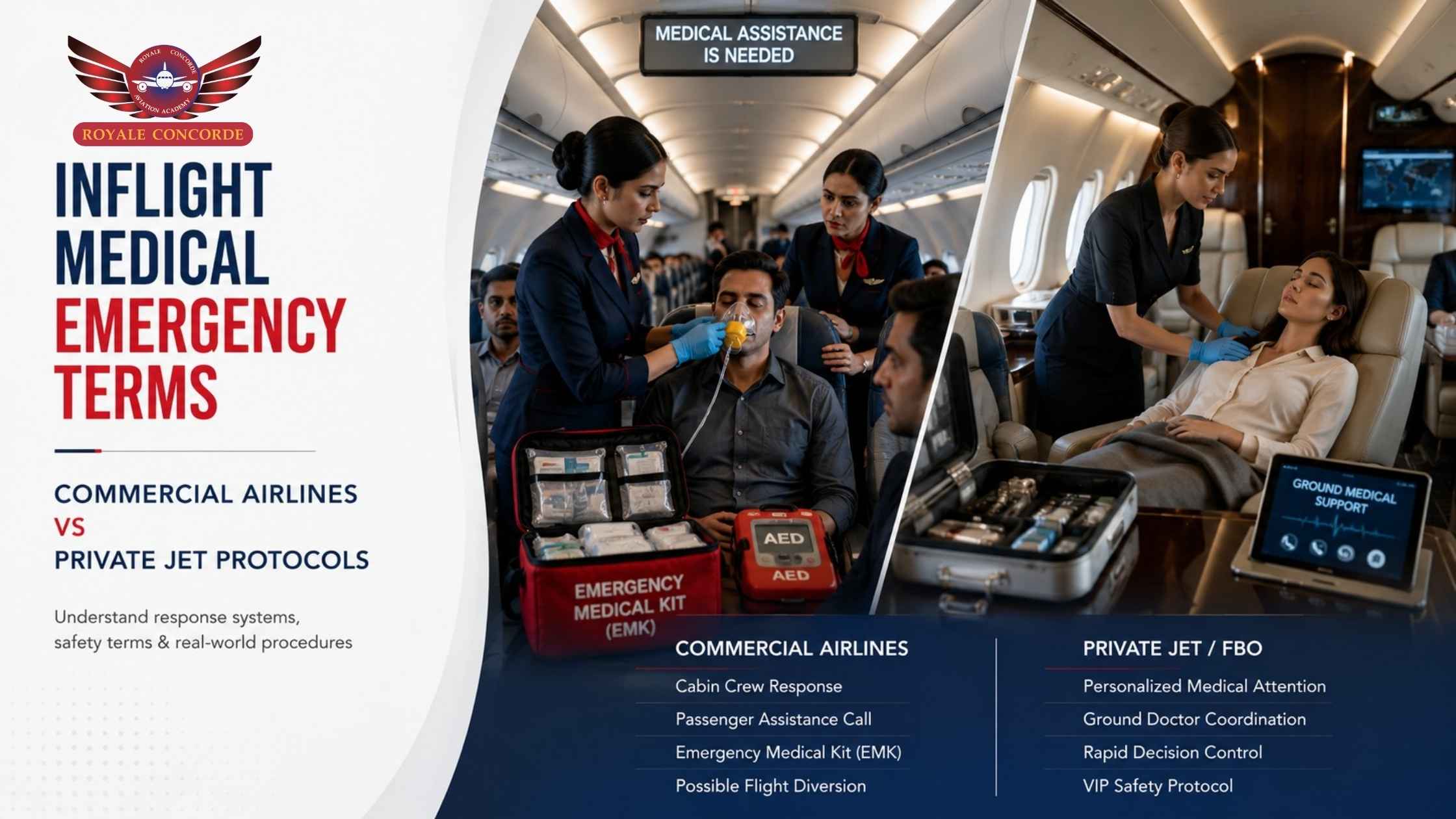
The doctor on board protocol is a clearly defined process for summoning and utilizing the expertise of trained medical professionals among the passengers during an inflight emergency. On commercial airlines, this typically involves:
- Making a public address announcement requesting a doctor or medical professional.
- Verifying the credentials of the volunteering individual.
- Working with the doctor to assess and treat the passenger in distress.
- Documenting the event according to airline and regulatory requirements.
On private jets, the protocol may be less formal but equally critical. Given the smaller passenger manifest, the crew may directly ask for medical expertise and coordinate with ground-based support as needed.
Royale Concorde Aviation Academy trains its students to execute the doctor on board protocol with confidence, ensuring both passenger safety and regulatory compliance.
How does MedLink and telemedicine support inflight medical emergencies?
MedLink is a leading telemedicine service providing real-time medical consultation to flight crews during inflight emergencies. It is widely used by major commercial airlines to connect cabin crew and pilots with ground-based medical professionals, enabling expert advice even at 35,000 feet.
- Telemedicine allows the crew to describe symptoms, receive instructions, and decide on critical actions such as medication administration or medical diversion.
- Private jets may use MedLink or similar services, but often rely more heavily on direct communication with the operator’s preferred physicians or medical assistance companies.
At Royale Concorde Aviation Academy, practical training modules include simulated MedLink and telemedicine scenarios to ensure future professionals are adept at leveraging these life-saving resources.
What are EMK and first aid kit requirements on different aircraft?
The EMK (Emergency Medical Kit) and first aid kit are critical onboard resources for managing medical incidents. Their contents and usage protocols are defined by aviation authorities and differ between commercial airlines and private jets.
- Commercial Airlines: Must carry both first aid kits and EMKs, each with standardized supplies and medications. These kits are routinely inspected and crew are trained in their contents.
- Private Jets: May customize the contents based on passenger profile and mission type. Some smaller jets may only carry a basic first aid kit, while larger or long-range jets are equipped with EMKs similar to commercial carriers.
Understanding the differences in EMK and first aid kit regulations is a core part of the safety and emergency management curriculum at Royale Concorde Aviation Academy.
What is a medical diversion and when is it necessary?
Medical diversion is the process of changing the flight’s planned route to land at the nearest suitable airport due to a passenger’s life-threatening medical condition. The decision is complex, factoring in medical advice (often via MedLink or telemedicine), the passenger’s stability, and operational considerations.
- Commercial Airlines: Have clear procedures for evaluating when to divert, involving the captain, cabin crew, and ground medical support.
- Private Jets: The process may be more agile, with decisions made collaboratively between the crew and operator, often with direct input from passengers or their representatives.
Royale Concorde Aviation Academy’s crisis response training includes realistic medical diversion scenarios, ensuring trainees are prepared for rapid, decisive action.
How is medevac vocabulary relevant to airline and private jet protocols?
Medevac vocabulary refers to the specialized terminology associated with medical evacuation procedures. While commercial airlines rarely conduct full medevacs (dedicated medical evacuations are typically handled by specialized aircraft), the vocabulary is essential for communicating effectively during extreme emergencies, especially when coordinating with ground teams or air ambulances.
- Terms such as “stretcher case,” “isolation kit,” and “priority landing” are part of medevac vocabulary and may be used in inflight communications.
- Private jets, especially those configured for air ambulance roles, employ medevac vocabulary on a regular basis, requiring crew to be comfortable with both technical and layman’s terms.
At Royale Concorde Aviation Academy, students are taught medevac vocabulary as part of their broader aviation safety education, preparing them for any scenario.
Comparison of emergency protocols: Commercial airlines vs private jets
Understanding the contrasting protocols is crucial for aviation professionals. Here’s a summary table:
| Aspect | Commercial Airlines | Private Jets |
|---|---|---|
| Medical Equipment | Standardized (EMK, first aid kit, AED mandatory) | Customizable, may exclude AEDs or advanced EMKs on small jets |
| Doctor On Board Protocol | Strictly defined, globally recognized | Flexible, based on crew judgement and passenger profile |
| Telemedicine Support | Widely used (e.g., MedLink) | Used based on operator preference, sometimes direct physician contact |
| Medical Diversion | Regulated, with ground coordination | Faster decision-making, more flexibility |
| Medevac Vocabulary | Less frequent, but required knowledge | Common in air ambulance/private medevac operations |
Royale Concorde Aviation Academy’s training ensures students are fully prepared to adapt to both environments, making them highly employable in India’s rapidly growing aviation sector.
How does Royale Concorde Aviation Academy prepare students for inflight medical emergencies?
Royale Concorde Aviation Academy is a premier aviation training institute based in Bangalore, Karnataka. We specialize in comprehensive training for cabin crew, air hostess programs, aviation hospitality, and airport ground operations, with a strong focus on safety and emergency management.
- Practical simulations: Realistic emergency scenarios using aircraft cabin mock-ups, EMK, and first aid kit drills.
- Expert faculty: Led by seasoned aviation professionals and women leaders with real-world airline experience.
- Updated curriculum: Incorporates latest inflight medical emergency terminology, first aid aviation terms, and protocols for both commercial and private aviation.
- Career readiness: Prepares students for interviews and operational roles in domestic and international airlines, as well as private jet operators.
Through structured modules on MedLink, telemedicine, medical diversion, and medevac vocabulary, Royale Concorde Aviation Academy ensures that graduates are not just knowledgeable, but confident and operationally ready for any inflight medical emergency.
People also ask
What is the role of cabin crew in an inflight medical emergency?
Cabin crew are the first responders for any inflight medical emergency, trained to assess, communicate, provide first aid, use EMKs, and coordinate with doctors on board or telemedicine services. They play a critical role in decision-making, including whether to initiate a medical diversion.
Are private jets safer than commercial airlines for medical emergencies?
Both private jets and commercial airlines follow strict safety protocols, but private jets offer more flexibility and personalized response. However, commercial airlines may have more standardized equipment and access to telemedicine support like MedLink.
What qualifications do you need to handle inflight medical emergencies?
Aviation professionals need specialized training in inflight medical emergency terminology, first aid aviation terms, EMK and first aid kit usage, and crisis response. Royale Concorde Aviation Academy offers industry-aligned programs covering all these areas, ensuring global employability.
About Royale Concorde Aviation Academy
Royale Concorde Aviation Academy is a leading aviation training institute based in Bangalore, Karnataka, India, dedicated to shaping the next generation of aviation professionals. With a robust curriculum focused on cabin crew training, air hostess programs, aviation hospitality, and airport ground operations, RCAA prepares students for successful careers in domestic and international aviation.
- Industry-aligned training in safety, emergency management, and professional development
- Simulated aircraft cabin and emergency response practice modules
- Expert mentorship from experienced women leaders in aviation
- Comprehensive placement assistance and career guidance
Begin your aviation career with confidence—choose Royale Concorde Aviation Academy for world-class training, real-world readiness, and a pathway to global opportunities.
Contact: Bangalore, Karnataka, India
Phone: +91 7204805777 / +91 7204806777
Email: mail@royaleconcordeaviation.com
Facebook | Instagram | X (Twitter) | YouTube
Frequently Asked Questions
What is the difference between inflight medical emergency terminology used in commercial airlines and private jets?
Inflight medical emergency terminology varies between commercial airlines and private jets mainly due to differences in crew training, resources, and response protocols. Commercial airlines follow standardized terms and procedures set by regulatory bodies, such as “doctor on board protocol” or “medical diversion.” Private jets, however, often use more flexible terms and can tailor responses to the client’s needs, with providers like Royale Concorde Aviation ensuring crew are familiar with both international and bespoke emergency vocabulary.
How does the doctor on board protocol work on commercial flights versus private jets?
In commercial aviation, the doctor on board protocol involves making a cabin announcement to identify qualified medical professionals among passengers, who can assist the crew using the onboard emergency medical kit (EMK) and first aid kit. On private jets, this protocol can be more proactive—Royale Concorde Aviation can arrange for medical professionals or trained staff to be present if requested, offering a higher level of personalized care and immediate response without relying on passenger volunteers.
What is MedLink and how does telemedicine support inflight medical emergencies?
MedLink is a specialized telemedicine service that connects flight crews with ground-based medical experts during an inflight emergency. Commercial airlines commonly use MedLink to receive real-time advice. Private jet operators like Royale Concorde Aviation also offer telemedicine support, ensuring that crews have instant access to medical consultations, which can guide decisions and enhance passenger safety regardless of location.
What are the contents and differences between EMK and first aid kit on aircraft?
The EMK (Emergency Medical Kit) contains advanced medical equipment and medications meant for use by qualified professionals, while the first aid kit includes basic supplies for minor injuries and ailments. Commercial airlines are required to carry both. Royale Concorde Aviation ensures that their private jets are equipped with comprehensive EMK and first aid kit options, and can customize the kits based on passenger needs or specific routes.
How is medical diversion handled differently on private jets compared to commercial airlines?
Medical diversion refers to rerouting the aircraft to the nearest suitable airport due to a medical emergency. In commercial airlines, this decision is influenced by policies, air traffic, and coordination with ground medical services. Private jets, such as those operated by Royale Concorde Aviation, offer greater flexibility and can divert more rapidly, coordinating directly with medical facilities and ground teams to ensure seamless and discreet transfers for passengers requiring urgent care.
What role does medevac vocabulary play in private jet protocols?
Medevac vocabulary encompasses terms related to medical evacuation, such as “air ambulance,” “patient transfer,” and “critical care transport.” Private jet operators like Royale Concorde Aviation are well-versed in this terminology and can arrange dedicated medevac flights, staffed with medical professionals and equipped for critical care, ensuring safe and timely transfer of patients globally.
What specialized first aid aviation terms should passengers know when flying privately?
Passengers should be familiar with first aid aviation terms such as “EMK,” “automated external defibrillator (AED),” “oxygen bottle,” and “medical clearance.” Royale Concorde Aviation’s crew are trained to explain these terms and procedures, ensuring that passengers feel confident and informed about the available medical resources on board.
How does Royale Concorde Aviation enhance inflight medical emergency response?
Royale Concorde Aviation enhances inflight medical emergency response by providing advanced crew training, customizable medical kits, access to telemedicine services, and, upon request, onboard medical professionals. Their expert team can coordinate medevac solutions and ensure rapid medical diversion when necessary, offering a seamless and discreet response that prioritizes passenger safety and comfort.