What Are The Most Common Cabin Crew Myths?
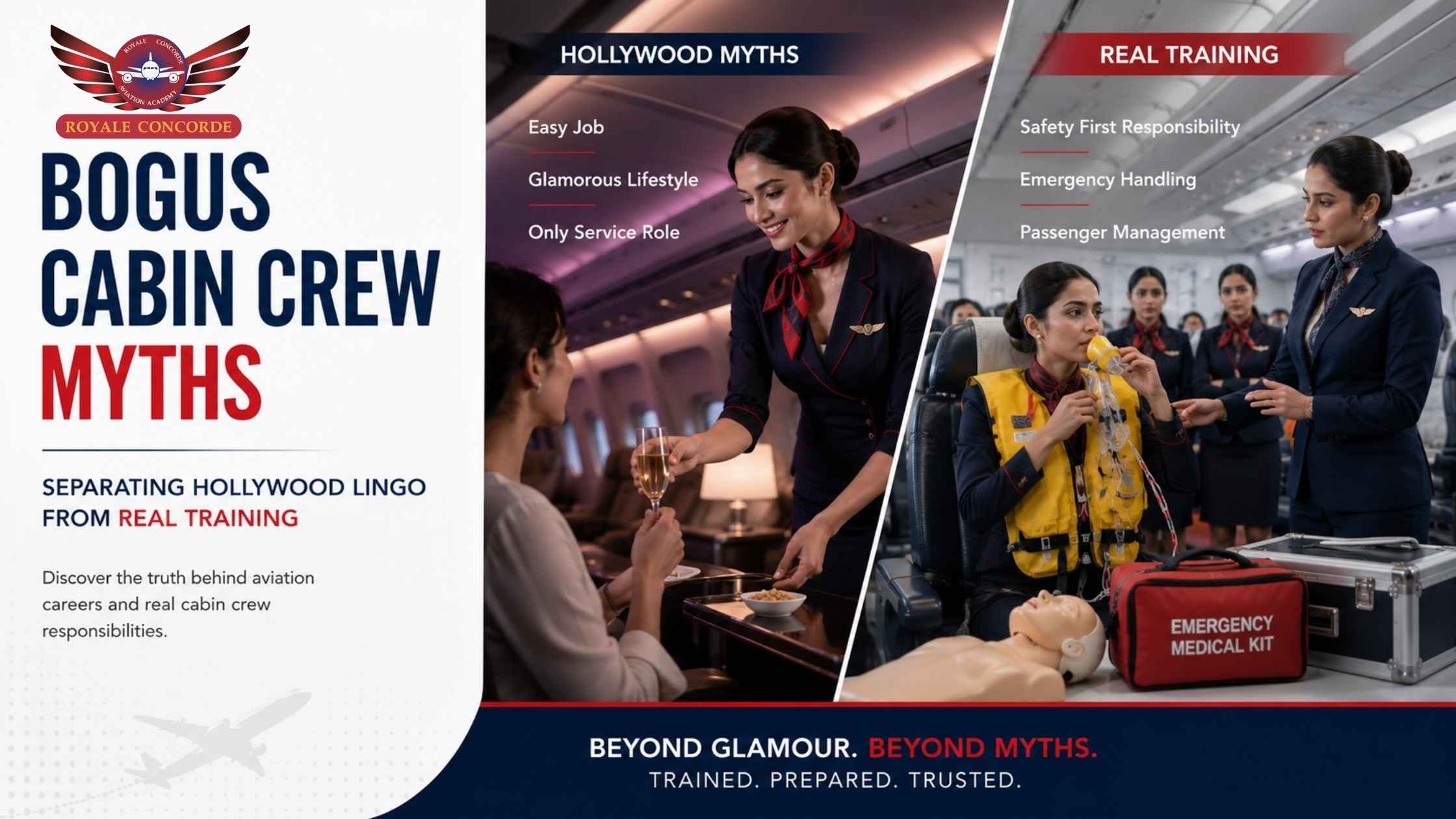
- Cabin crew only serve food and drinks.
- Cabin crew have secret lingo and codes unknown to even pilots.
- All flight attendants are air marshals or have secret police powers.
- Cabin crew live a life of constant travel, luxury, and adventure.
- Safety demonstrations and training are just routine formalities.
These misconceptions can mislead aspiring aviation professionals, causing confusion about the actual skills and attributes needed for a successful career in the skies. Royale Concorde Aviation Academy (RCAA) addresses and dispels these myths through its industry-aligned training programs in Bangalore.
How Does Real Cabin Crew Jargon Vs Myths Differ?
Industry Jargon: Professional aviation uses globally accepted terminology for communication, safety, and service. For example, “cross-check” means verifying doors are armed or disarmed, while “final cabin check” is a real procedure before takeoff or landing.
Hollywood Myths: Movies often invent dramatic-sounding phrases, such as “Code Red in the Galley” or “Operation Skyfall,” which are not part of any airline’s official language. These can lead to misunderstandings about the seriousness and professionalism of the role.
| Real Jargon | Hollywood Myth |
|---|---|
| Cross-check | Code Red in the Galley |
| Brace position | Buckle down for impact |
| Galley secure | Seal the kitchen |
| Final cabin check | All systems go |
At RCAA, students learn real world communication, regulatory phrases, and standard operating procedures. This prepares them for airline interviews and on-the-job responsibilities, eliminating confusion caused by pop culture fiction.
What Are The Biggest Flight Attendant Misconceptions?
- Cabin Crew Just Serve Meals: In reality, their primary responsibility is passenger safety, not just hospitality.
- It’s All Glamour: The role involves dealing with emergencies, unruly passengers, medical situations, and maintaining strict discipline.
- Minimal Training: Actual cabin crew training covers detailed safety procedures, aviation regulations, first aid, and even firefighting techniques.
- Language Skills Not Important: Communication, including English proficiency and cultural sensitivity, is critical for international airlines.
- Cabin Crew Are Air Marshals: Only specially trained individuals serve as air marshals; regular cabin crew do not have law enforcement powers.
Royale Concorde Aviation Academy ensures that all students understand the full scope of professional responsibilities, focusing on both safety and service excellence.
How Can You Identify Fake Airline Codes?
All legitimate airlines and airports use internationally recognized codes:
- IATA Codes: Three-letter codes for airports (e.g., BLR for Bangalore), and two-letter codes for airlines (e.g., AI for Air India).
- ICAO Codes: Four-letter airport codes (e.g., VOBL for Kempegowda International Airport) and three-letter airline codes (e.g., AIC for Air India).
Examples of Fake Codes: “SKY123” or “ALN-999” are not assignable and have no basis in the global aviation system. RCAA’s curriculum covers aviation terminology, helping students avoid such pitfalls and maintain professional credibility.
What Are The Most Persistent Cabin Safety Myths?
- Oxygen Masks Last Indefinitely: In truth, masks supply oxygen for about 12-15 minutes, enough to descend to a safe altitude.
- Life Vests Are Just Props: Life vests are required and regularly checked; their use is vital in emergency water landings.
- Cabin Crew Don’t Face Real Danger: Crew are trained for fire, smoke, decompression, and evacuation scenarios.
- Seatbelts Are Pointless: Wearing seatbelts during turbulence or takeoff/landing is essential for passenger safety.
Royale Concorde Aviation Academy’s training includes real-life safety drills, mock evacuations, and use of safety equipment, ensuring students are prepared for every contingency.
How Is Air Marshal Protocol Different From Cabin Crew Duties?
Key Differences:
- Air marshals are government-appointed, armed, and specially trained in counter-terrorism.
- Cabin crew are trained in conflict de-escalation, security procedures, and emergency protocols, but do not carry weapons or make arrests.
- Air marshal protocol remains confidential and is not disclosed to passengers or general crew.
At RCAA, students receive security awareness training, learning how to detect suspicious behavior and report potential threats, but are never misled about the boundaries of their responsibilities.
Are There Really Galley Secrets Among Cabin Crew?
Examples of galley secrets taught at Royale Concorde Aviation Academy include:
- Efficiently organizing carts for quick and safe service delivery
- Handling dietary requests and special meals discreetly
- Managing limited storage and waste during long flights
- Communicating effectively with colleagues using standardized hand signals and protocols
These skills are refined through simulation-based training and real-life scenarios, ensuring RCAA graduates are equipped to deliver exceptional service.
How Does Aviation Culture Shape Cabin Crew Training?
Key Elements of Aviation Culture at RCAA:
- Professionalism: Uniform standards, punctuality, and communication protocols are ingrained from day one.
- Diversity and Inclusion: Exposure to multicultural scenarios and global service standards.
- Safety First: Every action is guided by the principle of passenger and crew safety.
- Continuous Growth: Regular feedback, self-improvement, and adaptation to industry trends.
Royale Concorde Aviation Academy’s focus on developing both technical and soft skills ensures that students embody the values of modern aviation professionals.
Why Trust Royale Concorde Aviation Academy For Cabin Crew Training?
- Comprehensive curriculum covering real cabin crew jargon vs myths
- Simulation-based safety and emergency management training
- Personality development, communication, and interview preparation
- Placement support and industry networking
- Mentorship from international and domestic airline professionals
- Located in Bangalore, India’s aviation education hub
RCAA’s mission is to nurture confident, competent aviation professionals who understand the realities of airline work—free from the distractions of pop culture myths.
People also ask: Key quick answers
- What is real cabin crew jargon vs myths?
Real jargon is official, standardized language used for safety and operations. Myths are movie-invented terms with no basis in the aviation industry. - How are flight attendant misconceptions addressed in training?
Professional academies like RCAA use practical simulations and updated curriculum to teach the true responsibilities and skills required. - What are fake airline codes?
They are non-existent codes not recognized by IATA/ICAO; real codes follow global aviation standards. - Are cabin safety myths dangerous?
Yes, believing myths can lead to unsafe behavior. Proper training ensures factual knowledge and safe practices. - Do all cabin crew know air marshal protocol?
No, air marshal protocol is confidential and not part of standard crew duties; cabin crew are trained for safety and security, not law enforcement.
About Royale Concorde Aviation Academy
Royale Concorde Aviation Academy (RCAA) is a premier aviation training institute in Bangalore, Karnataka, dedicated to producing world-class cabin crew, air hostesses, and aviation professionals. Founded by Shri L. R. Shivarame Gowda, RCAA is committed to blending technical knowledge, personality development, and practical exposure for holistic career preparation. The Academy’s women-led leadership and experienced mentors ensure students benefit from industry-best guidance and training.
- Location: Bangalore, Karnataka, India
- Phone: +91 7204805777 / +91 7204806777
- Email: mail@royaleconcordeaviation.com
- Website: royaleconcordeaviation.com
Royale Concorde Aviation Academy stands for industry excellence, integrity, and career success. Choose RCAA to begin your journey with the truth—beyond the myths of Hollywood, into the reality of global aviation.
Frequently Asked Questions
What are some common flight attendant misconceptions seen in movies?
Hollywood often portrays flight attendants as simply serving food and smiling, but in reality, their primary role is ensuring passenger safety and responding to emergencies. Royale Concorde Aviation addresses these flight attendant misconceptions by offering comprehensive safety, first aid, and emergency training as part of our curriculum, empowering trainees with real skills beyond the silver screen image.
How does real cabin crew jargon vs myths affect new trainees?
Many new trainees come in expecting to use “secret” codes and lingo popularized in movies, but real aviation language is standardized for clarity and safety. At Royale Concorde Aviation, we clarify the difference between real cabin crew jargon vs myths and teach the authentic communication protocols used worldwide, so our students are truly industry-ready.
Are the airline codes and abbreviations heard in films accurate?
Not always. Many movies use fake airline codes or made-up abbreviations for dramatic effect. Royale Concorde Aviation trains students to recognize genuine IATA and ICAO codes, as well as industry-standard abbreviations, ensuring clear and precise communication in real-life airline environments.
What are some cabin safety myths that could put passengers at risk?
Common cabin safety myths include the belief that oxygen masks are filled with sleeping gas or that exit doors can be opened mid-flight. Royale Concorde Aviation’s real-world training dispels these myths and ensures that trainees understand the science and protocols behind all safety procedures, making them trustworthy in any situation.
Is there any truth to the secret air marshal protocol shown in TV series?
While air marshals do travel incognito, the dramatic “codes” and hand signals shown on TV are mostly fiction. Royale Concorde Aviation includes awareness training on air marshal protocol —helping cabin crew understand their role in ensuring discreet security and cooperation without relying on Hollywood dramatizations.
What galley secrets are important for a successful flight attendant?
The galley is the heart of inflight service, but it’s also a hub for safety equipment and emergency supplies. At Royale Concorde Aviation, trainees learn genuine galley secrets —from efficient meal prep to stowing dangerous goods and managing space—dispelling the myth that it’s simply about “serving coffee.”
How does Royale Concorde Aviation foster authentic aviation culture?
We nurture a true aviation culture by emphasizing teamwork, respect, and professionalism. Our training goes beyond technical skills to instill the values and mindset required for a global aviation community, helping trainees thrive in real airline environments—not just act out movie scenes.
What solutions does Royale Concorde Aviation offer to overcome industry myths?
Royale Concorde Aviation offers hands-on training, scenario-based learning, and up-to-date industry knowledge to replace myths with facts. Our curriculum ensures every trainee understands the realities of cabin crew life, so they can confidently face interviews and real-world airline duties.