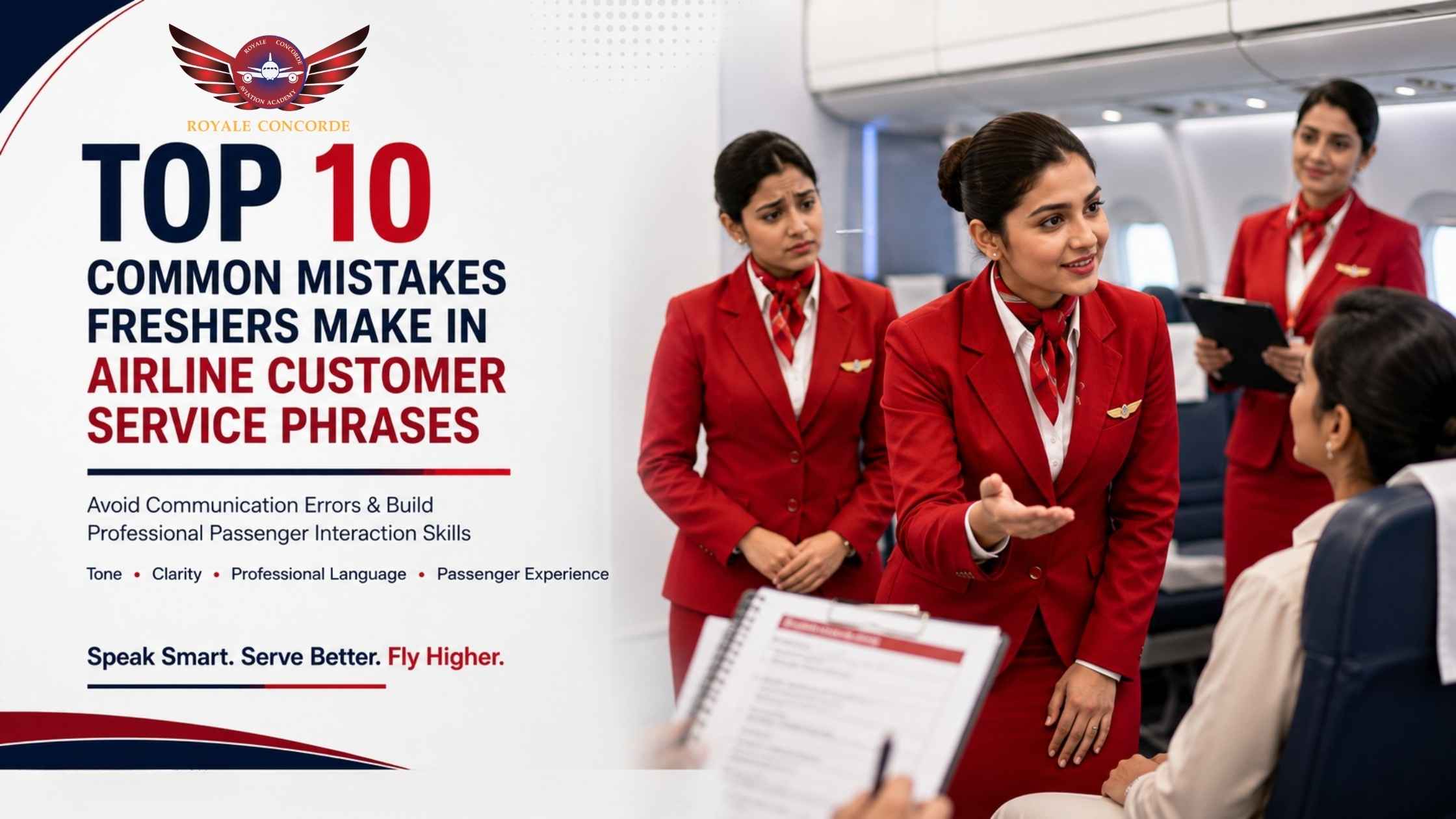
What are the most frequent mistakes in airline customer service phrases made by new airline professionals, and how can they be corrected? In the dynamic and passenger-centric aviation industry, effective communication is not just a skill—it’s a necessity. Airline and airport staff are the face of the airline, and every word or phrase they use shapes the passenger experience. Royale Concorde Aviation Academy, Bangalore’s premier aviation training institute, equips aspiring airline professionals to master customer service communication and avoid common pitfalls.
Why is mastering airline customer service language critical for freshers?
For freshers stepping into the world of aviation, communication errors can have far-reaching consequences. Whether you are part of the cabin crew or ground staff, a single misstep in phrasing can lead to misunderstandings, passenger dissatisfaction, or even safety concerns. Royale Concorde Aviation Academy’s curriculum is designed to address these issues head-on, building both technical language skills and the confidence to handle real-world scenarios with professionalism.
What are the top 10 mistakes in airline customer service phrases freshers make?
Below is a detailed breakdown of the ten most common mistakes, with practical examples and guidance for each. This knowledge is essential for anyone aspiring to excel in airline customer service roles.
-
Using informal or colloquial language with passengers
Beginners often default to everyday casual language, which can diminish the professional image of the airline. For example, saying “Hey, what’s up?” instead of “Good morning, how may I assist you today?” is a classic mistake in airline customer service phrases. Royale Concorde Aviation Academy emphasizes the importance of using courteous, polished language at all times.
-
Ground staff communication errors: Giving unclear or incomplete information
One of the most frequent ground staff communication errors is providing vague directions or incomplete answers. For instance, telling a passenger, “It’s somewhere over there” rather than, “The security check is straight ahead, then turn left at Gate 3.” Precise, step-by-step communication ensures passengers feel supported and confident in navigating the airport.
-
Cabin crew announcement mistakes: Rushing or mumbling announcements
Clear public announcements are critical for safety and passenger comfort. Cabin crew announcement mistakes such as rushing, using jargon, or speaking too softly can confuse passengers during safety briefings or flight updates. At Royale Concorde Aviation, trainees practice making announcements with clarity, appropriate pacing, and emphasis on key information.
-
Failing to use de-escalation techniques during conflicts
In situations of passenger frustration or conflict, new staff may react defensively or respond with rigid “policy” language. The art of de-escalation involves empathetic listening, calm tone, and choosing words that defuse tension. For example, instead of “That’s not my problem,” saying “I understand your concern; let me see what I can do to help” can resolve issues peacefully.
-
Mismanaging passenger handling through inappropriate phrasing
Passenger handling goes beyond logistics; it’s about making passengers feel valued. Phrases like “You have to wait” sound abrupt and dismissive. A better approach is, “Thank you for your patience; we are working to resolve the delay as quickly as possible.” Royale Concorde Aviation trains students to use positive language that reassures and comforts travelers.
-
Lack of phonetic clarity in names and codes
In aviation, phonetic clarity is vital, especially when communicating seat numbers, names, or codes over radio or public address systems. Mispronunciations can lead to boarding errors or miscommunication in emergencies. Using the international phonetic alphabet (“A for Alpha, B for Bravo…”) is a standard taught at Royale Concorde Aviation Academy.
-
Incorrect use of professional communication protocols
Professionalism is reflected in language. Freshers may forget to use courteous titles or formal greetings, resulting in professional communication lapses. For example, failing to address a passenger as “Sir” or “Ma’am,” or neglecting to introduce oneself at the beginning of an interaction, can leave a negative impression.
-
Overusing negative or absolute language
Words like “never,” “can’t,” or “impossible” can escalate situations or make passengers feel helpless. Instead, staff should focus on what can be done (“Let me check what options are available for you”) to maintain a solutions-oriented approach.
-
Failing to check for understanding
Assuming that passengers understand instructions—especially when there are language or cultural differences—is risky. Always confirm comprehension by asking, “Do you have any questions about what I just explained?” or “Would you like me to repeat that?”
-
Ignoring non-verbal cues and body language
Communication is not just verbal. Missing signs of confusion, frustration, or anxiety in passengers can result in poor service. Royale Concorde Aviation’s holistic training includes reading body language and responding empathetically to ensure every passenger feels heard and supported.
Quick reference table: Common mistakes and best practice alternatives
| Mistake | Example Phrase | Best Practice |
|---|---|---|
| Informal Language | “Hey, what’s up?” | “Good evening, how may I assist you?” |
| Vague Directions | “It’s over there.” | “Proceed straight, then left at Gate 3.” |
| Rushed Announcements | Mumbling flight info | Clear, slow, confident announcements |
| Poor De-escalation | “That’s not my problem.” | “Let me see how I can help.” |
| Negative Language | “You have to wait.” | “Thank you for your patience.” |
| No Phonetic Clarity | “Is your name Anil or Sunil?” | “A for Alpha, N for November…” |
How does Royale Concorde Aviation Academy address these mistakes?
Royale Concorde Aviation Academy’s aviation customer service training integrates classroom instruction, real-world simulations, and practical communication exercises. The following strategies are core to the Royale Concorde approach:
- Role-plays and mock scenarios: Students practice handling difficult passengers, making announcements, and following standard operating procedures under supervision.
- Accent and phonetic clarity training: Focused modules ensure clear speech, pronunciation, and use of the aviation phonetic alphabet.
- Personality and body language development: Training includes reading and responding to non-verbal cues to enhance the passenger experience.
- Feedback and continuous improvement: Instructors review each student’s performance and provide actionable feedback to build confidence and competence.
- De-escalation and conflict management: Special attention is given to teaching language and techniques that calm tense situations and resolve complaints professionally.
Why is professional communication a core skill in aviation?
Aviation operates in a high-stakes, multicultural environment. Every interaction—whether in the terminal, onboard, or via announcements—can impact safety, brand image, and passenger loyalty. Professional communication ensures that information is conveyed accurately, misunderstandings are minimized, and passengers feel respected and valued.
- Safety: Clear instructions during emergencies can save lives.
- Service excellence: Courteous phrasing enhances the passenger journey.
- Brand reputation: Consistent, positive language reflects well on the airline.
Frequently asked questions about airline customer service communication
How can freshers avoid mistakes in airline customer service phrases?
Through structured training, real-world practice, and regular feedback, freshers can build the habits needed for effective communication. Royale Concorde Aviation Academy’s simulation-based learning ensures students experience and correct these mistakes before entering the workforce.
What is the impact of ground staff communication errors on passenger experience?
Errors in ground staff communication can lead to confusion, delays, and frustration. Clear, concise, and courteous language ensures passengers feel cared for and confident navigating the airport.
Why do cabin crew announcement mistakes matter?
Cabin crew announcement mistakes can compromise safety and create anxiety among passengers. Proper training helps ensure that all critical information is delivered clearly and authoritatively.
How is phonetic clarity taught at Royale Concorde Aviation Academy?
Through dedicated modules, students learn the international phonetic alphabet and practice pronouncing challenging names, codes, and seat numbers, minimizing risks of miscommunication.
What de-escalation techniques are recommended for airline staff?
Active listening, empathetic phrasing, offering solutions, and maintaining a calm demeanor are all central to effective de-escalation. Royale Concorde Aviation’s curriculum includes hands-on exercises to master these skills.
About Royale Concorde Aviation Academy
Royale Concorde Aviation Academy (RCAA) is a premier aviation training institute in Bangalore, Karnataka, dedicated to shaping the next generation of aviation professionals. With comprehensive programs in cabin crew training, air hostess courses, aviation hospitality, and airport ground operations, RCAA is recognized for its industry-relevant curriculum, practical exposure, and holistic career development.
- Founded by Shri L. R. Shivarame Gowda and led by a team of experienced women aviation professionals
- Focuses on communication skills, grooming, personality development, and hands-on aviation training
- Equips students to meet recruitment standards of top domestic and international airlines
For more information, visit Royale Concorde Aviation Academy or call +91 7204805777 / +91 7204806777.
Frequently Asked Questions
What are the most common mistakes in airline customer service phrases made by freshers?
Freshers often use informal, ambiguous, or overly technical language that confuses passengers. Some tend to use negative phrasing, lack empathy, or forget to express appreciation. Royale Concorde Aviation addresses these issues with targeted training modules focusing on positive language, empathy, and context-appropriate responses for effective professional communication.
How does Royale Concorde Aviation help reduce ground staff communication errors?
Our programmes emphasize clear, concise messaging, active listening, and real-world simulations. By practicing role-plays and scenario-based exercises, trainees learn to avoid ground staff communication errors and develop confidence in delivering accurate information to passengers, even during high-pressure situations.
What are some common cabin crew announcement mistakes, and how are they corrected?
Frequent cabin crew announcement mistakes include monotone delivery, unclear pronunciation, and missing important details. Royale Concorde Aviation’s training ensures that crew members practice with feedback, master phonetic clarity, and learn to engage passengers with clear, confident, and friendly announcements.
How is de-escalation taught to freshers to handle upset passengers?
De-escalation is taught through interactive workshops focusing on empathy, active listening, and calm verbal strategies. Freshers learn to acknowledge passenger concerns, maintain composure, and guide conversations toward positive solutions, significantly improving passenger handling and satisfaction.
Why is phonetic clarity vital for airline communication, and how is it taught?
Phonetic clarity ensures that passengers and colleagues correctly understand important information like seat numbers, gate changes, or safety instructions. Royale Concorde Aviation incorporates voice modulation, diction drills, and the use of the ICAO phonetic alphabet into its curriculum to boost trainees’ phonetic clarity and minimize misunderstandings.
How does Royale Concorde Aviation improve professional communication skills for new airline staff?
We combine theoretical learning with hands-on practice in our professional communication modules. Trainees receive feedback on tone, language, and body language, enabling them to communicate with confidence, courtesy, and clarity—key to building positive airline experiences.
What role does passenger handling play in avoiding communication mistakes?
Effective passenger handling requires anticipating needs, responding calmly to requests, and using clear, respectful language. Our training teaches staff to personalize interactions and avoid common pitfalls that lead to mistakes in airline customer service phrases, thus ensuring a seamless travel experience.
How are freshers assessed on their ability to avoid ground staff communication errors?
Royale Concorde Aviation uses mock counters, scenario tests, and peer feedback to evaluate how well trainees avoid ground staff communication errors. This practical approach highlights areas for improvement and builds real-world competency.
What support does Royale Concorde Aviation offer for continuous improvement in airline customer service?
We provide refresher courses, feedback sessions, and access to updated materials on best practices for airline communication. This ongoing support helps staff consistently avoid mistakes in airline customer service phrases and maintain industry-leading standards.