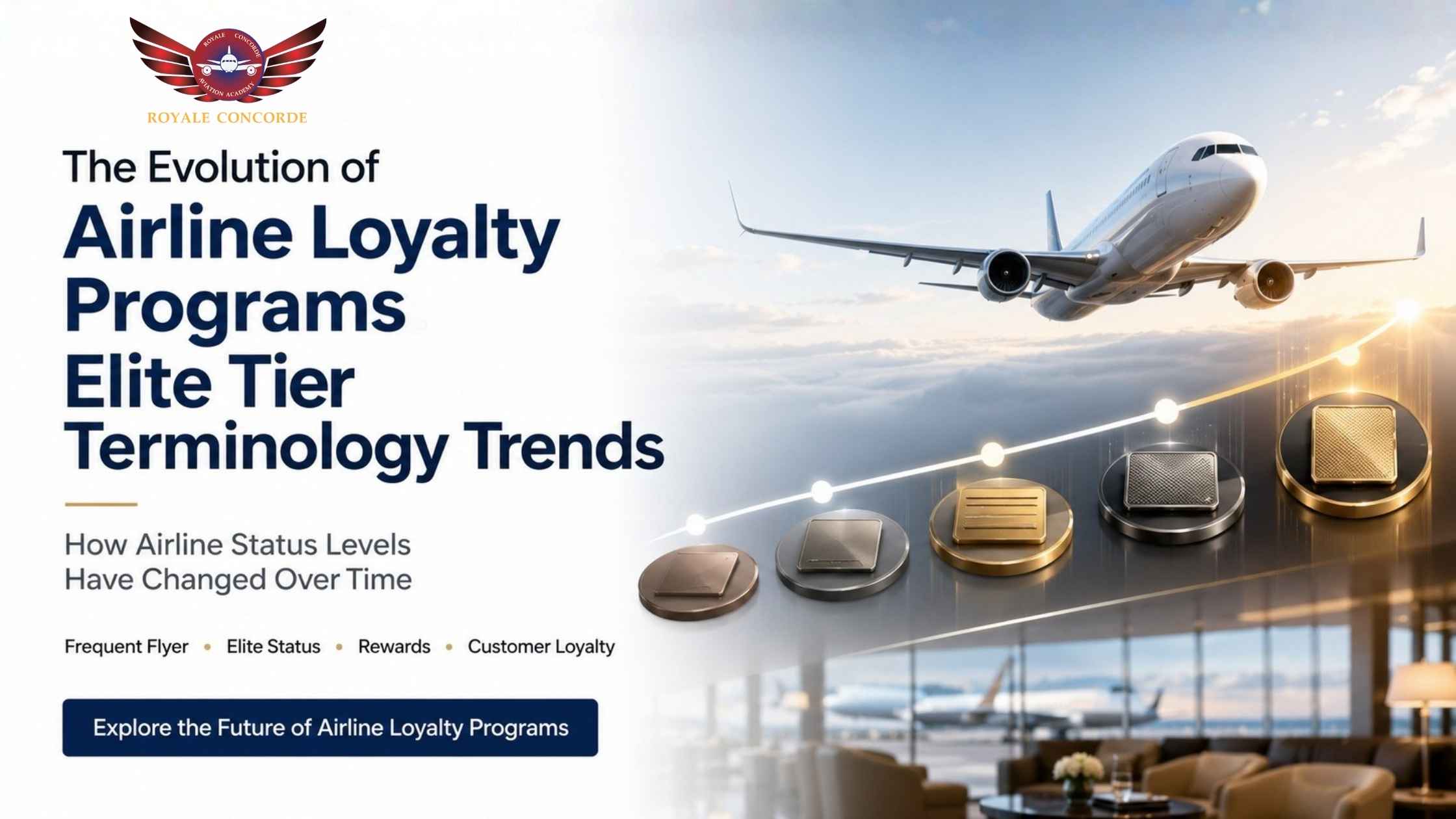
What is the evolution of airline loyalty program terminology and how does it impact aspiring aviation professionals? Airline loyalty program terminology has evolved dramatically over the decades, reflecting shifts in traveler expectations, airline business strategies, and the competitive landscape of aviation. Understanding these trends and elite tier terminology is crucial for any aviation student or professional. At Royale Concorde Aviation Academy in Bangalore, we prepare future aviation leaders with deep insights into these industry dynamics, ensuring our graduates are airline-ready and globally competent.
How have airline loyalty programs changed over time?
Airline loyalty programs began as simple mileage schemes but have grown into complex, tiered systems with sophisticated terminology. The earliest programs rewarded frequent flyers with free flights based on distance flown. Today, loyalty programs are powerful marketing tools, driving customer retention and ancillary revenue through a range of benefits and elite status levels. As the aviation industry has globalized, terms like airline loyalty program terminology and “elite passenger status” have taken center stage, influencing everything from customer experience to airline profitability.
Key milestones in loyalty program evolution
- 1981: American Airlines launches AAdvantage, the world’s first frequent flyer program.
- 1990s: Tiered status and partner airline networks appear, introducing airline alliances.
- 2000s: Ancillary services and alliance lounge access become prominent incentives.
- 2010s-Present: Digital apps, dynamic rewards, and personalized offers redefine loyalty, with terminology evolving to match.
What is airline loyalty program terminology and why does it matter?
Airline loyalty program terminology encompasses the specialized language, acronyms, and status descriptors used in frequent flyer programs. For aviation professionals—especially those trained at Royale Concorde Aviation Academy—mastery of this terminology is essential. It enhances communication with global passengers, supports seamless service, and ensures operational efficiency.
Common airline loyalty terms explained
| Term | Definition |
|---|---|
| Elite Passenger Status | Special recognition levels in loyalty programs (e.g., Silver, Gold, Platinum) that grant enhanced benefits, such as priority boarding and free upgrades. |
| Frequent Flyer Glossary | The comprehensive set of terms, codes, and abbreviations used by airlines and travelers to describe program features, rewards, and benefits. |
| Mileage Accrual | The process by which travelers earn points or miles based on distance flown, base fare, or spending—key to progressing through loyalty tiers. |
| Alliance Lounge Access | Entry privileges to partner airline lounges, typically reserved for elite members or those flying with airline alliances. |
| Ancillary Revenue Terms | Terms related to revenue generated from non-ticket sources, such as baggage fees, seat selection, and paid lounge access—often tied to loyalty perks. |
| Revenue Passenger Kilometer | A metric indicating the distance traveled by paying passengers, used by airlines to measure demand and loyalty program effectiveness. |
Why is elite passenger status so important in aviation today?
Elite passenger status is not just a badge of loyalty—it is a powerful incentive that drives frequent flyer engagement and brand loyalty. Airlines use elite tiers to reward high-value customers with exclusive benefits. For aviation professionals, understanding how these tiers work is vital for delivering premium service and managing high-expectation travelers.
- Service differentiation: Elite status holders expect personalized service, priority check-in, and expedited security.
- Operational implications: Elite tiers influence onboard upgrades, baggage handling, and disruption management.
- Career advantage: At Royale Concorde Aviation Academy, students learn to recognize and serve elite passengers, a skill highly valued by global airlines.
What is a frequent flyer glossary and how does it help professionals?
A frequent flyer glossary is a curated list of terms, codes, and industry jargon used in loyalty programs. Mastery of this glossary is critical for aviation students, as it enables clear communication with passengers and airline colleagues worldwide.
- Ensures accuracy in customer interactions
- Reduces confusion during irregular operations
- Supports professional development, especially for those pursuing careers in customer service, ground operations, and cabin crew roles
How do ancillary revenue terms shape the modern airline experience?
Ancillary revenue terms refer to fees and services beyond the base ticket price. Loyalty programs often integrate these terms, offering waived fees or complimentary services to elite members. For future aviation leaders trained at Royale Concorde Aviation Academy, understanding these revenue streams is key to appreciating airline business models and maximizing customer satisfaction.
- Examples include baggage fees, seat upgrades, and in-flight purchases.
- Elite status typically unlocks complimentary or discounted ancillary services.
- Airline staff must balance revenue goals with passenger satisfaction—an area emphasized in RCAA’s training.
What is mileage accrual and why is it foundational to loyalty?
Mileage accrual is the mechanism by which travelers earn points or miles for their journeys. It forms the backbone of all frequent flyer programs. Airlines calculate accrual based on flight distance, fare class, or money spent. Understanding mileage accrual helps aviation students anticipate customer queries, explain program benefits, and support marketing initiatives.
- Directly linked to advancing through elite status tiers
- Shapes the value proposition of loyalty programs
- Increasingly tied to credit card spending and partner activities in India and globally
How does alliance lounge access add value for elite members?
Alliance lounge access is a major perk for frequent flyers. Members of certain elite tiers gain entry to exclusive airport lounges, even when flying partner airlines within airline alliances like Star Alliance, oneworld, or SkyTeam. This access enhances the travel experience—offering comfort, privacy, and premium services.
- Recognizing lounge privileges is crucial for ground and cabin crew professionals.
- At RCAA, students learn how to verify eligibility and manage guest policies for alliance lounge access.
- Lounges are a symbol of status and a powerful loyalty driver.
What is revenue passenger kilometer and how is it used in airline analytics?
Revenue passenger kilometer (RPK) is a core metric in aviation analytics. It represents the number of kilometers traveled by paying passengers. Airlines use RPK to assess demand, program performance, and the impact of loyalty schemes. For students at Royale Concorde Aviation Academy, understanding RPK is part of building a strong foundation in airline operations and commercial strategy.
- Helps airlines optimize routes and capacity
- Links loyalty program participation to tangible revenue outcomes
- Informs decisions about tier thresholds and reward structures
Why are airline alliances important in loyalty program design?
Airline alliances—groups of airlines collaborating on schedules, loyalty, and services—are fundamental to the modern frequent flyer experience. Through alliances, passengers can earn and redeem miles, and access elite benefits across multiple carriers.
- Examples: Star Alliance, oneworld, SkyTeam
- Loyalty programs align terminology and elite status recognition across member airlines
- Royale Concorde Aviation Academy’s curriculum covers alliance structures and their impact on passenger experience
How does Royale Concorde Aviation Academy prepare students for success in a loyalty-driven industry?
Royale Concorde Aviation Academy (RCAA) in Bangalore is India’s premier aviation training institution, equipping the next generation of aviation professionals with the knowledge and skills to excel in a loyalty-driven landscape.
- Industry-relevant curriculum: Covers airline loyalty program terminology, frequent flyer glossary, and real-world case studies.
- Practical training: Simulated customer service interactions, elite passenger handling, and alliance lounge management.
- Placement and career support: Mock interviews, resume workshops, and direct connections to leading Indian and international airlines.
- Mentorship: Led by experienced industry leaders and women mentors, RCAA ensures holistic development and confidence building.
By focusing on EEAT principles—expertise, experience, authority, and trust—RCAA ensures that students not only understand the latest in airline loyalty but are also prepared to deliver exceptional guest experiences in any role.
Frequently asked questions about loyalty terminology and aviation careers
What are the most important airline loyalty program terminology terms for aviation students?
Key terms include elite passenger status, mileage accrual, alliance lounge access, revenue passenger kilometer, and ancillary revenue terms. Understanding these is essential for handling passengers, explaining benefits, and supporting airline operations.
How does frequent flyer glossary knowledge help in interviews?
Interviewers often test candidates on common loyalty terms. Mastery of the frequent flyer glossary demonstrates industry awareness and readiness for frontline roles, giving RCAA graduates a competitive advantage.
Why is mileage accrual changing in India?
With more Indians flying and spending via partner credit cards, airlines are shifting from distance-based to spending-based mileage accrual. This trend rewards higher spenders and aligns with global loyalty practices.
Which airline alliances matter most for Indian travelers?
Star Alliance, oneworld, and SkyTeam have significant presence in India. Knowledge of these alliances and their lounge access policies is essential for aviation professionals in Bangalore and beyond.
About Royale Concorde Aviation Academy
Royale Concorde Aviation Academy (RCAA) is a premier aviation training institute in Bangalore, Karnataka, committed to shaping globally-ready aviation professionals. Founded by Shri L. R. Shivarame Gowda, RCAA specializes in:
- Cabin crew and air hostess training
- Aviation hospitality and ground operations
- Personality development, communication, and grooming
- Industry-aligned curriculum with practical simulations
Guided by visionary women leaders, RCAA prepares students for domestic and international aviation careers, emphasizing professionalism, confidence, and real-world readiness. Located in Bangalore—a major aviation hub—RCAA is your gateway to a dynamic future in the skies.
Contact:
Bangalore, Karnataka, India
+91 7204805777 / +91 7204806777
mail@royaleconcordeaviation.com
Frequently Asked Questions
What are the latest trends in airline loyalty program terminology?
Airline loyalty program terminology has evolved rapidly in recent years. Airlines are moving away from traditional terms like “frequent flyer miles” to incorporate concepts such as “tier points,” “status credits,” and “qualifying dollars.” These changes reflect a broader focus on spend-based rewards, elite passenger status, and customization of benefits. Royale Concorde Aviation helps members make sense of these changes by providing up-to-date education and consulting on maximizing value from the latest program structures.
How does Royale Concorde Aviation assist clients in understanding the frequent flyer glossary?
Royale Concorde Aviation offers comprehensive guidance on the frequent flyer glossary, demystifying complex terms and program rules. Our team provides personalized advice, interactive workshops, and tailored resources to ensure clients are fluent in the language of airline loyalty. This empowers clients to make informed decisions, whether they’re seeking elite passenger status or optimizing travel benefits.
What is elite passenger status and why is it important?
Elite passenger status refers to the higher tiers within an airline’s loyalty program, usually achieved through a combination of flight activity and spending. Benefits often include priority check-in, extra baggage, enhanced mileage accrual, and exclusive alliance lounge access. Royale Concorde Aviation specializes in helping clients reach and maintain these elite levels, unlocking a premium travel experience.
What role do ancillary revenue terms play in loyalty programs?
Ancillary revenue terms refer to the various ways airlines generate income beyond ticket sales, such as seat selection, baggage fees, and in-flight purchases. Some loyalty programs now incorporate ancillary spend into their qualification criteria for elite passenger status. Royale Concorde Aviation helps clients understand how these terms affect loyalty accrual and redemption strategies.
How has mileage accrual changed in recent airline programs?
Mileage accrual has shifted from distance-based models to revenue-based systems in many programs. Now, points are often earned based on the amount spent rather than miles flown. Royale Concorde Aviation helps travelers adapt by advising on the most rewarding booking strategies and tracking spend to maximize rewards under the new models.
What is alliance lounge access and how can Royale Concorde Aviation help me gain it?
Alliance lounge access provides travelers entry to premium lounges operated by partner airlines within major airline alliances, such as Star Alliance, Oneworld, or SkyTeam. Royale Concorde Aviation guides clients to the right status or credit cards to unlock global lounge networks, enhancing comfort and productivity during travel.
Can you explain the term revenue passenger kilometer and its relevance to loyalty programs?
Revenue passenger kilometer (RPK) is an industry metric representing one paying passenger transported one kilometer. While primarily used to measure airline traffic and performance, some loyalty programs factor RPK or similar metrics into their qualification or reporting. Royale Concorde Aviation helps clients understand these terms and their impact on earning and maintaining status.
What are airline alliances and why are they significant for frequent flyers?
Airline alliances are partnerships between multiple airlines to offer enhanced connectivity, reciprocal rewards, and shared benefits for travelers. For frequent flyers, this means expanded route networks, easier mileage accrual and redemption, and more opportunities for elite passenger status recognition. Royale Concorde Aviation advises clients on leveraging alliances to unlock maximum travel rewards.
How does Royale Concorde Aviation provide solutions for navigating loyalty program changes?
Royale Concorde Aviation offers strategic consulting, status optimization, and real-time program monitoring to help clients stay ahead of changes in airline loyalty program terminology and structure. Our expert team ensures you maximize benefits, understand all program nuances, and maintain elite passenger status, regardless of industry shifts.