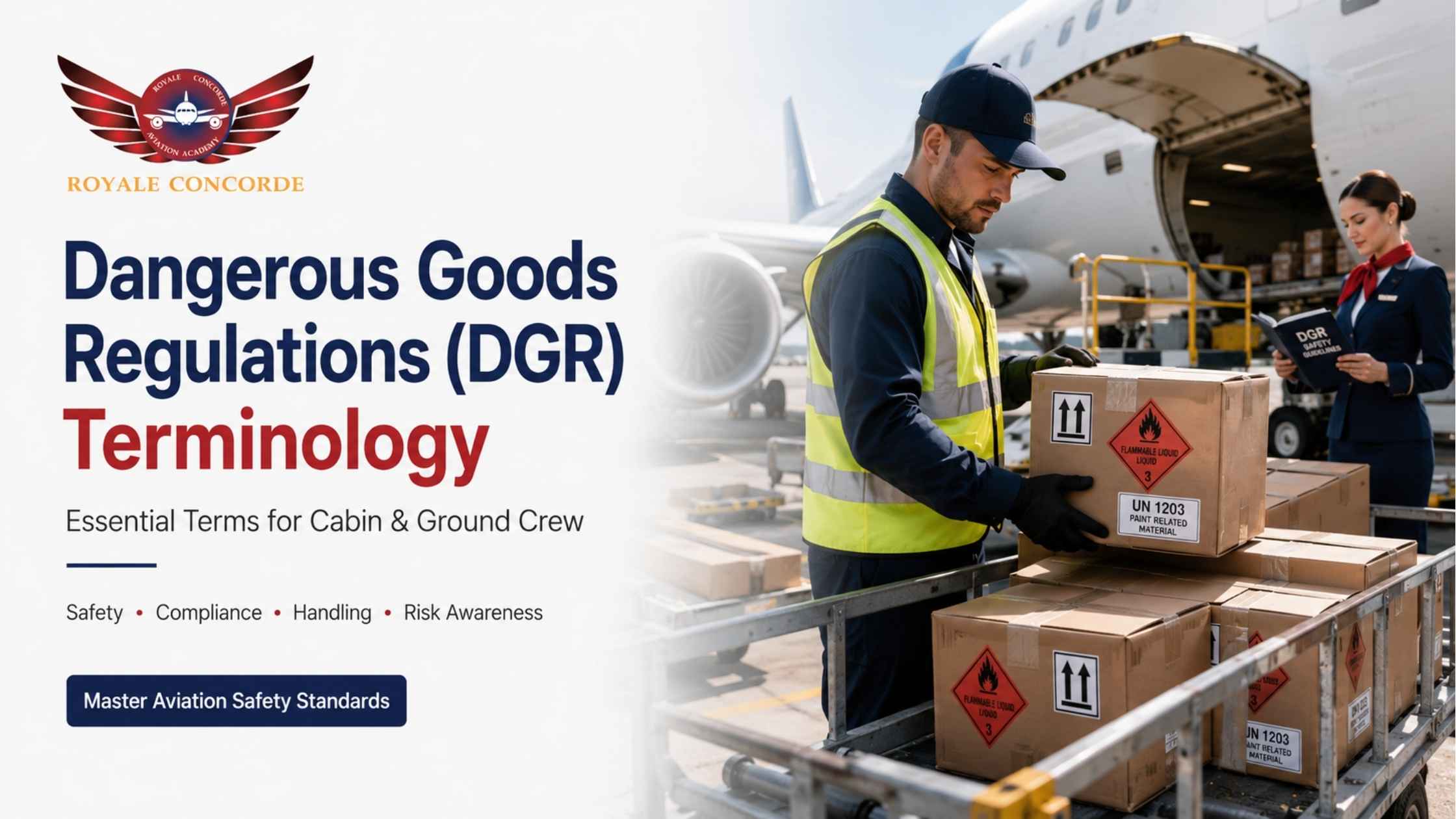
Royale Concorde Aviation Academy is Bangalore’s premier aviation training institute, empowering the next generation of aviation professionals with world-class education in airline safety, cabin crew, and ground operations. This comprehensive guide covers dangerous goods regulations aviation and essential DGR terminology, tailored for both aspiring and current cabin and ground crew.
What Are Dangerous Goods Regulations In Aviation?
Dangerous goods regulations aviation refers to the global set of rules and procedures established to safely transport hazardous materials by air. These regulations are designed to protect passengers, crew, and aircraft from risks posed by substances that could explode, catch fire, corrode, or otherwise harm people and property in flight.
- Key Point: All airline staff—especially cabin and ground crew—must understand and adhere to these regulations to ensure safety and regulatory compliance.
At Royale Concorde Aviation Academy, our curriculum ensures that students understand not only the theoretical aspects of dangerous goods, but also how to apply regulations in real-life airline scenarios—preparing them for both domestic and international aviation careers.
How Are DGR Categories Defined In Aviation?
DGR categories classify dangerous goods into specific groups based on the nature of the hazard they present. There are nine classes, ranging from explosives to miscellaneous dangerous substances.
| DGR Category | Type of Hazard | Examples |
|---|---|---|
| Class 1 | Explosives | Fireworks, Ammunition |
| Class 2 | Gases | Oxygen, Propane |
| Class 3 | Flammable Liquids | Petrol, Alcohol |
| Class 4 | Flammable Solids | Matches, Magnesium |
| Class 5 | Oxidizing Substances & Organic Peroxides | Bleach, Hydrogen Peroxide |
| Class 6 | Toxic & Infectious Substances | Pesticides, Medical Samples |
| Class 7 | Radioactive Material | Medical Isotopes |
| Class 8 | Corrosive Substances | Acids, Batteries (liquid-filled) |
| Class 9 | Miscellaneous Dangerous Goods | Lithium batteries, dry ice, magnetized materials |
Cabin crew and ground staff must be familiar with all DGR categories for effective identification, handling, and emergency response. At Royale Concorde Aviation Academy, we provide hands-on training to ensure crew can quickly recognize and manage these classes, reducing the risk of accidents.
Understanding Hidden Dangerous Goods
Hidden dangerous goods are items containing hazardous materials that are not easily identified or declared by passengers or shippers. These pose a major safety risk because they may bypass standard screening procedures.
- Examples include tools with fuel, camping gas stoves, hair sprays, and medical devices powered by lithium batteries.
- Failure to identify hidden dangerous goods can lead to in-flight emergencies such as fires, chemical leaks, or even explosions.
Royale Concorde Aviation Academy’s training modules equip students with the skills to detect and manage hidden dangerous goods through scenario-based exercises, real-life case studies, and regulatory simulations.
Focus on Lithium Batteries in Airline Operations
Lithium batteries are classified as dangerous goods due to their potential to overheat, catch fire, or explode if damaged or improperly packed. These batteries power a wide range of consumer electronics, making them common in passenger and crew baggage.
- Improperly packed lithium batteries have caused several high-profile aviation incidents worldwide.
- Crew must know how to identify, pack, and respond to incidents involving lithium batteries, including using fire containment bags and notifying the flight deck if overheating is detected.
At Royale Concorde Aviation Academy, we teach practical protocols for handling lithium batteries from both a regulatory and operational perspective, ensuring crew readiness for modern airline environments.
Dry Ice Usage and Regulation in Aviation
Dry ice (solid carbon dioxide) is often used as a refrigerant for perishable goods in air cargo and catering. However, its sublimation (conversion from solid to gas) can displace oxygen, creating an asphyxiation hazard in confined spaces like aircraft holds.
- Dry ice is classified under Class 9 dangerous goods.
- Proper labeling, packaging, and ventilation are essential to prevent hazardous buildup of carbon dioxide gas.
- Crew training includes emergency procedures for dry ice-related incidents and safe handling guidelines.
Royale Concorde Aviation Academy’s curriculum covers dry ice handling as part of comprehensive DGR training, ensuring students understand both theory and practical aspects.
Spill Kits: Emergency Response Tools
A spill kit is an emergency resource containing absorbent materials, gloves, protective equipment, and tools for containing and cleaning hazardous leaks or spills of dangerous goods.
- Cabin and ground crew must know the location, contents, and correct usage of spill kits on aircraft and at airport facilities.
- Regular drills and practical exercises are essential for building confidence in handling spills quickly and safely.
At Royale Concorde Aviation Academy, we simulate spill events as part of our safety and emergency management modules, training students to respond efficiently and minimize risks to passengers and crew.
Overview of Class 9 Dangerous Goods
Class 9 dangerous goods include substances and articles that pose diverse hazards during air transport but do not fit neatly into other categories. Examples include lithium batteries, dry ice, first aid kits containing chemicals, and environmentally hazardous substances.
- Identification, labeling, and handling of Class 9 goods are critical for both ground and cabin crew safety.
- Failure to manage these items correctly can result in regulatory violations and operational hazards.
Royale Concorde Aviation Academy’s training emphasizes real-world recognition and handling of Class 9 dangerous goods, bridging the gap between regulations and airline practice.
Cabin Safety Terminology in Practice
Cabin safety terminology encompasses the standard language, abbreviations, and codes used to communicate safety procedures and emergency information among cabin crew, flight deck, and ground staff.
- Common terms include “brace position,” “rapid decompression,” “smoke hood,” “portable oxygen bottle,” and “emergency locator transmitter (ELT).”
- Understanding this terminology is vital for prompt, clear communication—especially during emergencies involving dangerous goods.
Royale Concorde Aviation Academy integrates cabin safety terminology into every aspect of its cabin crew and ground staff training, ensuring graduates are prepared for real-world airline operations.
Airline Safety Regulations for Dangerous Goods
Airline safety regulations are frameworks established by international bodies like ICAO (International Civil Aviation Organization) and IATA (International Air Transport Association), as well as national civil aviation authorities. These regulations specify requirements for:
- Packaging, labeling, and documentation of dangerous goods
- Training and certification of airline staff
- Procedures for handling, reporting, and responding to dangerous goods incidents
- Passenger and crew communication regarding prohibited items
Royale Concorde Aviation Academy’s courses are meticulously aligned with global airline safety regulations, ensuring students graduate with industry-ready knowledge and practical compliance skills for both Indian and international airlines.
Preparing Students for DGR Compliance
Royale Concorde Aviation Academy is a premier aviation training institute based in Bangalore, Karnataka. Our focus on dangerous goods regulations aviation is woven throughout our cabin crew and ground staff programs, emphasizing both technical knowledge and employability.
- Industry-aligned DGR training modules
- Simulated aircraft cabin and airport operational environments
- Scenario-based learning for real-world emergency response
- Practical assessments and regular refreshers
- Expert faculty with real airline experience
Our training is structured to meet the latest airline and regulatory standards, enhancing the career prospects of every student. Graduates are equipped with both the technical acumen and the confidence necessary for safe, compliant airline operations.
About Royale Concorde Aviation Academy
Royale Concorde Aviation Academy (RCAA) is a leading aviation career institute in Bangalore, delivering industry-relevant training for cabin crew, air hostess, and ground operations roles. Founded by Shri L. R. Shivarame Gowda, RCAA is guided by a vision of excellence, professionalism, and global standards in aviation education.
- Specialized in aviation safety, airline operations, customer service, and emergency management
- Women-led leadership and mentorship, empowering the next generation of aviation professionals
- State-of-the-art training facilities with simulated aircraft setups and real-world operational modules
- Comprehensive placement support and industry networking
For more information, training opportunities, or career guidance, contact Royale Concorde Aviation Academy at +91 7204805777, +91 7204806777, or mail@royaleconcordeaviation.com.
Frequently Asked Questions
What are dangerous goods regulations in aviation and why are they important?
Dangerous goods regulations aviation are the internationally recognized rules and standards for the handling, transport, and storage of hazardous materials on aircraft. These regulations, such as those set by IATA and ICAO, ensure airline safety regulations are met by mitigating risks associated with dangerous substances. Royale Concorde Aviation provides comprehensive training to cabin and ground crew, ensuring all team members understand and follow these crucial guidelines for safe flight operations.
How does Royale Concorde Aviation help crew understand DGR categories?
Royale Concorde Aviation offers specialized training modules that break down DGR categories, helping cabin and ground crew identify, classify, and manage different types of dangerous goods. Our courses use real-world scenarios and up-to-date resources to make sure crew members are confident in recognizing and handling everything from explosives to infectious substances, ensuring compliance and safety at every stage.
What are hidden dangerous goods, and how can crew detect them?
Hidden dangerous goods are items that may contain hazardous materials but are not obviously labeled as such (e.g., machinery with fuel, camping equipment, or certain consumer goods). Through Royale Concorde Aviation’s training, cabin and ground crew learn to spot indicators of hidden dangerous goods and apply cabin safety terminology to communicate and address potential risks proactively.
Why are lithium batteries a major focus in DGR training?
Lithium batteries are classified as hazardous due to their potential to overheat, catch fire, or explode if damaged or improperly handled. Royale Concorde Aviation emphasizes the correct procedures for recognizing, packaging, and storing lithium batteries, ensuring compliance with airline safety regulations and minimizing the risks associated with these common but potentially dangerous items.
How should crew members handle and transport dry ice on board?
Dry ice, used for preserving perishables, is considered a hazardous material due to its potential to release carbon dioxide gas. Royale Concorde Aviation’s DGR programs teach crew members the correct handling, labeling, and storage methods for dry ice, ensuring that all airline safety regulations are met and that the safety of passengers and crew is maintained.
What is a spill kit and why is it essential for airline crew?
A spill kit contains materials and equipment designed to safely contain and clean up hazardous material spills on the ground or in the cabin. Royale Concorde Aviation equips crew with knowledge on the proper use of a spill kit, ensuring swift, compliant, and effective response to incidents and maintaining a safe environment for everyone on board and on the ground.
What are Class 9 dangerous goods and how do they affect aviation operations?
Class 9 dangerous goods are miscellaneous hazardous materials that don’t fit into other DGR categories, such as environmentally hazardous substances, magnetized materials, or certain battery-powered devices. Royale Concorde Aviation’s training ensures all crew members can identify and manage Class 9 dangerous goods, reducing operational risks and ensuring regulatory compliance.
How does Royale Concorde Aviation reinforce cabin safety terminology in their training?
Our training incorporates the latest cabin safety terminology to ensure clear and consistent communication among cabin and ground crew. By standardizing emergency and hazard-related terms, Royale Concorde Aviation enhances response times and ensures everyone understands their role in upholding airline safety regulations and best practices.
What makes Royale Concorde Aviation’s approach to dangerous goods training unique?
Royale Concorde Aviation combines real-world case studies, interactive content, and up-to-date regulatory knowledge to deliver engaging, effective dangerous goods training. Our focus on practical skills, DGR categories, hidden dangerous goods, and in-depth procedures for items like lithium batteries and dry ice ensures crew members are well-prepared for any situation, supporting a culture of safety and compliance at every level.