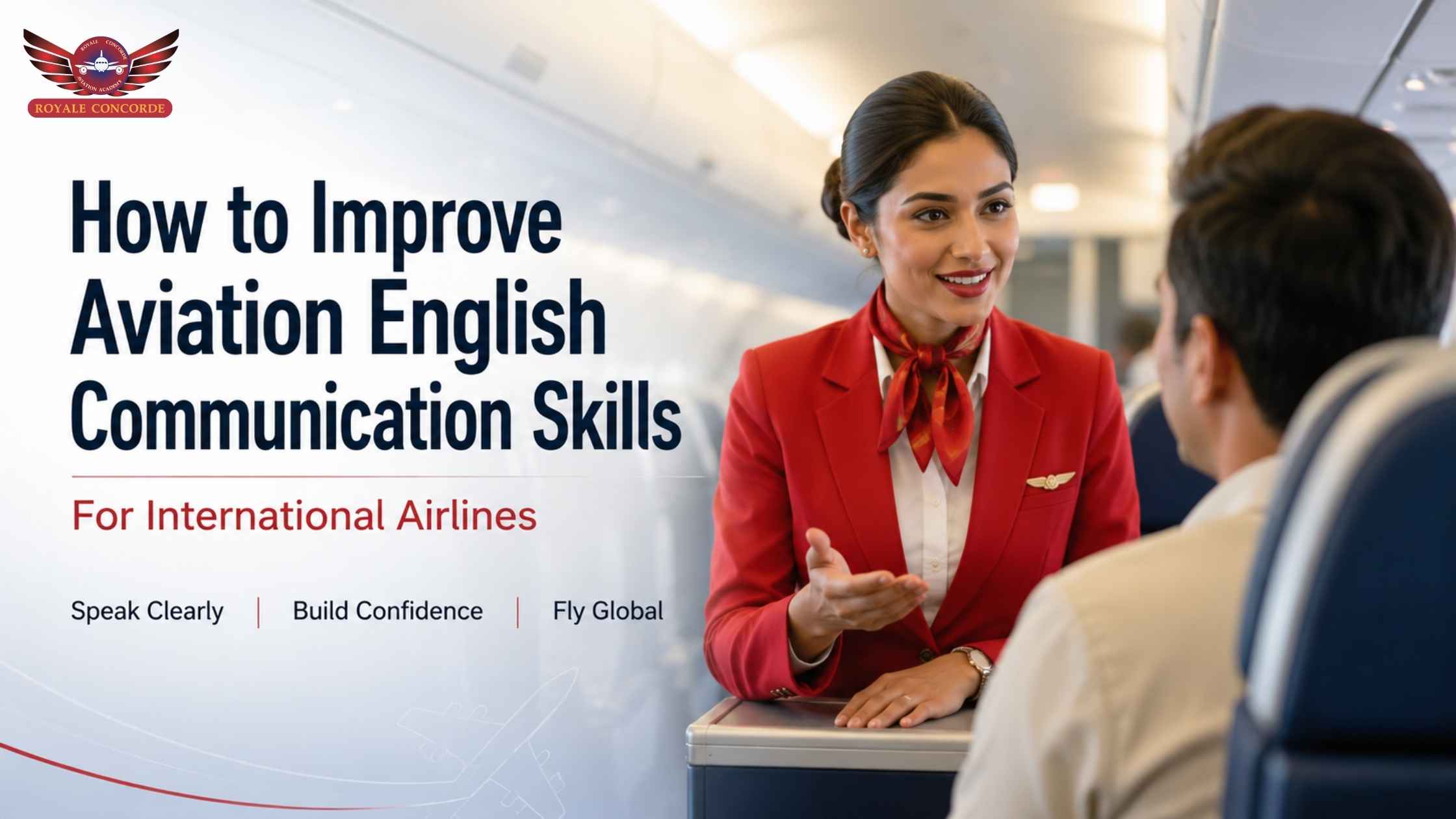
Improve Aviation English Skills is one of the most important steps for students preparing for international airline careers. Strong communication abilities help cabin crew professionals interact confidently with passengers, coordinate with airline teams, and maintain global service standards. At Royale Concorde Aviation Academy in Bangalore, students receive structured communication training designed specifically for aviation careers, helping them build fluency, confidence, pronunciation, and professional speaking abilities for domestic and international airlines.
In today’s aviation industry, communication is more than just speaking English. International airlines expect candidates to demonstrate clarity, confidence, professionalism, cultural sensitivity, and the ability to handle real-time passenger interactions. This is why communication training at Royale Concorde Aviation Academy focuses on practical airline scenarios, helping students become globally employable professionals.
Why are aviation English communication skills important for international airlines?
Aviation English communication skills are essential because airline professionals interact with passengers, crew members, and airport teams from different countries every day. Clear communication improves passenger satisfaction, ensures safety, and helps airline staff maintain professionalism during normal and emergency situations.
International airlines prioritize candidates who can communicate confidently and professionally in English because aviation is a global industry. Whether it is onboard announcements, passenger handling, emergency communication, or customer service interactions, language plays a critical role in airline operations.
At Royale Concorde Aviation Academy, students are trained to handle:
- International passenger interactions
- Cabin announcements
- Conflict resolution conversations
- Emergency communication scenarios
- Hospitality-focused airline communication
- Professional interview communication
- Cross-cultural customer service interactions
How can students Improve Aviation English Skills effectively?
Students can Improve Aviation English Skills effectively through regular speaking practice, aviation vocabulary training, pronunciation correction, listening exercises, mock airline interactions, and professional communication coaching. Consistent exposure to aviation-specific communication improves confidence and fluency over time.
Royale Concorde Aviation Academy follows a structured training methodology that combines classroom learning with practical simulations. Instead of relying only on textbook English, students practice real-world aviation conversations that reflect actual airline environments.
Daily communication practice
One of the best ways to improve communication is through consistent speaking practice. Students are encouraged to:
- Speak in English during classroom interactions
- Practice airline dialogues daily
- Participate in group discussions
- Attend mock interview sessions
- Engage in roleplay activities
These exercises gradually improve aviation speaking skills and help students become comfortable speaking professionally in front of passengers and airline recruiters.
Learning aviation-specific vocabulary
Aviation communication differs from regular conversational English. Cabin crew professionals must understand industry-specific terminology related to:
- Passenger safety
- Emergency procedures
- Airport operations
- In-flight hospitality
- Aircraft announcements
- Boarding procedures
- Customer assistance
Royale Concorde Aviation Academy integrates aviation terminology into communication training so students become familiar with the language used by international airlines.
What are the best ways to improve aviation speaking skills?
The best ways to improve aviation speaking skills include pronunciation practice, active listening, airline roleplays, confidence-building exercises, and communication simulations that reflect real airline environments.
Many aspiring cabin crew professionals understand English but struggle with confidence while speaking. This often happens because they lack practical communication exposure. Royale Concorde Aviation Academy addresses this challenge through hands-on speaking exercises that simulate airline scenarios.
Roleplay-based communication training
Students participate in realistic aviation simulations such as:
- Welcoming international passengers
- Handling difficult customer situations
- Managing onboard requests
- Making in-flight announcements
- Providing emergency instructions
- Addressing passenger concerns professionally
This practical approach significantly improves aviation speaking skills by helping students speak naturally and confidently in airline environments.
Listening and comprehension exercises
Communication is not just about speaking clearly. Cabin crew members must also understand passengers with different accents and speech patterns. Students are trained using:
- International English listening exercises
- Airline announcement recordings
- Hospitality communication drills
- Passenger interaction simulations
These methods help students adapt to real-world airline communication challenges.
How does cabin crew English fluency impact airline selection?
cabin crew English fluency directly affects recruitment opportunities because airlines prefer candidates who can communicate professionally with international passengers and crew members.
Recruiters evaluate fluency during:
- Personal interviews
- Group discussions
- Customer handling simulations
- Communication assessments
- Presentation rounds
Fluent communication demonstrates professionalism, confidence, and customer service readiness. Candidates who communicate smoothly often leave a stronger impression during airline recruitment drives.
Royale Concorde Aviation Academy helps students improve cabin crew English fluency through:
| Training Area | Benefits |
|---|---|
| Public speaking practice | Builds communication confidence |
| Mock interviews | Improves recruiter interaction |
| Group discussions | Enhances spontaneous speaking |
| Airline simulations | Prepares students for real situations |
| Vocabulary enhancement | Improves professional communication |
Why is aviation accent training important for airline careers?
aviation accent training is important because clear pronunciation and neutral speech improve communication with international passengers and airline teams. Airlines value candidates who can speak clearly and professionally in multicultural environments.
Many students worry that they must completely change their natural accent to work for international airlines. However, airline communication training focuses more on clarity, neutrality, and understandable pronunciation rather than eliminating regional accents entirely.
At Royale Concorde Aviation Academy, aviation accent training includes:
- Neutral English pronunciation coaching
- Speech clarity improvement
- Voice modulation exercises
- Professional speaking techniques
- Listening and repetition practice
- International communication exposure
Common pronunciation improvements taught during training
Students often improve:
- Word stress and sentence rhythm
- Pronunciation clarity
- Professional speaking pace
- Confidence while speaking publicly
- Listening comprehension skills
This helps aspiring aviation professionals communicate more effectively with passengers from around the world.
What are the best aviation pronunciation tips for cabin crew students?
The best aviation pronunciation tips include practicing slowly, listening to international speakers, recording your voice, improving word stress, and speaking clearly instead of speaking quickly.
Students preparing for international airlines should focus on clarity and professionalism. Communication training at Royale Concorde Aviation Academy emphasizes practical pronunciation improvement methods that students can apply daily.
Top aviation pronunciation tips for students
- Practice speaking slowly and clearly
- Listen to international airline announcements
- Read English newspapers aloud daily
- Record and review your speaking sessions
- Focus on pronunciation consistency
- Improve listening comprehension regularly
- Learn professional aviation vocabulary
- Practice mock passenger interactions
These aviation pronunciation tips help students improve confidence while communicating in professional airline environments.
How does Royale Concorde Aviation Academy help students become airline-ready?
Royale Concorde Aviation Academy is a leading aviation training institute in Bangalore specializing in cabin crew training, aviation hospitality, communication skills, and airline career preparation. The academy combines theoretical instruction with practical learning experiences to prepare students for domestic and international airline opportunities.
The academy focuses on:
- Industry-relevant aviation training
- Communication and personality development
- Cabin crew grooming standards
- Emergency and safety training
- Interview preparation sessions
- Simulation-based practical learning
Students benefit from modern learning facilities, experienced trainers, structured curriculum design, and career-focused guidance that aligns with airline recruitment standards.
What communication qualities do international airlines look for?
International airlines look for communication qualities such as confidence, clarity, professionalism, listening ability, empathy, cultural sensitivity, and customer service excellence.
Airlines expect cabin crew professionals to represent the brand positively while ensuring passenger comfort and safety. This requires strong interpersonal communication abilities.
Important qualities include:
- Professional speaking style
- Positive body language
- Clear pronunciation
- Passenger empathy
- Problem-solving communication
- Polite customer interaction
- Confidence under pressure
Royale Concorde Aviation Academy trains students extensively in these areas to improve employability and interview performance.
How can aviation students practice communication skills at home?
Aviation students can practice communication skills at home by speaking English daily, watching airline communication videos, practicing interviews, reading aloud, and engaging in self-recording exercises.
Simple home-based communication exercises include:
- Watching English aviation content
- Practicing airline announcements
- Reading hospitality scripts aloud
- Participating in online speaking groups
- Learning aviation terminology daily
- Practicing mirror speaking techniques
Consistent practice significantly improves communication confidence and professional speaking abilities over time.
About Royale Concorde Aviation Academy
Royale Concorde Aviation Academy is a premier aviation training institute based in Bangalore, Karnataka, specializing in cabin crew training, aviation hospitality, airport ground operations, personality development, and communication skills training. Founded under the leadership of Shri L. R. Shivarame Gowda, the academy focuses on preparing students for successful careers in domestic and international airlines through industry-oriented training programs and practical learning exposure.
The academy’s structured approach combines aviation education with personality transformation, helping aspiring aviation professionals develop the confidence, communication abilities, grooming standards, and operational knowledge expected by leading airlines worldwide.
Contact Royale Concorde Aviation Academy
Location: Bangalore, Karnataka, India
Phone: +91 7204805777 / +91 7204806777
Email: mail@royaleconcordeaviation.com
Frequently Asked Questions
Why is Aviation English important for international airline careers?
Aviation English is one of the most critical skills for professionals working in international airlines because clear communication directly impacts passenger safety, teamwork, and customer experience. Pilots, cabin crew, and ground staff are expected to communicate confidently with passengers and colleagues from different countries and language backgrounds.
Royale Concorde Aviation helps students Improve Aviation English Skills through structured speaking sessions, communication labs, role-play activities, and real-world airline interaction training. The institute focuses on improving clarity, confidence, listening comprehension, and professional vocabulary so students are prepared for global aviation environments.
How can students improve their aviation speaking confidence?
Consistent practice is the key to building strong aviation speaking skills. Students should regularly participate in mock airline interviews, passenger announcement exercises, group discussions, and scenario-based communication practice.
At Royale Concorde Aviation, trainers conduct interactive classroom activities that simulate airport and cabin situations. Students learn how to communicate calmly during passenger queries, delays, emergency situations, and inflight service interactions. These practical exercises help learners develop natural fluency and professional confidence required in international airline operations.
Does Royale Concorde Aviation provide training for cabin crew communication?
Yes. Royale Concorde Aviation provides specialized communication training designed specifically for aspiring cabin crew professionals. The program focuses on passenger interaction, inflight service etiquette, professional greetings, announcement delivery, and handling international travelers with confidence.
The academy also places strong emphasis on cabin crew English fluency by helping students improve sentence formation, pronunciation, listening skills, and hospitality communication. Trainers guide students on how to sound professional, polite, and confident in real airline environments.
What role does pronunciation play in Aviation English?
Pronunciation plays a major role in Aviation English because unclear speech can create confusion during communication. Airline professionals are expected to pronounce words clearly so passengers and crew members from different nationalities can understand instructions without difficulty.
Royale Concorde Aviation includes dedicated sessions on aviation pronunciation tips where students learn voice clarity, stress patterns, pronunciation correction, and effective communication techniques. Trainers help learners identify commonly mispronounced aviation terms and improve speech delivery through guided practice and audio-based learning.
Can accent training help students prepare for international airlines?
Yes. Accent training can significantly improve communication clarity and help students adapt to global airline standards. International airlines value professionals who can communicate in a neutral, understandable, and professional tone while interacting with passengers from different countries.
Royale Concorde Aviation offers aviation accent training that focuses on pronunciation clarity, neutral speech patterns, listening exercises, and communication confidence. The training helps students reduce hesitation, improve articulation, and communicate more effectively in multinational airline environments.
How long does it take to improve Aviation English communication skills?
The time required depends on the student’s current communication level, learning consistency, and daily practice habits. Many learners notice improvements within a few months when they regularly participate in speaking exercises, listening practice, and interactive classroom sessions.
Royale Concorde Aviation follows a practical training approach that combines grammar support, speaking activities, interview preparation, and aviation-based communication exercises. This structured system allows students to gradually build confidence and communicate professionally in airline settings.
What are the best ways to practice Aviation English outside the classroom?
Students can improve their communication skills outside the classroom by listening to airline announcements, watching aviation-related videos, practicing mirror speaking, recording their voice, and reading aviation articles aloud. Daily speaking practice helps improve confidence and sentence flow over time.
Royale Concorde Aviation also encourages students to participate in communication clubs, mock interview sessions, and peer interaction activities. These exercises create a practical learning environment that helps students become comfortable speaking English naturally and professionally.
Why do international airlines prefer candidates with strong communication skills?
International airlines prefer candidates with strong communication skills because airline professionals regularly interact with passengers, crew members, and airport authorities from diverse cultural and linguistic backgrounds. Clear communication improves customer satisfaction, teamwork, and operational efficiency.
Royale Concorde Aviation prepares students for these expectations through personality development, communication coaching, interview preparation, and practical airline training. The institute’s industry-focused learning approach helps students become confident professionals ready for global aviation careers.