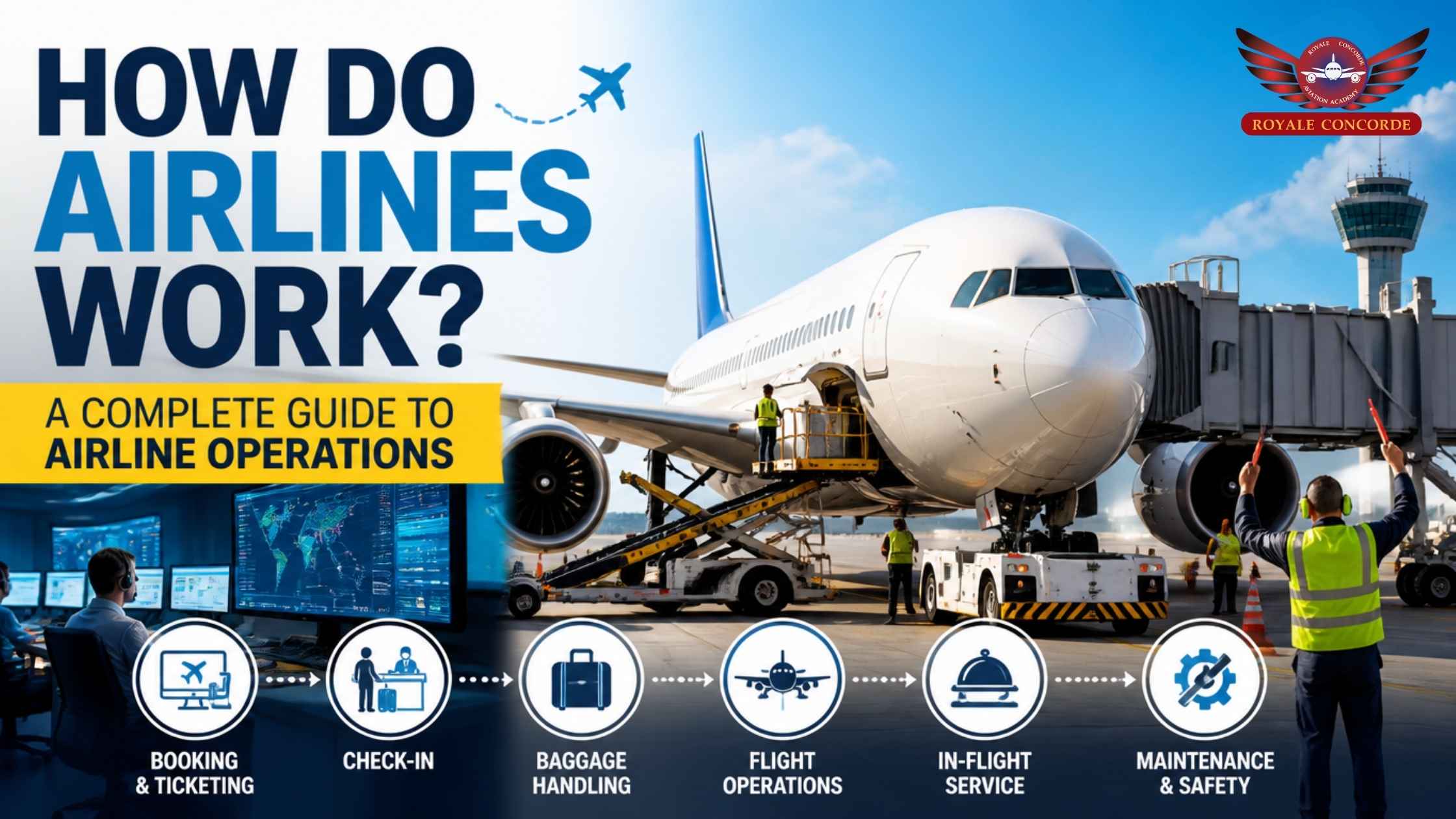
How do airlines work? Airlines are complex organizations that integrate flight operations, airline management, customer service, logistics, and safety to transport millions of passengers and tons of cargo every day. At Royale Concorde Aviation Academy, Bangalore’s premier aviation training institute, we prepare future professionals to master every aspect of this dynamic industry, from cockpit to cabin and beyond.
What is the structure of an airline? Understanding airline departments
Airlines are made up of multiple specialized departments, each playing a vital role in ensuring safe, efficient, and profitable operations. The main airline departments include:
- Flight operations: Responsible for managing pilots, flight planning, aircraft dispatch, and all aspects of flying the aircraft.
- Cabin crew services: Focused on passenger safety, in-flight hospitality, service, and emergency procedures.
- Ground operations: Handles baggage, cargo, check-in, boarding, and aircraft turnaround at airports.
- Maintenance and engineering: Ensures every aircraft is airworthy through routine checks, repairs, and scheduled maintenance.
- Commercial and revenue management: Manages ticket sales, pricing, marketing, and network planning to maximize profitability.
- Customer service: Addresses passenger needs, queries, and service recovery.
- Human resources and training: Recruits, trains, and manages airline staff across all functions.
- Corporate management: Oversees overall airline strategy, compliance, and financial management.
Each department collaborates closely with others, demonstrating that how airlines operate is a result of seamless teamwork and coordination. At Royale Concorde Aviation Academy, we train our students to understand and excel in these interconnected fields.
How do flight operations keep airlines running safely and efficiently?
Flight operations are the backbone of any airline, responsible for the safe and timely movement of aircraft. This department oversees everything that happens from the moment a flight is scheduled until it lands safely at its destination.
- Flight planning: Creating the safest, most economical routes considering weather, airspace restrictions, and aircraft performance.
- Pilot management: Scheduling, briefing, and ensuring pilots have the necessary rest and certifications.
- Aircraft dispatch: Coordinating between pilots, ground staff, and air traffic control to get flights off the ground on schedule.
- Safety oversight: Monitoring compliance with aviation regulations and airline policies.
At Royale Concorde Aviation Academy, students gain hands-on experience in simulated flight operations environments, preparing them for real-world airline challenges.
What does airline staff do? Key roles and responsibilities
The airline staff is a diverse group, including pilots, cabin crew, ground staff, engineers, and managers. Each role requires specific skills but shares a common goal: delivering a safe, smooth, and enjoyable journey for every passenger.
| Role | Primary Responsibilities |
|---|---|
| Pilot | Operating the aircraft, ensuring safety, communicating with air traffic control, and handling emergencies. |
| Cabin Crew | Passenger safety, customer service, in-flight hospitality, and emergency response. |
| Ground Staff | Check-in, boarding, baggage handling, and resolving passenger issues at the airport. |
| Maintenance Engineer | Aircraft inspections, repairs, and ensuring airworthiness. |
| Customer Service Agent | Assisting passengers with bookings, queries, complaints, and special needs. |
| Management/Administration | Strategic planning, compliance, HR, finance, and regulatory affairs. |
Royale Concorde Aviation provides targeted training for each of these roles, equipping graduates for successful entry into the aviation industry.
How does airline management shape airline business success?
Airline management is about making strategic decisions that enable an airline to thrive in a highly competitive market. This includes route selection, fleet acquisition, cost control, partnership development, branding, and regulatory compliance. The airline business is both capital-intensive and service-oriented, requiring leaders who can balance operational efficiency with exceptional customer experience.
- Strategic planning: Deciding which routes to fly, how to price tickets, and where to invest in new aircraft or technology.
- Revenue management: Using data and analytics to optimize sales and profitability.
- Quality and safety assurance: Maintaining the highest standards of operational safety and service quality.
- Brand management: Building loyalty and trust through consistent service and reputation.
- Regulatory compliance: Navigating complex international and domestic aviation laws.
Through practical case studies and industry projects, Royale Concorde Aviation Academy prepares students for management positions in airlines, airports, and aviation companies.
What makes airline operations unique in the aviation industry?
Airline operations differ from other sectors due to the global nature of air travel, strict regulatory oversight, and the need for constant innovation. Every day, airlines must adapt to changing weather, fluctuating demand, geopolitical issues, and rapid technological advances.
- Global connectivity: Airlines must coordinate across countries, languages, and time zones.
- Safety as the top priority: Strict adherence to international safety standards and procedures.
- Operational resilience: Responding to disruptions such as weather delays, technical faults, or security alerts with agility and professionalism.
- Customer-centricity: Providing a seamless experience from booking to baggage claim, even in challenging circumstances.
At Royale Concorde Aviation Academy, students learn not just theory but also how to apply practical solutions to real airline operational scenarios.
How are passengers and cargo managed in airline operations?
Airlines simultaneously manage passenger comfort and cargo logistics. This involves:
- Passenger services: Ticketing, check-in, boarding, in-flight service, and after-arrival support.
- Cargo operations: Transporting goods, mail, and special shipments under strict deadlines and safety requirements.
- Coordination: Ensuring the right balance of weight, security, and efficiency for every flight.
Graduates from Royale Concorde Aviation are trained in both customer service and operational logistics, ready to address the unique challenges of passenger and cargo management.
What is the importance of training and development in airline staff?
Airlines invest heavily in training to ensure every team member—from pilots to ground crew—meets the highest standards of safety, service, and professionalism. At Royale Concorde Aviation Academy, the curriculum combines:
- Technical knowledge of aviation regulations and procedures
- Personality development and communication skills
- Simulated emergency drills and real-world scenarios
- Customer service and hospitality training
- Interview preparation and grooming
This all-rounded approach ensures students are airline-ready and capable of adapting to the demands of the modern aviation industry.
How can you build a career in airline operations and management?
Building a career in the airline industry involves the right education, industry exposure, and professional development. At Royale Concorde Aviation Academy, Bangalore, students receive:
- Industry-aligned courses in cabin crew training, aviation hospitality, airport ground operations, and airline management.
- Practical training in simulated aircraft cabins and emergency modules.
- Communication and grooming workshops to build confidence and employability.
- Placement support with resume building, mock interviews, and industry networking.
Whether you aspire to become cabin crew, work in ground operations, or lead in airline management, Royale Concorde Aviation Academy provides a launchpad for your aviation career.
Why is Bangalore a leading hub for aviation training in India?
Bangalore is one of India’s busiest aviation and technology hubs, offering excellent connectivity and a vibrant job market for aviation professionals. Royale Concorde Aviation Academy, located in Bangalore, leverages this ecosystem to provide students with exposure to real-world airline operations and access to leading aviation employers.
About Royale Concorde Aviation Academy
Royale Concorde Aviation Academy (RCAA) is a premier aviation training institute in Bangalore dedicated to shaping the next generation of aviation professionals. Founded by Shri L. R. Shivarame Gowda and led by a visionary team, RCAA specializes in cabin crew training, air hostess programs, aviation hospitality, and airport ground operations.
With a curriculum designed for industry readiness, practical simulation-based learning, and a strong focus on personality development and communication, RCAA stands as a leader in aviation education. The academy’s mission is to nurture talent, build confidence, and prepare students for successful careers in both domestic and international airlines.
- Comprehensive industry-aligned training programs
- Experienced mentors with real airline backgrounds
- World-class facilities and simulated learning environments
- Placement assistance and industry networking
- Women-led leadership inspiring the next generation
Learn more or apply today at Royale Concorde Aviation Academy.
Contact: +91 7204805777 | mail@royaleconcordeaviation.com
Frequently asked questions
What is the primary function of airline operations?
Airline operations coordinate all activities required to move passengers and cargo safely from origin to destination, including flight scheduling, crew management, ground services, and customer support.
Why is training important for airline staff?
High-quality training ensures airline staff meet global safety, service, and operational standards, enabling them to handle emergencies, deliver hospitality, and represent the airline brand professionally.
How do airlines handle disruptions like delays or cancellations?
Airlines activate contingency plans, rebook passengers, arrange alternate flights or accommodation, and communicate transparently with affected customers to minimize inconvenience and maintain service quality.
What are common career paths in the aviation industry?
Popular aviation careers include cabin crew, pilot, ground operations, airline management, aviation hospitality, customer service, and airport administration. Royale Concorde Aviation Academy offers specialized training for each path.
How do I enroll at Royale Concorde Aviation Academy?
Prospective students can apply online via the official website, call +91 7204805777, or email mail@royaleconcordeaviation.com for admissions information and eligibility criteria.
Frequently Asked Questions
What are the main components of airline operations?
Airline operations encompass everything involved in running an airline, from flight planning and crew scheduling to aircraft maintenance and customer service. Core components include flight operations, ground handling, reservations, ticketing, safety management, and regulatory compliance. Each department plays a vital role in ensuring safe and efficient journeys for travelers.
How do airlines coordinate between different departments?
Airlines rely on seamless coordination among various airline departments such as operations control, engineering, finance, and customer service. Communication systems, real-time software, and regular operational meetings help ensure everyone is aligned. This integrated approach is crucial for minimizing delays and optimizing the airline business as a whole.
What does flight operations involve in an airline?
Flight operations refer to the planning, execution, and monitoring of all flights. This includes tasks like assigning crews, preparing flight plans, monitoring weather conditions, and ensuring regulatory compliance. The flight operations team works closely with pilots, air traffic controllers, and maintenance staff to ensure every flight is safe and efficient.
How do airlines manage their staff and crew scheduling?
Airline staff management is a complex process involving advanced scheduling systems, compliance with rest regulations, and adapting to last-minute changes due to delays or disruptions. Airlines use sophisticated software to optimize crew assignments, manage rosters, and ensure both safety and efficiency.
What challenges do airlines face in the aviation industry today?
The aviation industry is faced with challenges like fluctuating fuel prices, ever-changing regulations, increased competition, and evolving customer expectations. Additionally, airlines must address issues related to sustainability, digital transformation, and global events that can disrupt schedules and demand.
What role does airline management play in ensuring a successful airline?
Airline management is responsible for strategic planning, financial oversight, regulatory compliance, and operational efficiency. Effective management ensures the airline remains competitive, profitable, and capable of delivering a superior passenger experience while maintaining safety and reliability.
How do airlines operate safely and efficiently every day?
Safety and efficiency are achieved through rigorous training, strict adherence to procedures, regular maintenance, and leveraging technology for real-time decision-making. Airlines invest heavily in safety management systems and continuous improvement to ensure both passengers and crews are protected at every stage of travel.
How can Royale Concorde Aviation help optimize airline operations?
Royale Concorde Aviation offers tailored solutions that streamline airline operations, from digital transformation and process optimization to staff training and compliance support. Their expertise in the aviation industry enables airlines to enhance efficiency, reduce costs, and deliver better customer experiences.
What services does Royale Concorde Aviation provide to support airline business growth?
Royale Concorde Aviation provides a wide range of services, including operational consulting, technology implementation, regulatory advisory, and training programs. By partnering with airlines, they help improve profitability, operational excellence, and adaptability in a dynamic aviation landscape.