Royale Concorde Aviation Academy is Bangalore’s premier aviation training institute, dedicated to training the next generation of cabin crew and aviation professionals with world-class standards.
What Is Cabin Crew Emergency Checklist Jargon?
Cabin crew emergency checklist jargon refers to the specialized language, commands, and procedural phrases used by professional cabin crew during emergency situations. These terms are vital for ensuring fast, coordinated, and effective responses in high-pressure scenarios, where clarity and accuracy can save lives.
Every aspiring cabin crew member at Royale Concorde Aviation Academy learns to master this language, which is meticulously detailed in the airline’s safety manual terminology. Understanding these terms is not just a matter of passing exams—it is about developing the presence of mind and professionalism expected by top airlines worldwide.
Why Is Emergency Jargon Critical For Cabin Crew?
Emergency jargon is designed to ensure that communication during a crisis is clear, unambiguous, and universally understood amongst the cabin crew. The use of standardized phrases allows for:
- Instant recognition of commands
- Rapid response and action
- Elimination of confusion under stress
- Coordination between crew members and cockpit
At Royale Concorde Aviation Academy, students are trained to internalize these phrases through simulation and real-world scenarios, building muscle memory and confidence to perform under pressure.
What Are The Most Important Emergency Terms For Cabin Crew?
Here, we break down the core components of cabin crew emergency checklist jargon, explaining why each is critical and how it is used in real airline operations.
Cabin crew emergency terminology: The Language of Preparedness
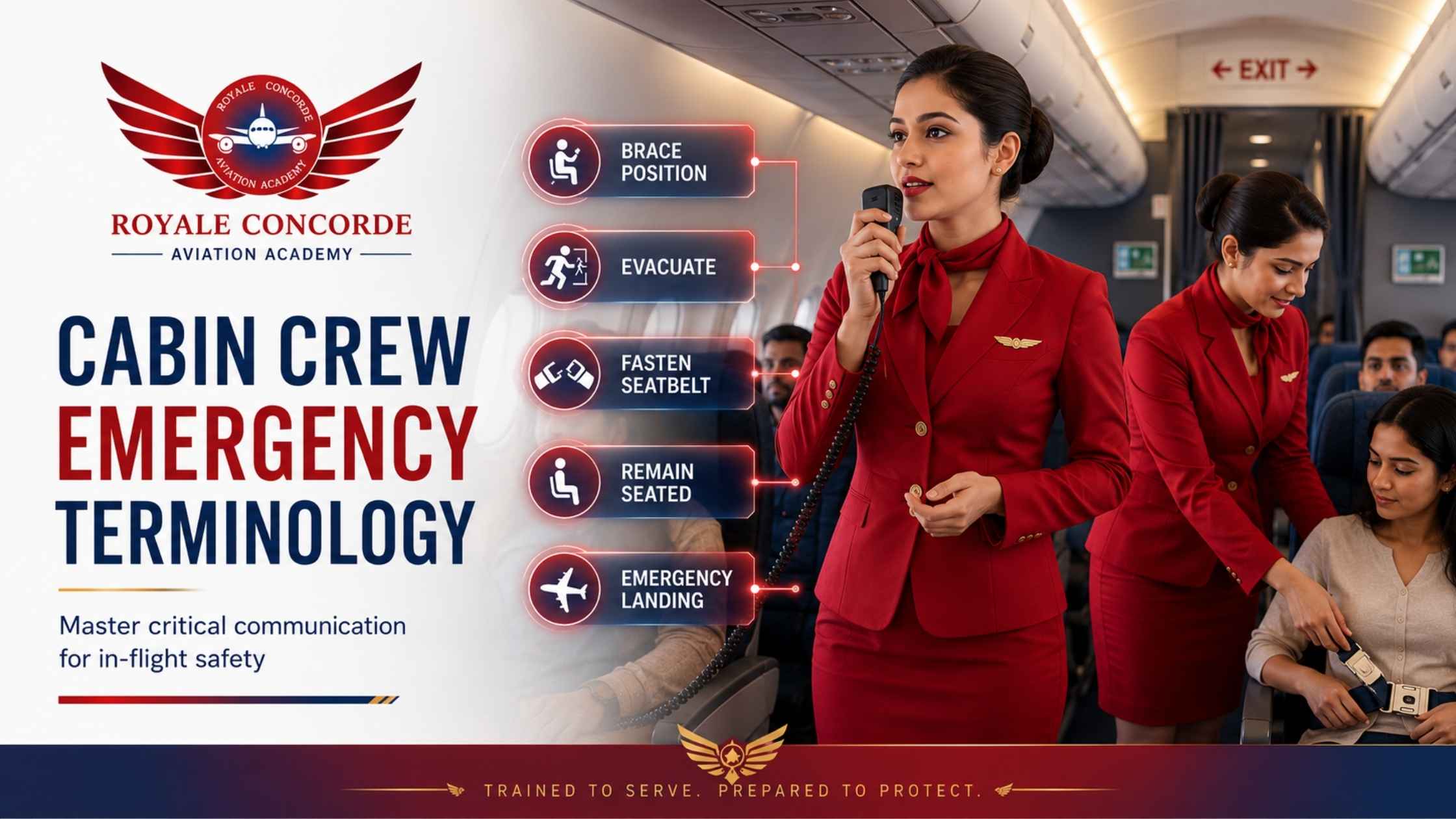
Cabin crew emergency terminology encompasses a set of essential words and phrases that have specific, action-oriented meanings. These terms are used to direct, alert, and command both crew and passengers during emergencies, ensuring a unified understanding regardless of language barriers or airline origin.
- “Emergency”: Signals an abnormal, potentially dangerous situation requiring immediate action.
- “Evacuate”: Directs all onboard to leave the aircraft using specified exits.
- “Remain Seated”: Used to prevent premature movement during turbulence or emergency.
Students at Royale Concorde Aviation Academy drill these terms to perfection, as they anchor all emergency actions within the cabin.
Inflight evacuation phrases: The Commands That Save Lives
Inflight evacuation phrases are standardized orders issued during a rapid aircraft evacuation. These are short, firm, and universally recognized by airline professionals:
- “Open your seatbelt”: Instructs passengers to release seatbelts before exiting.
- “Come this way”: Directs passengers to the nearest usable exit.
- “Jump and slide”: Used when exiting via inflatable slides.
- “Move away from the aircraft”: Ensures passengers clear the area for safety.
Mastering these phrases is a core focus at Royale Concorde Aviation, where practice in simulated cabin environments prepares students for real-world emergencies.
Brace for impact: A Command Of Critical Importance
“Brace for impact” is one of the most crucial emergency commands given by either the cockpit or the senior cabin crew. It instructs passengers and crew to assume the safest position possible in preparation for a potential crash landing or hard impact.
- Passengers are taught to bend forward, feet flat, hands over their heads or braced against the seat in front.
- Crew members have a specific bracing posture, often practiced repeatedly during training at Royale Concorde Aviation Academy.
The ability to instantly recognize and respond to this command is a life-saving skill, heavily emphasized in RCAA’s curriculum.
Leave baggage behind: Why This Phrase Saves Time and Lives
During an evacuation, leave baggage behind is a critical instruction that cabin crew must communicate assertively. Carry-on luggage can obstruct aisles, damage evacuation slides, and cause dangerous delays.
- Cabin crew are trained to repeat “Leave baggage behind!” loudly and clearly.
- Passengers are instructed to leave all personal items and evacuate immediately.
At Royale Concorde Aviation, this phrase is drilled during every evacuation simulation, reinforcing its non-negotiable importance.
Rapid decompression: Responding To Sudden Cabin Pressure Loss
Rapid decompression refers to the sudden loss of cabin pressure at altitude. This is an extremely dangerous scenario that requires immediate, protocol-driven action by the cabin crew:
- Deployment of oxygen masks
- Directing passengers to “Don oxygen masks, breathe normally”
- Securing oneself and monitoring the cabin for signs of hypoxia or distress
RCAA students learn the science behind decompression, as well as the exact steps and jargon used in these rare but critical events.
Emergency commands: The Backbone Of Crew Communication
Emergency commands are direct, rehearsed instructions that form the backbone of cabin crew communication in crises. These are delivered loudly, clearly, and repeatedly to override panic and ensure compliance.
| Command | Purpose |
|---|---|
| “Release seatbelts” | Initiate evacuation |
| “Come this way” | Guide passengers to exits |
| “Jump and slide” | Evacuate via slide |
| “Leave everything” | Prevent delays |
| “Move away from the aircraft” | Ensure safety post-evacuation |
At Royale Concorde Aviation, students rehearse these commands through role-play and scenario-based exercises, ensuring instant recall under pressure.
Safety manual terminology: Your Lifeline In The Skies
Safety manual terminology comprises all the official jargon, acronyms, and definitions found in airline safety manuals. These manuals are the foundation of every airline’s safety culture and are required reading for all cabin crew.
- Defines every emergency procedure
- Explains the meaning and use of each jargon term
- Outlines checklists and responsibilities for all crew positions
Royale Concorde Aviation Academy’s training programs are built upon these manuals, ensuring students graduate with a working knowledge of the language and procedures used by top airlines globally.
How Royale Concorde Aviation Academy Prepares Students for Real Emergencies
At Royale Concorde Aviation Academy in Bangalore, emergency procedures and jargon are integrated into every aspect of training. The Academy ensures that every graduate is ready to meet real-world airline expectations through a combination of practical experience, expert instruction, and continuous assessment.
- Simulation-Based Learning: Students practice emergency jargon in realistic cabin mock-ups, responding to simulated smoke, fire, decompression, and evacuation scenarios.
- Industry-Driven Curriculum: Training is aligned with global airline standards, ensuring students master both Indian and international safety manual terminology.
- Mentorship by Industry Experts: Instructors with years of airline experience guide students, sharing real-life stories of how jargon and command phrases have been applied in actual flights.
- Continuous Assessment: Regular drills, oral exams, and scenario assessments build competence and confidence in emergency language and procedures.
This immersive methodology produces cabin crew who not only understand the jargon, but can use it instinctively when it matters most.
Frequently Asked Questions: Cabin Crew Emergency Jargon
What is the most important cabin crew emergency terminology for new trainees?
The most important terms include “evacuate,” “brace for impact,” “leave baggage behind,” and “rapid decompression.” Mastery of these ensures clear, quick action in emergencies.
How does inflight evacuation phrases training help save lives?
Inflight evacuation phrases standardize instructions for all passengers, eliminating confusion and ensuring swift, orderly evacuations, which are crucial during life-threatening situations like fire or water landings.
Why must passengers leave baggage behind during an evacuation?
Carry-on luggage can block aisles, slow exits, and damage evacuation slides. “Leave baggage behind” is enforced to maximize speed and safety during an emergency evacuation.
How are emergency commands different from regular instructions?
Emergency commands are concise, action-oriented phrases delivered with authority, designed to override panic and prompt immediate compliance, unlike general instructions given during routine operations.
About Royale Concorde Aviation Academy
Royale Concorde Aviation Academy (RCAA) is Bangalore’s leading aviation training institute, specializing in cabin crew, air hostess, aviation hospitality, and airport ground operations training. With a robust industry-relevant curriculum and practical training modules, RCAA prepares students for successful careers in both domestic and international airlines. Founded by Shri L. R. Shivarame Gowda and led by visionary women mentors, RCAA’s graduates are recognized for their professionalism, confidence, and readiness for real-world aviation challenges.
- Location: Bangalore, Karnataka, India
- Phone: +91 7204805777 / +91 7204806777
- Email: mail@royaleconcordeaviation.com
- Website: royaleconcordeaviation.com
Frequently Asked Questions
What is cabin crew emergency terminology, and why is it so important?
Cabin crew emergency terminology refers to the specific words, phrases, and codes used by airline staff to communicate quickly and clearly during emergencies. This standardized language helps prevent misunderstandings in high-stress situations, ensuring that instructions are instantly understood and followed. At Royale Concorde Aviation, our training programs focus on demystifying this terminology, so crew members can respond confidently and consistently under pressure.
How do Royale Concorde Aviation’s courses help with safety manual terminology?
Royale Concorde Aviation’s courses break down complex safety manual terminology into practical, easy-to-understand modules. We use real-world scenarios and interactive drills, so trainees not only memorize the language but also learn when and how to use it effectively. This approach ensures that every crew member can interpret and execute safety procedures without hesitation.
What are inflight evacuation phrases, and how does training address their use?
Inflight evacuation phrases are concise commands such as “Evacuate!”, “Jump and slide!”, or “Come this way!” These phrases are designed to be universally recognized and easily shouted in noisy, chaotic environments. Royale Concorde Aviation’s simulation-based training ensures crew members practice using these exact phrases, so they become second nature during real emergencies.
What does “brace for impact” mean, and how is it communicated to passengers?
“Brace for impact” is an emergency command used to instruct passengers to assume a protective position before a crash landing or severe turbulence. Cabin crew are trained to loudly and repeatedly give this command using clear body language and demonstration, ensuring passengers know exactly what to do to minimize injury. Royale Concorde Aviation’s programs teach the proper delivery and timing of this crucial command.
Why is “leave baggage behind” emphasized during evacuations?
“Leave baggage behind” is a vital instruction during evacuations because carrying personal items can slow down the escape process and endanger lives. Baggage may block aisles, damage evacuation slides, or injure others. Royale Concorde Aviation reinforces this command in all evacuation drills, ensuring crew and passengers understand its critical importance.
What is rapid decompression, and what emergency commands are used?
Rapid decompression is a sudden loss of cabin pressure, which can lead to hypoxia and other life-threatening situations. Emergency commands like “Put on your oxygen mask!” are used immediately. Royale Concorde Aviation’s training features realistic decompression scenarios, teaching crew to recognize warning signs, communicate effectively, and follow proper safety protocols under extreme conditions.
How does Royale Concorde Aviation simplify emergency commands for trainees?
We use role-play, scenario-based learning, and repetition to make emergency commands instinctive for trainees. By practicing with authentic checklists and real equipment, students learn to deliver commands with authority and clarity, reducing uncertainty in actual emergencies.
Can Royale Concorde Aviation customize training for different airlines’ safety manuals?
Absolutely. We tailor our instruction to each airline’s specific safety manual terminology and procedures. Our expert instructors work closely with carriers to ensure that their unique protocols are fully integrated into every training session, so crew members are always compliant and confident.
What ongoing solutions does Royale Concorde Aviation offer for cabin crew competency?
Royale Concorde Aviation provides continuous learning opportunities, including recurrent training, workshops on new regulations, and refreshers on cabin crew emergency terminology. Our solutions ensure that all personnel stay up-to-date, comfortable with the latest inflight evacuation phrases, and prepared for any situation.