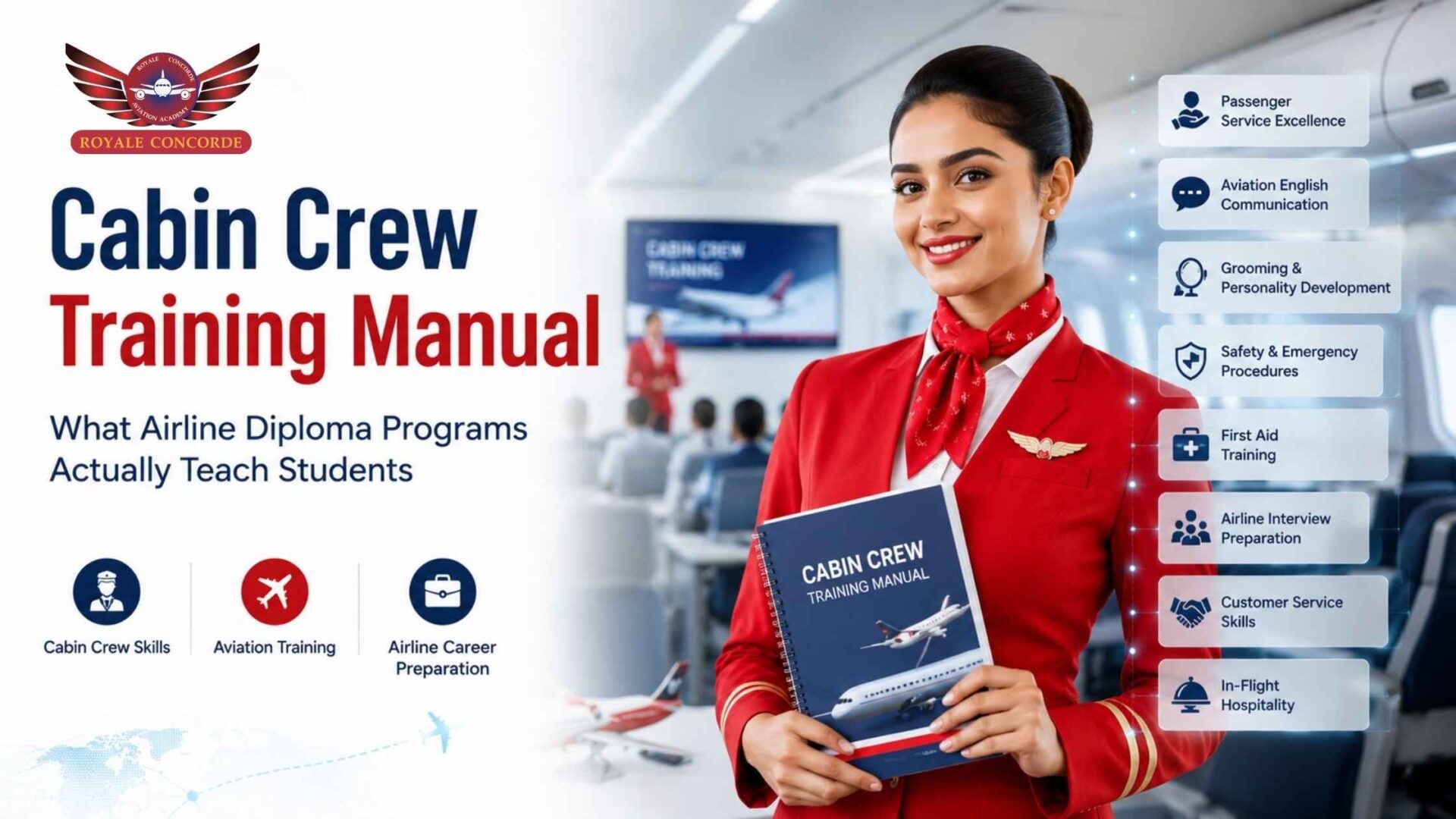
What does a cabin crew diploma syllabus cover, and how do airline diploma programs prepare students for real-world aviation roles? At Royale Concorde Aviation Academy in Bangalore, students receive comprehensive training that goes beyond theory, equipping them with the skills, confidence, and professionalism required for a successful airline career. This article explores the in-depth subjects, practical modules, and career outcomes of cabin crew training, focusing on industry standards, real-world readiness, and the competitive advantage of learning at a premier aviation institute.
The cabin crew diploma syllabus at Royale Concorde Aviation Academy is meticulously designed to meet the standards of both domestic and international airlines. Students are introduced to a wide array of topics that ensure they are airline-ready, covering everything from in-flight service to safety protocols.
This holistic approach ensures that graduates are not just knowledgeable, but also adaptable, courteous, and ready to thrive in high-pressure airline environments.
Cabin crew training subjects at RCAA are selected based on current airline recruitment trends and future industry needs. While all subjects are essential, some are especially pivotal for a successful career:
By focusing on these critical cabin crew training subjects, Royale Concorde Aviation Academy ensures that students meet—and exceed—airline expectations.
Aviation grooming classes are a cornerstone of cabin crew training at RCAA. Airlines hold strict grooming standards to maintain their brand image and to ensure every crew member projects professionalism and confidence.
These aviation grooming classes not only prepare students to meet airline selection criteria, but also boost their personal confidence and help them stand out during recruitment.
Airline safety training is a non-negotiable aspect of every cabin crew diploma at RCAA. Safety is the number one responsibility of every cabin crew member, making this training both rigorous and practical.
By simulating high-stress scenarios, airline safety training ensures that RCAA graduates are calm, capable, and trusted by airlines to safeguard passengers in any situation.
Aviation communication skills are among the most sought-after attributes in cabin crew recruitment. Effective communication underpins safety, service, and teamwork in the airline environment.
RCAA’s aviation communication skills modules use real-life scenarios, role play, and feedback to build the confidence and clarity essential for aviation professionals.
Royale Concorde Aviation Academy stands out for its blend of classroom learning and hands-on experience. As a premier aviation career academy in Bangalore, RCAA’s focus is on practical, simulation-based learning that bridges the gap between theoretical knowledge and real-world application.
This approach ensures students are confident, industry-ready, and equipped with both technical and soft skills.
To join Royale Concorde Aviation Academy’s cabin crew diploma program, students must typically meet the following criteria:
These requirements ensure that candidates are ready for the demands of cabin crew training and future airline recruitment.
Graduates of Royale Concorde Aviation Academy’s cabin crew diploma program are prepared for a variety of exciting roles:
RCAA’s dedicated placement and industry interface team supports students in securing interviews and job placements, making the transition from classroom to career seamless.
Royale Concorde Aviation Academy is recognized as a premier aviation training institute in Bangalore, combining EEAT principles—expertise, experience, authority, and trustworthiness—in every aspect of education.
With a strong legacy, visionary leadership, and an unwavering commitment to student success, RCAA offers a transformative educational experience for aspiring cabin crew professionals.
Royale Concorde Aviation Academy (RCAA) is a women-led, premier aviation training institute based in Bangalore, Karnataka. RCAA specializes in cabin crew training, air hostess programs, aviation hospitality, and airport ground operations. Under the leadership of founder Shri L. R. Shivarame Gowda and educational visionary Bhavna Jain, RCAA is dedicated to nurturing talent, fostering professionalism, and preparing students for successful global aviation careers.
Contact Information:
Location: Bangalore, Karnataka, India
Phone: +91 7204805777 / +91 7204806777
Email: mail@royaleconcordeaviation.com
Website: royaleconcordeaviation.com
Core subjects include in-flight service, passenger management, airline safety training, aviation grooming classes, aviation communication skills, emergency procedures, customer service, and personality development.
Aviation grooming classes help students meet airline appearance standards, building confidence and professionalism—both crucial for passing interviews and excelling as cabin crew.
Airline safety training ensures cabin crew are prepared to manage emergencies, protect passengers, and comply with strict aviation regulations—making it essential for every flight attendant.
Airlines value clear English proficiency, confident public speaking, effective passenger interaction, and cross-cultural communication skills in their cabin crew.
RCAA combines industry-relevant curriculum, practical simulations, expert mentorship, and a strong focus on holistic development, setting students apart in airline recruitment.
The cabin crew diploma syllabus is designed to cover all the essential aspects of becoming a professional flight attendant. At Royale Concorde Aviation, students learn about in-flight safety procedures, passenger service, first aid, emergency management, and aviation industry regulations. The syllabus is customized to reflect current airline standards and includes practical training sessions that simulate real-world scenarios, ensuring graduates are job-ready for leading airlines.
Key cabin crew training subjects include airline safety training, customer service excellence, emergency evacuation procedures, and effective aviation communication skills. Royale Concorde Aviation places a strong emphasis on both theoretical and hands-on learning, ensuring students understand everything from safety demonstrations to handling challenging passenger situations with confidence.
Aviation grooming classes are a core part of the training at Royale Concorde Aviation. These classes teach students the importance of professional appearance, personal hygiene, and etiquette required by international airlines. By mastering grooming standards, students project the polished image that airlines seek, significantly improving their chances of being selected during recruitment drives.
The airline safety training component includes detailed instruction on aircraft safety features, emergency equipment usage, fire fighting techniques, evacuation protocols, and handling medical emergencies. Royale Concorde Aviation’s trainers are industry experts who guide students through practical drills and real-flight simulations, ensuring they are prepared to respond confidently to any onboard crisis.
Absolutely! Aviation communication skills are integral to the program at Royale Concorde Aviation. Students are trained in both verbal and non-verbal communication, learning how to interact with passengers from diverse backgrounds and coordinate effectively with crew members. This module includes language proficiency, announcement etiquette, and conflict resolution strategies.
Royale Concorde Aviation blends classroom learning with hands-on training, mock interviews, role play, and exposure to real airline environments. The focus on practical skills—such as aviation grooming classes, emergency response, and soft skills—ensures that graduates not only meet but exceed the expectations of global airlines.
The academy offers placement assistance, resume-building workshops, and personalized interview coaching. Students benefit from Royale Concorde Aviation’s strong industry connections, giving them access to exclusive recruitment drives and career counseling tailored to the aviation sector.
Yes, practical training is a significant part of the cabin crew diploma syllabus at Royale Concorde Aviation. Students participate in simulated in-flight environments, safety drills, customer service scenarios, and grooming assessments to build real-world skills and confidence.
Royale Concorde Aviation stands out by offering a holistic curriculum that integrates the latest cabin crew training subjects, intensive airline safety training, and advanced aviation communication skills. The institute’s faculty comprises seasoned aviation professionals, and its industry partnerships ensure students receive up-to-date, globally relevant training and job opportunities.
Royale Concorde Aviation Academy goes beyond just training. we inspire passion and confidence in students to reach their full potential.
Let’s connect and create something remarkable together.
Copyright © Royale Concorde Aviation. All Rights Reserved. Run by Widepool.