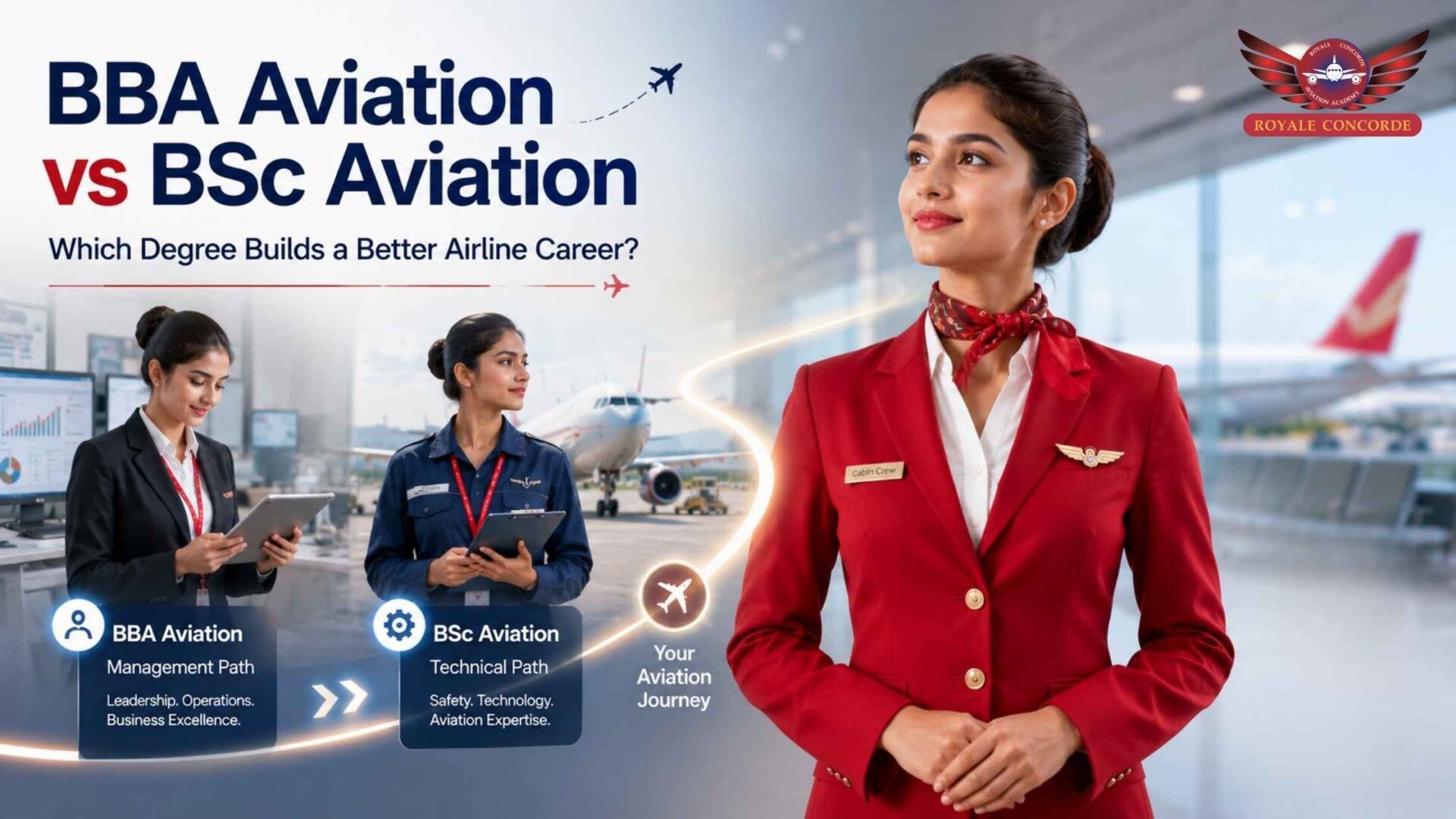
Which is better for an airline career: BBA Aviation or BSc Aviation? The answer depends on your interests, career goals, and the training environment you choose. In this comprehensive guide, we compare bba aviation vs bsc aviation to help you make an informed decision, with expert insights from Royale Concorde Aviation Academy in Bangalore, one of India’s premier aviation training institutes.
The main difference between BBA Aviation and BSc Aviation lies in their academic focus, career outcomes, and skillsets developed during the course:
Both degrees offer unique pathways into the aviation industry, but the right choice depends on whether you are more interested in management and administration (BBA) or technical and operational roles (BSc).
Choosing the right degree starts with understanding your career aspirations:
Royale Concorde Aviation Academy recommends evaluating your strengths, interests, and the kind of work environment you thrive in before deciding.
Both degrees open doors to a wide range of careers, but the specific opportunities and career progression can differ:
| Degree | Typical Career Opportunities |
|---|---|
| BBA Aviation |
|
| BSc Aviation |
|
At Royale Concorde Aviation Academy, our expert counseling helps students match their strengths with the right aviation pathway, ensuring a higher chance of career growth and satisfaction.
Let’s do an aviation degree comparison to highlight the key differences and similarities:
An aviation management degree, such as BBA Aviation, is designed for students who want to handle the business and operational aspects of airlines and airports. It covers:
This degree is ideal for those who want leadership roles and aspire to shape the future of the aviation industry from a management perspective. Royale Concorde Aviation Academy’s industry-aligned BBA Aviation program is structured to meet the latest airline recruitment standards.
BSc aviation career opportunities are ideal for students who have a passion for science and technology, and who wish to work in operational, technical, or flight-related roles. Common career paths include:
Royale Concorde Aviation Academy offers specialized training and mentorship to help BSc Aviation graduates gain a competitive edge in these areas.
The aviation industry demands more than textbook knowledge. At Royale Concorde Aviation Academy, practical training is a core component of both BBA and BSc programs:
This approach ensures students gain confidence, communication skills, and real-time problem-solving ability—critical for success in any airline career.
Royale Concorde Aviation Academy in Bangalore is recognized for its comprehensive approach to aviation education:
Our mission is to create airline-ready professionals who are disciplined, confident, and globally competitive.
Both BBA Aviation and BSc Aviation offer excellent scope, but in different domains. BBA Aviation is better for management and administrative roles, while BSc Aviation is suited for technical and operational positions. The best choice depends on your personal interests and career goals.
BBA Aviation graduates can pursue pilot training (CPL) after graduation, but the BSc Aviation degree may provide more relevant technical knowledge for aspiring pilots. However, both degrees can serve as a foundation for pilot training if followed by the necessary licensing courses.
Both programs typically require completion of 10+2 or equivalent qualification. BSc Aviation may require a science background with Physics and Mathematics, while BBA Aviation is open to students from any stream. Royale Concorde Aviation Academy provides detailed guidance on eligibility and admissions.
Salary depends on the role and airline. Management positions after BBA Aviation can offer high salaries with experience, while technical roles from BSc Aviation (like pilots or safety officers) can also command attractive compensation. Practical skills, professional grooming, and placement support from institutes like Royale Concorde Aviation Academy significantly influence earning potential.
Royale Concorde Aviation Academy is a premier aviation training institute in Bangalore, Karnataka, specializing in cabin crew training, aviation management, airport operations, and aviation hospitality. Founded by Shri L. R. Shivarame Gowda and led by a visionary team of women leaders, the academy is committed to transforming aspiring students into confident, skilled aviation professionals ready to meet global airline standards.
Whether you choose BBA Aviation or BSc Aviation, Royale Concorde Aviation Academy ensures you are fully prepared for a successful and rewarding airline career.
There is no one-size-fits-all answer to the question of bba aviation vs bsc aviation. Both degrees offer unique strengths and career opportunities in the aviation sector. The best degree for you depends on your interest in management versus technical roles, your academic background, and your long-term ambitions. What truly matters is the quality of education, practical exposure, and mentorship you receive—elements that Royale Concorde Aviation Academy excels in delivering.
Begin your journey towards a high-flying airline career by choosing the right aviation degree and the best training environment in Bangalore. For personalized counseling or to know more about our programs, contact Royale Concorde Aviation Academy today.
The primary difference between a BBA Aviation and a BSc Aviation degree lies in their focus areas. BBA Aviation is an aviation management degree that emphasizes business, management, and leadership skills needed in airline and airport operations. In contrast, BSc Aviation is more technical, focusing on the science and technology aspects of aviation, including navigation, meteorology, and aircraft systems. Your choice depends on whether you want to build a managerial or a technical career in the aviation sector.
Both degrees offer strong career prospects, but the best choice depends on your interests. BBA Aviation graduates are often preferred for roles in airline management, airport operations, and customer service management. Meanwhile, BSc Aviation career opportunities include positions like flight operations analyst, air traffic controller, or aircraft maintenance planning. Reviewing an aviation degree comparison can help you determine which path aligns best with your career goals.
Royale Concorde Aviation provides personalized counseling and detailed guidance on the bba aviation vs bsc aviation decision. Our experienced mentors help you understand the curriculum, career outcomes, and industry requirements for each program, ensuring you choose the degree that best fits your aspirations in the aviation industry.
Yes, the curriculum for each degree is tailored to its focus area. The BBA Aviation program at Royale Concorde Aviation covers airline business management, airport operations, marketing, and aviation law. The BSc Aviation program delves into technical subjects like aerodynamics, meteorology, aircraft systems, and navigation. This aviation degree comparison ensures that students acquire the skills and knowledge relevant to their chosen career path.
BSc aviation career opportunities include roles like flight operations officer, air traffic controller, aviation safety analyst, and technical support in airlines and airports. Graduates may also pursue advanced pilot training, aircraft maintenance, or continue with postgraduate studies in aviation science and technology.
Pursuing an aviation management degree from Royale Concorde Aviation gives you access to industry-relevant curriculum, hands-on training, internships, and strong placement support. The program is designed to develop leadership, communication, and analytical skills, preparing you for diverse roles in the management and administration of airlines and airports.
Royale Concorde Aviation has a dedicated placement cell that partners with leading airlines, airports, and aviation service providers. Students receive career counseling, soft skills training, and interview preparation. This support ensures a smooth transition from academic life to professional roles in the aviation industry.
While each program has its unique curriculum, Royale Concorde Aviation offers guidance and academic support for students who wish to switch tracks early in their studies. Our counselors help evaluate your academic progress and assist in making a smooth transition, should your career interests evolve.
Royale Concorde Aviation stands out due to its industry-oriented curriculum, experienced faculty, modern training facilities, and strong industry connections. We focus on holistic development, practical exposure, and continuous mentorship to help students excel, whether they pursue a management or technical aviation career.
Royale Concorde Aviation Academy goes beyond just training. we inspire passion and confidence in students to reach their full potential.
Let’s connect and create something remarkable together.
Copyright © Royale Concorde Aviation. All Rights Reserved. Run by Widepool.