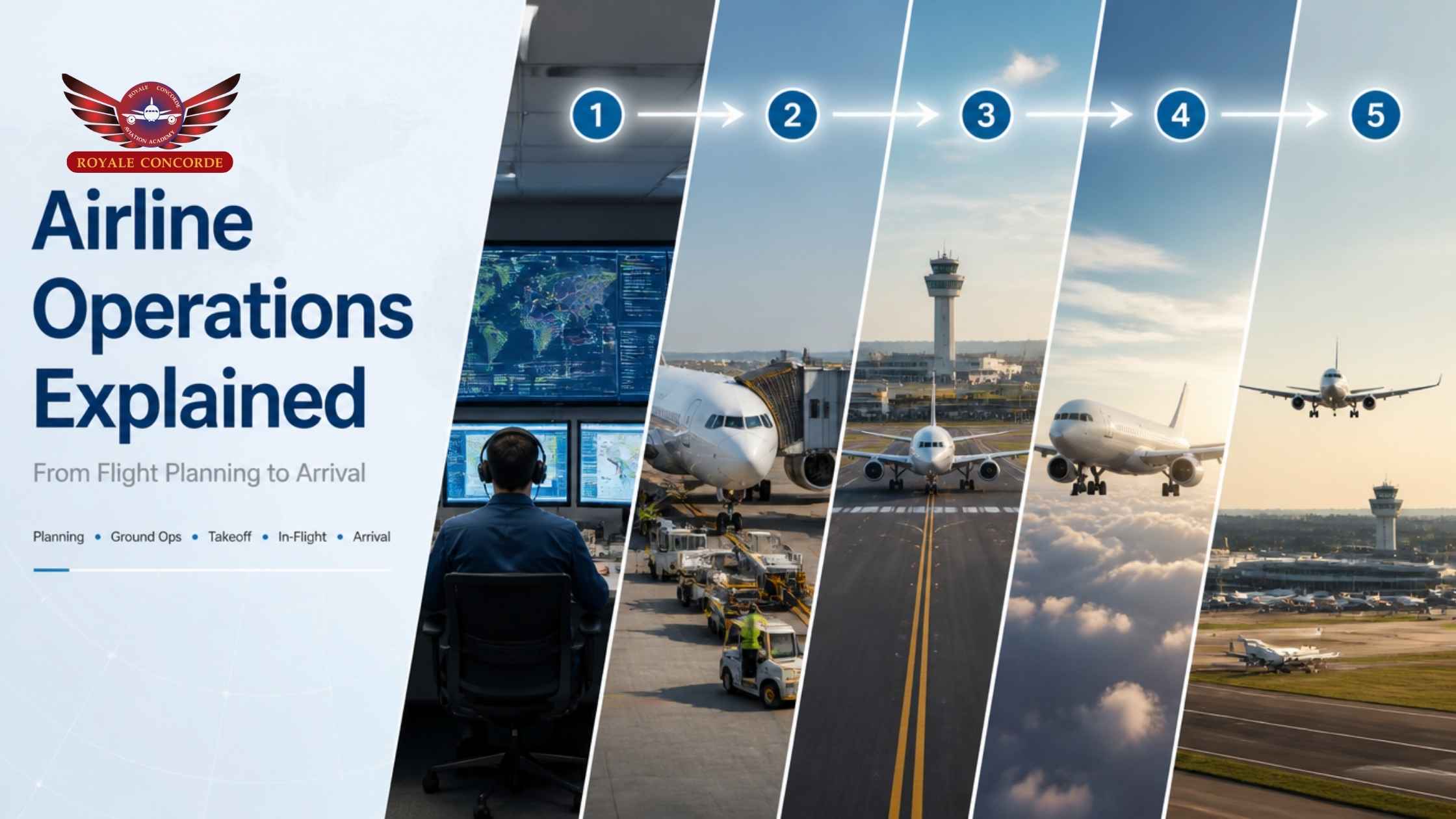
How do airlines operate flights seamlessly from planning through arrival? Airline operations are a coordinated set of processes—spanning flight planning, aircraft operations, and ground support—that ensure safe, efficient, and reliable air travel. At Royale Concorde Aviation Academy in Bangalore, we prepare aspiring professionals to master these complex systems, opening the door to successful aviation careers.
What are airline operations and why are they vital to aviation?
Airline operations encompass all activities involved in running airline flights—from initial planning to the safe arrival of passengers and cargo at their destination. This multifaceted process brings together airline management, operational staff, technology, and regulatory compliance to deliver a seamless travel experience.
- Ensures passenger safety and comfort
- Optimizes flight schedules and resource use
- Coordinates between departments (flight crew, ground staff, air traffic control, etc.)
- Manages disruptions, emergencies, and efficiency targets
At Royale Concorde Aviation Academy, we explain airline operations in detail, preparing students for roles across airline flight operations, airport management, and aviation hospitality.
How does flight planning set the foundation for every airline journey?
Flight planning is the first critical step in airline operations. It involves charting a safe, efficient, and cost-effective route for the aircraft, factoring in weather, airspace restrictions, fuel requirements, aircraft performance, and regulatory guidelines.
- Route selection: Choosing the safest and most efficient path between origin and destination
- Weather analysis: Assessing meteorological data to avoid hazards and turbulence
- Fuel calculation: Ensuring sufficient fuel for the journey, including reserves for contingencies
- Weight and balance: Confirming payload distribution for optimal aircraft performance
- Regulatory compliance: Meeting all aviation authority requirements, such as NOTAMs and airspace permissions
Airline flight operations teams, including dispatchers and pilots, collaborate closely during this phase. At Royale Concorde Aviation Academy, students receive hands-on training in professional flight planning, equipping them for real-world airline environments.
What is involved in airline flight operations and aircraft operations?
Airline flight operations and aircraft operations are integral to getting every flight off the ground safely and on time. These functions include:
- Pre-flight checks: Aircraft inspections, systems tests, and documentation reviews by pilots and engineers.
- Crew briefing: Pilots and cabin crew are briefed on weather, route, passenger details, and special requirements.
- Boarding and loading: Airline staff coordinate passenger boarding, baggage handling, and cargo loading to maintain safety and efficiency.
- Pushback and taxi: Ground control and ramp staff direct the aircraft for departure.
- Take-off and en-route management: Pilots, supported by air traffic control, monitor navigation, fuel, and in-flight safety.
These steps require specialized skills and teamwork. Our academy’s curriculum covers each aspect, blending theory with simulation-based training.
How do aviation operations teams ensure safety and service in the air?
Once airborne, aviation operations focus on maintaining safety, compliance, and passenger experience. This includes:
- Continuous communication with air traffic control
- Monitoring weather and route adjustments
- Managing in-flight emergencies or medical needs
- Delivering exemplary in-flight service and hospitality
- Preparing for approach and landing
At Royale Concorde Aviation Academy, our training emphasizes both technical procedures and the interpersonal skills needed to excel in aviation operations.
What happens during flight arrival and post-flight processes?
Flight arrival is more than just touchdown—it’s a coordinated effort involving pilots, cabin crew, and ground teams to ensure a smooth transition for passengers and aircraft. The key steps include:
- Landing and taxi: Pilots coordinate with air traffic control for a safe landing and guidance to the gate.
- Disembarkation: Cabin crew assist passengers, while ground staff handle baggage and cargo unloading.
- Turnaround operations: Aircraft is cleaned, serviced, and prepared for its next flight, involving maintenance checks and refueling.
- Reporting: Pilots and crew debrief, noting any issues or irregularities for airline management and maintenance teams.
Efficient flight arrival procedures are crucial for maintaining airline schedules and safety standards.
Who are the key airline staff involved in successful airline operations?
The success of airline operations depends on a diverse team of professionals, each contributing specialized expertise:
| Role | Main Responsibilities |
|---|---|
| Pilots & First Officers | Flight planning, navigation, in-flight safety, emergency management |
| Cabin Crew | Passenger safety, in-flight service, emergency response |
| Flight Dispatchers | Flight planning, weather monitoring, regulatory compliance |
| Ground Staff | Boarding, baggage handling, aircraft turnaround |
| Maintenance Technicians | Aircraft inspections, repairs, safety checks |
| Airline Management | Strategic decision-making, operations oversight, resource allocation |
At Royale Concorde Aviation Academy, students learn about these roles through industry-aligned training, mentorship, and practical exposure.
How does airline management drive operational excellence?
Airline management forms the backbone of efficient airline operations. Management teams oversee:
- Strategic planning and scheduling
- Resource and crew allocation
- Regulatory compliance and safety standards
- Customer service policies
- Emergency preparedness and disruption management
Effective management ensures that every department works in harmony, directly impacting an airline’s reputation, profitability, and passenger satisfaction. At Royale Concorde Aviation Academy, our curriculum includes modules on airline management, preparing students for leadership roles in aviation.
What career opportunities exist in airline operations for aspiring professionals?
The growth of India’s aviation sector, especially in hubs like Bangalore, has created a wealth of career opportunities in airline operations. Graduates from Royale Concorde Aviation Academy are well-positioned for roles such as:
- Cabin crew and flight attendant
- Flight dispatcher or operations executive
- Airport ground staff and terminal operations
- Aviation safety and emergency response specialist
- Customer service and aviation hospitality professional
- Roles in airline management and administration
These careers offer progression, international exposure, and the chance to be part of a dynamic, people-driven industry.
Why choose Royale Concorde Aviation Academy for a career in airline operations?
Royale Concorde Aviation Academy is a premier aviation training institute based in Bangalore, Karnataka. With a vision of global excellence and a mission to empower aspiring professionals, the academy offers:
- Industry-relevant curriculum for airline and airport operations
- Hands-on training in simulated aircraft and emergency scenarios
- Expert faculty with real airline and aviation experience
- Comprehensive programs in cabin crew, ground handling, hospitality, and management
- Personality development, communication, and grooming modules
- Career guidance and placement support
Founded by Shri L. R. Shivarame Gowda and led by visionary women mentors, Royale Concorde Aviation Academy stands out for its holistic approach and commitment to student success.
Frequently asked questions about airline operations
What skills are required for a successful career in airline operations?
Key skills include strong communication, teamwork, problem-solving, attention to detail, and the ability to remain calm under pressure. Technical knowledge, regulatory awareness, and customer service orientation are also crucial.
How does Royale Concorde Aviation Academy prepare students for airline operations?
The academy combines classroom learning with hands-on simulations, industry mentoring, and career readiness modules. Students gain exposure to real-world airline scenarios, interview preparation, and professional grooming.
What are the eligibility requirements for enrolling in aviation training programs?
Most programs require completion of 10+2 or equivalent, good communication skills, professional appearance, and fitness standards. Age and specific criteria may vary by course.
Why is Bangalore an ideal location for aviation training?
Bangalore is a major aviation and technology hub with excellent connectivity and a vibrant aviation ecosystem, offering ample career opportunities for aviation graduates.
About Royale Concorde Aviation Academy
Royale Concorde Aviation Academy is a leading, women-led aviation training institute in Bangalore, India. Specializing in cabin crew training, airline operations, and aviation hospitality, the academy combines world-class education, practical training, and professional mentoring to prepare students for global careers in aviation. With a focus on employability, confidence building, and industry alignment, Royale Concorde Aviation Academy stands as a beacon for aspiring airline professionals in India.
- Location: Bangalore, Karnataka, India
- Contact: +91 7204805777 / +91 7204806777
- Email: mail@royaleconcordeaviation.com
- Website: royaleconcordeaviation.com
-
Follow us:
Facebook |
Instagram |
X |
YouTube
Frequently Asked Questions
What are the key stages of airline operations from flight planning to arrival?
Airline operations involve several critical stages that ensure a safe and efficient journey. These include detailed flight planning, pre-flight checks, coordination with air traffic control, onboard procedures, enroute monitoring, and post-flight activities upon flight arrival. Each phase is managed by specialized airline staff and overseen by robust airline management systems. Royale Concorde Aviation provides integrated solutions that streamline these processes for seamless airline flight operations.
How does Royale Concorde Aviation support flight planning for airlines?
Royale Concorde Aviation offers advanced digital tools and expert consultancy that simplify the flight planning process. Their solutions include route optimization, weather analysis, fuel calculation, and regulatory compliance checks, ensuring that every aspect of flight planning is thorough and efficient. This proactive approach reduces delays and enhances the safety and reliability of airline operations.
What distinguishes airline flight operations from general aircraft operations?
Airline flight operations focus on the commercial aspects of scheduled passenger and cargo flights, involving complex coordination between multiple teams, strict adherence to timetables, and compliance with regulatory bodies. General aircraft operations can include private, charter, or cargo-only flights with different regulatory and operational needs. Royale Concorde Aviation tailors its services to match the unique requirements of both, ensuring smooth aviation operations across all sectors.
Who are the key airline staff involved in managing a flight?
Key airline staff include flight dispatchers, pilots, cabin crew, ground handlers, operations controllers, and maintenance teams. Each plays a vital role in ensuring flight safety, punctuality, and passenger comfort. Royale Concorde Aviation provides training, support systems, and technology solutions that empower airline staff at every step of the operational chain.
How does technology enhance airline operations explained?
Technology streamlines every aspect of airline operations, from real-time data sharing and automated scheduling to predictive maintenance and digital communication platforms. Royale Concorde Aviation leverages the latest in aviation technology to provide end-to-end visibility and control, enhancing decision-making and operational efficiency for clients seeking a clear understanding of airline operations explained in practical terms.
What solutions does Royale Concorde Aviation offer for improving flight arrival and turnaround times?
Royale Concorde Aviation delivers integrated turnaround management solutions, including ground support coordination, automated alerts, and real-time status updates. These tools help minimize ground delays and ensure that every flight arrival is managed efficiently, reducing costs and improving passenger satisfaction.
How does Royale Concorde Aviation contribute to effective airline management?
Royale Concorde Aviation supports airline management by providing comprehensive analytics, compliance monitoring, and strategic planning services. Their platforms enable managers to oversee operations holistically, manage resources efficiently, and respond proactively to disruptions, ultimately enhancing the overall performance of airline operations.
What role does safety play in aviation operations, and how is it maintained?
Safety is the foundation of all aviation operations, encompassing rigorous standards for maintenance, crew training, compliance, and emergency response. Royale Concorde Aviation integrates safety management systems and continuous monitoring tools to help airlines maintain the highest safety standards throughout every phase of aircraft operations.
Can Royale Concorde Aviation customize solutions for specific airline needs?
Absolutely. Royale Concorde Aviation works closely with each client to assess their operational challenges, regulatory environment, and business objectives. They develop bespoke solutions—whether it’s optimizing flight planning, enhancing communication among airline staff, or upgrading airline management systems—to meet unique requirements and drive operational excellence.