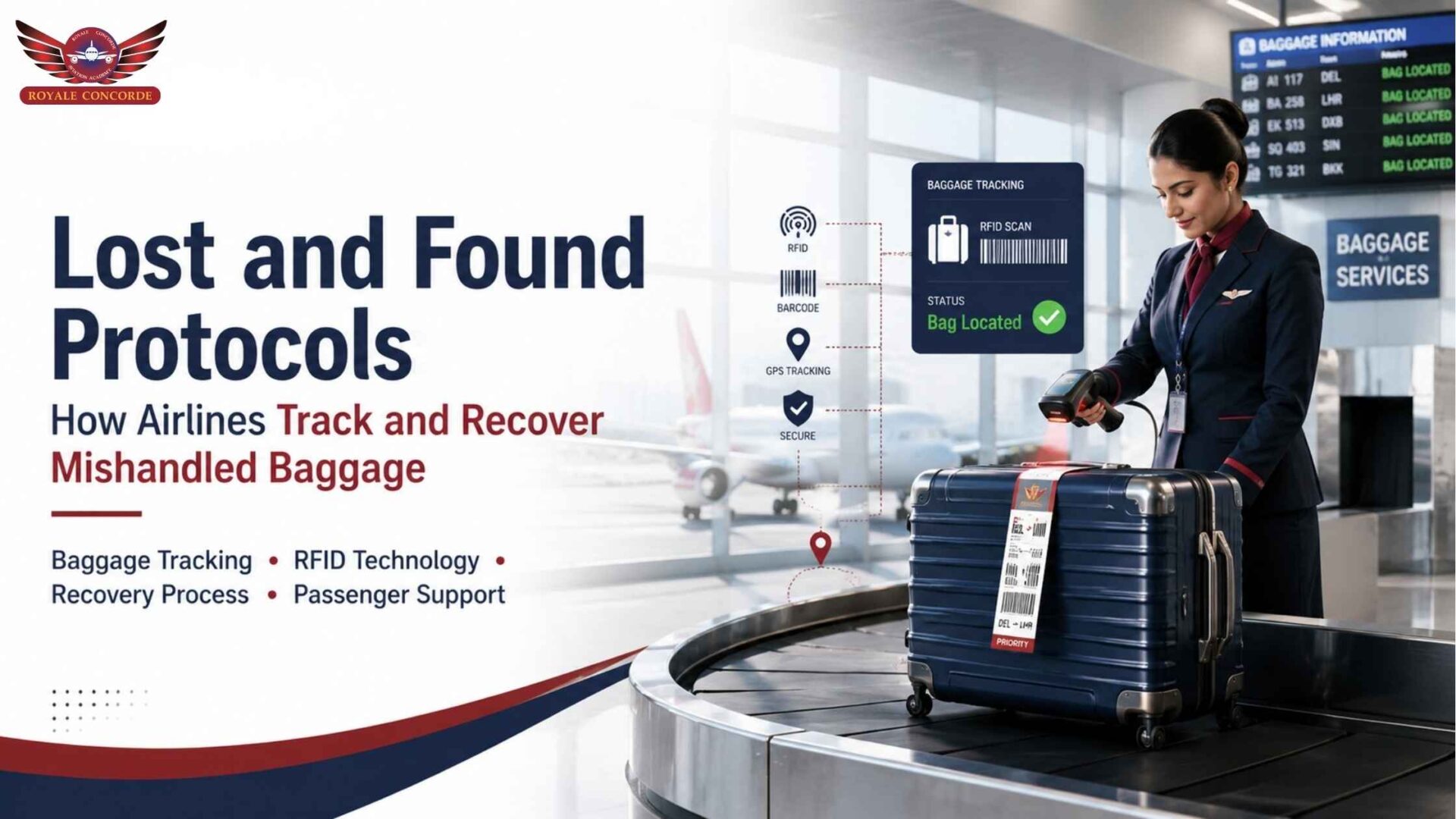
How do airlines track and recover lost baggage, and what protocols ensure passengers are reunited with their belongings? The answer lies in a robust combination of airline lost and found protocol, advanced baggage tracing processes, and global technology systems such as WorldTracer, all of which are critical to modern airline operations. At Royale Concorde Aviation Academy in Bangalore, students are equipped with in-depth knowledge and practical skills to excel in these essential airline baggage services, setting the foundation for impactful careers in aviation ground operations and passenger support.
What is airline lost and found protocol and why is it important?
Airline lost and found protocol refers to the standardized set of procedures airlines use to identify, trace, recover, and return mishandled or lost baggage to passengers. This protocol is vital for maintaining passenger trust, regulatory compliance, and operational efficiency in the aviation industry. At Royale Concorde Aviation Academy, trainees learn the step-by-step methodologies used globally, ensuring that every lost baggage incident is managed with professionalism, empathy, and precision.
- Immediate registration: As soon as a baggage irregularity is reported, staff initiate a formal report and log the complaint into a centralized system.
- Data collection: Precise details about the baggage (color, brand, tags, contents) and passenger journey are recorded.
- Initiation of tracing: The WorldTracer system and other global databases are accessed to begin locating the bag.
- Continuous updates: Passengers are regularly informed about search progress as per best practices in passenger complaint handling.
- Resolution and compensation: Once baggage is found, it is returned or delivered; if not, further steps for compensation are initiated as per airline policy.
How does the baggage tracing process work in modern airlines?
The baggage tracing process is a systematic approach to locating and retrieving mishandled luggage, relying on data integration, communication, and real-time technology. At Royale Concorde Aviation Academy, students learn the end-to-end workflow, from the initial passenger complaint to the final delivery of luggage. The steps include:
- Incident Reporting: Passenger notifies airline staff at the destination or via digital channels.
- Record Creation: All relevant baggage and passenger data are captured for accurate identification.
- Database Search: The bag’s details are entered into the WorldTracer system, which cross-references global lost and found records.
- Physical Search: Staff check storage areas, transit points, and unclaimed baggage rooms.
- Inter-Airline Coordination: If the passenger’s journey involved multiple carriers, all relevant airlines collaborate to trace the bag.
- Recovery and Delivery: Once found, the bag is dispatched to the passenger’s address or made available for collection.
This efficient baggage tracing process minimizes inconvenience and enhances the passenger experience, an area of expertise for Royale Concorde Aviation Academy graduates.
What is the WorldTracer system and why is it crucial for lost luggage tracking?
The WorldTracer system is a global baggage tracing platform developed by SITA, used by over 2,000 airports and nearly all major airlines to track and recover lost luggage. It facilitates the sharing of baggage information across airlines and airports, enabling rapid identification and return of bags worldwide.
- Centralized database: All mishandled baggage records are accessible to authorized airline staff globally.
- Real-time status updates: Passengers can check their baggage status online using a unique reference number.
- Automation & alerts: The system notifies staff when a bag matching the description is found anywhere in the network.
- Efficiency: Significantly reduces the time taken to reunite passengers with their belongings.
Royale Concorde Aviation Academy’s training covers hands-on use of the WorldTracer system, preparing students for real-world airline and airport ground operations.
How do airlines manage lost luggage tracking and passenger expectations?
Lost luggage tracking combines technology, communication, and customer service to ensure passengers are kept informed and reassured throughout the process. At Royale Concorde Aviation Academy, future aviation professionals are trained to:
- Log and track every incident with precision.
- Use the WorldTracer system for status checks and tracing updates.
- Maintain proactive communication with passengers to manage expectations.
- Coordinate with airport and airline baggage services for swift resolution.
This holistic approach not only recovers lost items but also mitigates passenger frustration and upholds the airline’s reputation.
What are the roles and responsibilities in airline baggage services?
Airline baggage services include specialized teams dedicated to managing baggage logistics, customer interactions, and lost and found operations. Royale Concorde Aviation Academy integrates these roles into its curriculum, emphasizing:
- Baggage handlers: Ensure proper loading, unloading, and transfer of baggage.
- Baggage tracing officers: Manage the end-to-end tracing process and system updates.
- Customer service executives: Handle passenger queries, complaints, and compensation claims.
- Supervisors: Oversee protocol adherence, team efficiency, and reporting accuracy.
| Role | Key Responsibilities |
|---|---|
| Baggage Handler | Physical movement, sorting, and safeguarding of baggage |
| Baggage Tracing Officer | Investigation, documentation, and use of tracing systems |
| Customer Service Executive | Passenger support, communication, complaint resolution |
| Supervisor | Protocol compliance, training, and operational reporting |
How do airlines excel at passenger complaint handling in baggage issues?
Effective passenger complaint handling is essential for customer satisfaction and airline credibility. At Royale Concorde Aviation Academy, students are trained in empathetic communication, clear explanation of protocols, and timely follow-up. The complaint handling process typically includes:
- Listening attentively to the passenger’s concern.
- Documenting details thoroughly and accurately.
- Explaining the baggage tracing process and expected timelines.
- Providing regular updates using the WorldTracer system or other tools.
- Offering compensation or alternatives if recovery is delayed or unsuccessful.
Professional complaint handling transforms difficult situations into opportunities for positive brand engagement.
Why choose Royale Concorde Aviation Academy for a career in airline baggage services?
Royale Concorde Aviation Academy in Bangalore is a premier institution specializing in aviation education, including airline lost and found protocol, baggage tracing, and passenger support services. Here’s what sets RCAA apart:
- Practical training: Simulated lost and found scenarios and hands-on use of tracing systems.
- Industry interface: Exposure to real-world airline operations and guest lectures from aviation professionals.
- Career guidance: Interview preparation, personality development, and communication skills tailored for baggage services roles.
- Placement support: Strong industry connections ensuring high employability for graduates in airline baggage services, ground operations, and customer support.
Frequently asked questions about airline lost and found protocol
What should I do if my baggage is missing after a flight?
Report the issue immediately at the airline’s lost and found desk or online portal. Provide a detailed description of your bag and request a reference number for tracking. Airlines will initiate their baggage tracing process and keep you informed.
How long does it usually take to recover lost luggage?
Most mishandled bags are found and returned within 24-72 hours. The timeline can vary depending on the airline, route, and circumstances. The WorldTracer system accelerates this process by connecting global baggage databases.
Will I get compensation if my bag is not found?
If your bag is declared lost after all tracing efforts, airlines typically offer compensation as per international conventions and their internal policies. Keep receipts for valuables and file all necessary documentation to support your claim.
Can I track my lost luggage online?
Yes, most airlines provide online tracking through the WorldTracer system or their own portals. Use the reference number given at the time of reporting to check status updates.
About Royale Concorde Aviation Academy
Royale Concorde Aviation Academy is a leading aviation training institute based in Bangalore, Karnataka, recognized for its excellence in producing skilled aviation professionals. The academy offers industry-aligned programs in cabin crew training, airline ground operations, aviation hospitality, and airport services. With a curriculum focused on practical exposure, professional grooming, and real-world readiness, RCAA prepares students for successful careers in the dynamic aviation sector.
- Location: Bangalore, Karnataka
- Contact: +91 7204805777 / +91 7204806777
- Email: mail@royaleconcordeaviation.com
- Website: https://royaleconcordeaviation.com/
-
Social:
Facebook |
Instagram |
X |
YouTube
Royale Concorde Aviation Academy: Your trusted partner for world-class aviation education and professional excellence in India.
Frequently Asked Questions
What is the standard airline lost and found protocol for mishandled baggage?
The standard airline lost and found protocol involves a systematic process where reported lost items or baggage are logged, tracked, and matched with found property. Airlines initiate the process as soon as a passenger reports a missing bag, creating a record and sharing details across various airport and airline networks. These protocols ensure that every reasonable effort is made to locate, identify, and return baggage to its rightful owner. Royale Concorde Aviation further enhances this process by integrating advanced tracking and proactive communication to maximize recovery rates and minimize passenger inconvenience.
How does the baggage tracing process work after reporting lost luggage?
Once a passenger reports lost luggage, the baggage tracing process begins with the collection of detailed information such as bag description, tags, and last known location. This information is entered into a global tracking system, often the WorldTracer system, to match lost items with found baggage worldwide. Royale Concorde Aviation assists by coordinating with airline baggage services and leveraging real-time data feeds, expediting the search, and keeping passengers updated throughout the tracing journey until the bag is recovered or declared irretrievable.
What is the WorldTracer system and how does it help in lost luggage tracking?
The WorldTracer system is an internationally adopted platform used by airlines and airports to track and recover mishandled baggage. It allows for the entry, sharing, and matching of lost and found reports across more than 2,800 locations globally. This system dramatically improves lost luggage tracking by enabling real-time searches and updates. Royale Concorde Aviation is fully integrated with WorldTracer, allowing us to provide timely status notifications and accelerate the reunification process for our clients.
How do airline baggage services coordinate to locate and return lost items?
Airline baggage services collaborate by sharing information, using standardized tracking systems, and maintaining open channels of communication with airport staff and other airlines. Once a lost item is reported, these services cross-reference databases, inspect physical storage areas, and use technology like barcodes and RFID for efficient searches. Royale Concorde Aviation partners closely with airline baggage services, offering dedicated support teams and advanced digital tools to streamline the recovery and return of lost property.
What should passengers do immediately after discovering their baggage is missing?
Passengers should immediately report the missing baggage at the airline’s lost and found or baggage service desk before leaving the airport. Provide all relevant details such as baggage tags, descriptions, and flight information. Early reporting ensures the baggage tracing process can start as soon as possible. Royale Concorde Aviation can assist passengers during this process, offering guidance and managing communications with the airline to expedite resolution.
How does Royale Concorde Aviation improve passenger complaint handling for lost baggage?
Royale Concorde Aviation adopts a proactive approach to passenger complaint handling by offering a dedicated support channel for lost baggage claims. Our team acts as a liaison between the passenger and the airline, ensuring all necessary documentation is submitted and updates are provided regularly. We prioritize customer satisfaction by resolving issues swiftly, providing transparency, and advocating for fair compensation or solutions when baggage cannot be recovered.
What solutions does Royale Concorde Aviation offer to prevent baggage mishandling?
Royale Concorde Aviation employs a combination of advanced baggage tracking technology, enhanced communication protocols, and staff training to minimize the risk of mishandling. We utilize digital tagging, real-time notifications, and predictive analytics to identify and correct issues before bags go missing. Our integrated platform ensures seamless coordination with airline baggage services, reducing the chances of loss and improving overall passenger experience.
Can passengers track the status of their lost luggage in real time?
Yes, with the integration of the WorldTracer system and Royale Concorde Aviation’s customer portal, passengers can monitor the progress of their lost luggage tracking in real time. Status updates, location information, and estimated recovery timelines are available through our digital interface, providing peace of mind and reducing uncertainty during the wait for lost items.
How long does it usually take to recover lost baggage, and what if it is not found?
Recovery times for lost baggage can vary from a few hours to several days, depending on the complexity of the case and international transfers. Most bags are located within 72 hours. If baggage is not found within 21 days, it is typically considered lost and compensation procedures are initiated. Royale Concorde Aviation supports clients throughout this period, managing follow-ups and ensuring that all avenues for recovery or reimbursement are explored.