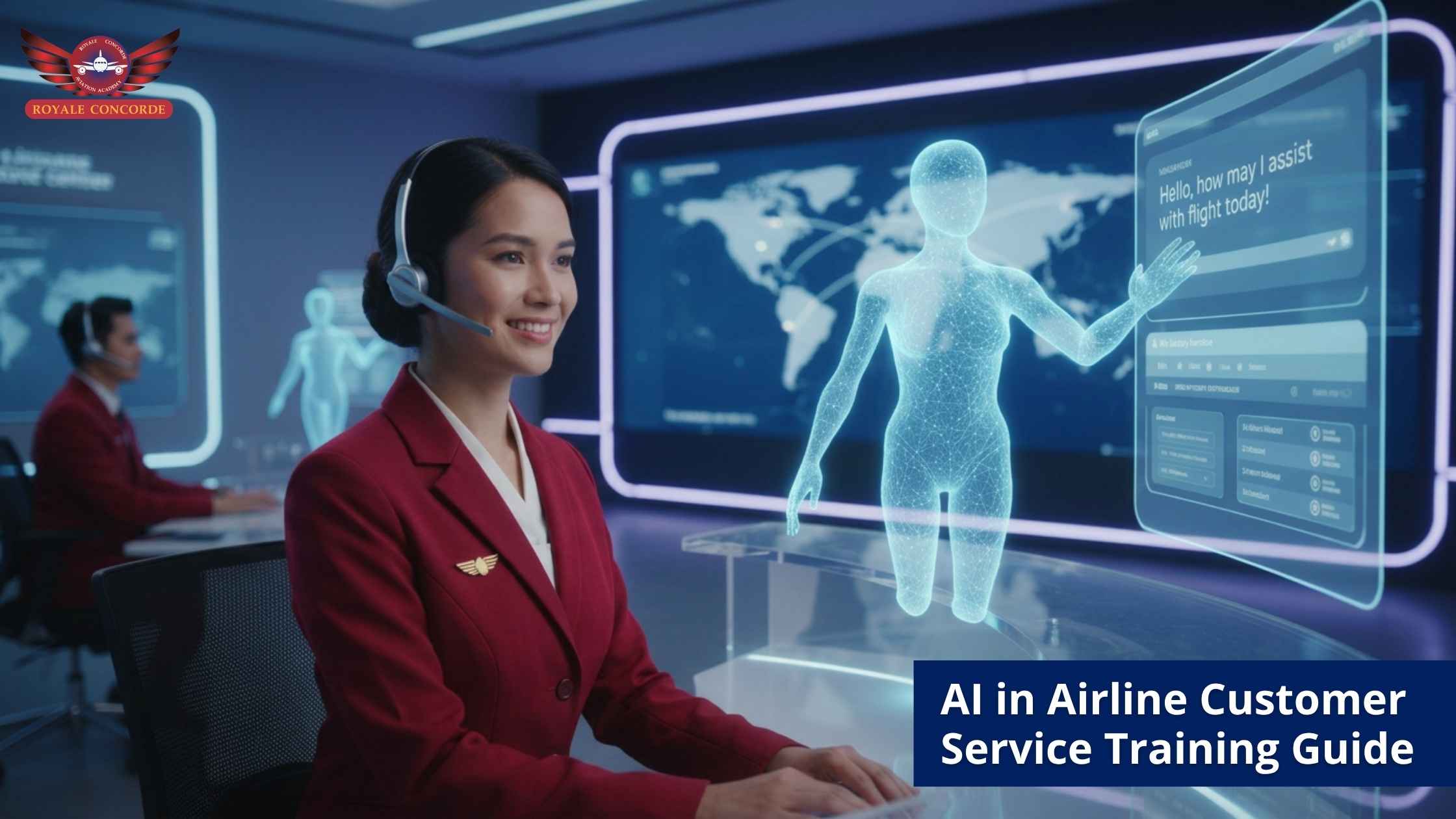
AI in airline customer service training guide explains how artificial intelligence is transforming the way airlines train their customer service teams—making learning faster, more personalized, and aligned with real-world passenger expectations. This transformation is especially critical in an industry where service quality directly impacts brand reputation and passenger loyalty.
At Royale Concorde Aviation Academy (RCAA), a premier aviation training institute in Bangalore, the integration of AI-powered methodologies ensures that aspiring aviation professionals are prepared for the evolving demands of global airlines. With a focus on practical exposure, simulation-based learning, and digital transformation, RCAA is redefining how aviation professionals are trained for excellence.
What is AI in aviation industry and why does it matter?
AI in aviation industry refers to the use of machine learning, automation, and data-driven systems to enhance operations, passenger experience, and workforce training. In customer service training, AI enables realistic simulations, instant feedback, and adaptive learning paths.
In today’s competitive aviation landscape, airlines expect professionals who can handle dynamic passenger interactions, cultural diversity, and high-pressure situations. AI bridges the gap between theoretical learning and real-world application.
- Enhances training efficiency through automation
- Provides real-time performance insights
- Simulates real passenger scenarios
- Improves decision-making skills
- Supports multilingual and global service standards
How do AI tools for airline customer service training improve learning outcomes?
AI tools for airline customer service training create immersive and adaptive learning environments that mimic real airline scenarios. These tools help trainees develop both technical knowledge and interpersonal skills required for aviation roles.
At Royale Concorde Aviation Academy, these tools are integrated into structured modules that include cabin crew training, airport operations, and aviation hospitality.
Key benefits of AI-driven training
- Personalized learning: AI adapts content based on student performance
- Scenario-based simulations: Realistic passenger interactions
- Instant feedback: Improves learning speed and retention
- Performance tracking: Identifies strengths and improvement areas
- Scalability: Enables consistent training across batches
What are aviation AI tools 2026 trends shaping training?
aviation AI tools 2026 are expected to bring advanced capabilities such as emotional intelligence analysis, voice recognition training, and predictive performance modeling. These innovations will redefine how aviation professionals are groomed for global roles.
RCAA stays ahead of these trends by continuously updating its curriculum to align with industry advancements and airline expectations.
Emerging trends in aviation AI training
- AI-powered virtual trainers and assistants
- Voice and speech analysis for communication skills
- Emotion detection for passenger interaction training
- Predictive analytics for performance improvement
- Augmented reality (AR) and virtual reality (VR) simulations
How does airline chatbot training prepare students for real-world scenarios?
airline chatbot training enables students to interact with AI-driven systems that simulate passenger queries, complaints, and service requests. This prepares them for real-time customer engagement across digital platforms.
At Royale Concorde Aviation Academy, chatbot-based simulations are integrated into customer service modules, allowing students to practice handling various passenger scenarios.
Applications of chatbot training
- Handling booking inquiries and cancellations
- Managing passenger complaints
- Providing travel information and updates
- Practicing multilingual communication
- Improving response time and accuracy
What is digital customer service aviation and why is it important?
digital customer service aviation refers to delivering passenger support through digital channels such as mobile apps, chatbots, and automated systems. Airlines increasingly rely on digital interfaces, making it essential for professionals to be trained in these platforms.
RCAA ensures that students are equipped with digital service skills alongside traditional customer service training.
Core components of digital aviation service
| Component | Description |
|---|---|
| Mobile customer support | Handling passenger queries via apps |
| Chatbot interactions | Automated responses and assistance |
| Social media engagement | Managing airline reputation online |
| Self-service kiosks | Assisting passengers with automated systems |
How do airline automation tools enhance training efficiency?
airline automation tools streamline training processes by automating assessments, tracking progress, and delivering standardized learning experiences. These tools reduce manual intervention and improve training consistency.
At Royale Concorde Aviation Academy, automation tools are used to simulate operational workflows, enabling students to understand real airline systems.
Advantages of automation in training
- Reduces training time
- Ensures consistent quality
- Improves accuracy in assessments
- Enhances scalability
- Supports data-driven decision making
What is aviation soft skills AI and how does it shape professionals?
aviation soft skills AI focuses on developing interpersonal skills such as communication, empathy, and professionalism using AI-driven analysis and feedback systems.
Royale Concorde Aviation Academy emphasizes soft skills as a critical component of aviation training, ensuring students are not only technically proficient but also emotionally intelligent.
Soft skills enhanced by AI
- Communication and language proficiency
- Emotional intelligence
- Conflict resolution
- Customer empathy
- Professional etiquette
How does Royale Concorde Aviation Academy integrate AI into training?
Royale Concorde Aviation Academy integrates AI across its training programs to create airline-ready professionals. The academy combines classroom learning with simulation-based training, ensuring students gain practical exposure.
AI integration across programs
- Cabin crew training with AI simulations
- Airport ground operations training with automation tools
- Personality development with AI-driven feedback
- Emergency response training using predictive simulations
- Interview preparation using AI mock assessments
What career opportunities are enhanced by AI training?
AI-driven training opens doors to a wide range of aviation careers by equipping students with industry-relevant skills.
- Cabin Crew / Flight Attendant
- Airline Customer Service Executive
- Airport Ground Staff
- Aviation Hospitality Professional
- Travel and Tourism Roles
About Royale Concorde Aviation Academy
Royale Concorde Aviation Academy is a premier aviation training institute based in Bangalore, Karnataka, specializing in cabin crew training, aviation hospitality, and airport operations. Founded by Shri L. R. Shivarame Gowda, the academy focuses on delivering industry-relevant training with a strong emphasis on practical exposure, personality development, and career readiness.
With state-of-the-art facilities, including simulated aircraft cabins and AI-enabled training modules, RCAA prepares students for successful careers in domestic and international airlines.
Contact Information:
Phone: +91 7204805777 / +91 7204806777
Email: mail@royaleconcordeaviation.com
Location: Bangalore, Karnataka, India
Frequently Asked Questions
What is the role of AI tools for airline customer service training in modern aviation?
AI tools for airline customer service training are transforming how airline professionals are trained by introducing real-time simulations, intelligent feedback systems, and adaptive learning paths. These tools allow trainees to practice handling passenger interactions, disruptions, and service recovery scenarios in a controlled yet realistic digital environment.
At Royale Concorde Aviation, these systems are integrated into training modules to ensure that learners not only understand theoretical concepts but also develop practical, job-ready skills aligned with evolving passenger expectations.
How do aviation AI tools 2026 differ from traditional training methods?
aviation AI tools 2026 bring a significant shift from static, classroom-based learning to dynamic, data-driven training experiences. Unlike traditional methods, these tools analyze learner behavior, personalize training content, and provide instant feedback.
Royale Concorde Aviation leverages these advancements to create immersive training environments where students can repeatedly practice complex service scenarios, ensuring higher retention and improved performance in real-world airline operations.
What is airline chatbot training and why is it important?
airline chatbot training focuses on teaching future aviation professionals how to interact with, manage, and optimize AI-powered chatbots used in customer service. These chatbots handle tasks such as booking assistance, flight updates, and passenger queries.
By incorporating airline chatbot training into its curriculum, Royale Concorde Aviation ensures that students are equipped to work alongside automated systems, enhancing efficiency while maintaining a human touch in customer interactions.
How is AI in aviation industry improving customer service standards?
AI in aviation industry is enabling airlines to deliver faster, more personalized, and consistent customer service. From predictive analytics to automated communication systems, AI helps anticipate passenger needs and resolve issues proactively.
Royale Concorde Aviation incorporates these concepts into training programs, preparing students to understand and utilize AI-driven insights to enhance passenger satisfaction and operational efficiency.
What is digital customer service aviation and how is it taught?
digital customer service aviation refers to delivering passenger support through digital platforms such as mobile apps, chat systems, and automated kiosks. It emphasizes speed, accessibility, and seamless communication across channels.
At Royale Concorde Aviation, students are trained using real-world simulations and AI-driven tools to handle digital interactions effectively, ensuring they can meet the expectations of tech-savvy travelers.
How do airline automation tools enhance training outcomes?
airline automation tools streamline repetitive processes such as passenger communication, ticketing, and service workflows. In training, these tools help learners understand system operations and improve efficiency in handling high-volume customer interactions.
Royale Concorde Aviation integrates these tools into practical modules, allowing students to gain hands-on experience with industry-relevant systems and workflows.
Can AI replace human interaction in airline customer service?
While AI enhances efficiency and handles routine queries, it cannot fully replace the emotional intelligence and empathy required in complex passenger interactions. Instead, AI works alongside human agents to improve overall service quality.
Royale Concorde Aviation focuses on balancing technology with human skills, ensuring that students are proficient in both AI systems and interpersonal communication.
What is the importance of aviation soft skills AI in training programs?
aviation soft skills AI refers to the use of artificial intelligence to assess and enhance communication, empathy, conflict resolution, and problem-solving abilities. These skills are critical in delivering exceptional customer service.
Royale Concorde Aviation uses AI-driven assessments and simulations to help students refine these soft skills, ensuring they are well-prepared to handle diverse passenger needs with professionalism and confidence.