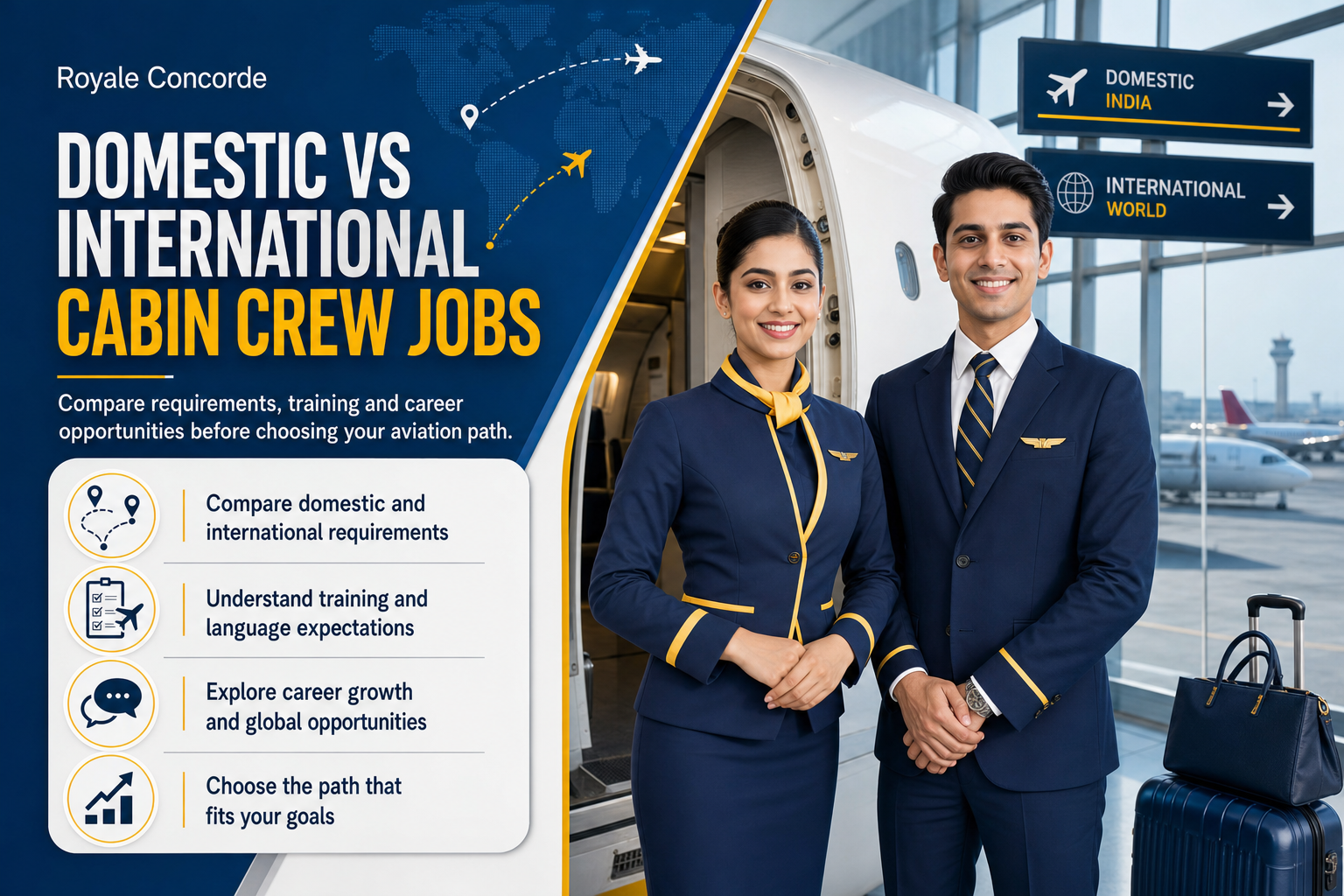
What is the difference between domestic and international cabin crew jobs? Domestic and international cabin crew jobs differ primarily in eligibility requirements, training focus, salary, work environment, and career progression. While both roles require strong service and safety skills, international cabin crew positions often demand additional language proficiency, cultural awareness, and adaptability for global travel.
As the aviation industry in India and worldwide expands, aspiring professionals face an important career choice: whether to pursue a domestic cabin crew job or aim for an international flight attendant position. At Royale Concorde Aviation Academy, Bangalore’s premier aviation training institute, we guide students through this decision by offering industry-aligned training for both domestic and international airline careers. This in-depth guide will help you understand the essential differences, requirements, and cabin crew opportunities available in the industry, empowering you to make an informed decision about your cabin crew career.
Domestic vs international cabin crew jobs differ in terms of eligibility, job roles, training, service expectations, and career growth. Domestic roles primarily involve working on flights within India, while international roles cover flights across countries and continents, demanding higher language proficiency and cultural adaptability.
While the core responsibilities remain similar, airline requirements for each type of cabin crew job can vary significantly. Airlines set minimum eligibility criteria based on their operational needs, safety standards, and service philosophies.
| Requirement Area | Domestic Cabin Crew Jobs | International Cabin Crew Jobs |
|---|---|---|
| Minimum Education | 10+2 (Higher Secondary) or equivalent | 10+2 (Higher Secondary) or equivalent, sometimes a graduate degree |
| Age | 18–27 years (varies by airline) | 21–30 years (varies by airline and country) |
| Height/Physical Criteria | 155–170 cm (female), 170–180 cm (male) (airline-specific) | 160–180 cm (female), 170–185 cm (male) (stricter for some international airlines) |
| Language Skills | Fluency in English and one Indian language | Fluency in English; knowledge of additional foreign languages preferred |
| Medical Fitness | Standard vision and health checks | Stringent international medical and dental standards |
| Passport | Not mandatory for all airlines | Mandatory |
| Experience | Freshers often welcome | Experience in hospitality or as domestic cabin crew an advantage |
Cabin crew roles, whether domestic or international, focus on ensuring passenger safety, delivering excellent service, managing emergencies, and representing the airline’s brand. However, international flight attendants encounter distinct scenarios due to longer flights and multicultural passenger profiles.
Training for domestic cabin crew jobs focuses on Indian aviation regulations, local language communication, and short-haul flight service standards. In contrast, international cabin crew jobs require a broader training approach, emphasizing:
At Royale Concorde Aviation Academy, students experience both types of training, gaining exposure to simulated international service environments and domestic airline operations.
Both career paths offer abundant cabin crew opportunities for qualified professionals. However, the scope, salary, and long-term growth can differ:
The right choice between domestic and international roles depends on your career goals, personal strengths, and long-term aspirations. Consider:
Royale Concorde Aviation Academy helps students evaluate these factors through counseling, personality development, and industry mentorship, ensuring you are prepared for the cabin crew path best suited to you.
Royale Concorde Aviation Academy in Bangalore is a leading institution specializing in both domestic and international aviation training. Here’s how RCAA ensures you are industry-ready:
RCAA is proud to be a women-led aviation academy, with mentors like Bhavna Jain, Monica K, and Khushbu C—professionals who have excelled in both domestic and international airlines. Their mentorship ensures holistic development, inspiring students to pursue excellence in any aviation environment.
International cabin crew typically earn higher salaries, with added benefits such as overseas allowances, accommodation, and travel perks. Domestic cabin crew in India enjoy competitive pay, but the earning potential is generally higher with international airlines.
Some international airlines hire freshers, but prior experience in domestic cabin crew jobs or hospitality is an advantage. Completing internationally recognized training at RCAA can improve your chances.
Cabin crew can progress to senior positions, trainers, pursers, or transition into aviation management and hospitality roles. International exposure often accelerates growth and opens global opportunities.
While not always mandatory, proficiency in additional languages significantly boosts your employability and is a strong asset for international airlines.
Royale Concorde Aviation Academy is a premier aviation training institute based in Bangalore, Karnataka, India. Founded by Shri L. R. Shivarame Gowda, RCAA is committed to shaping the next generation of aviation professionals through a blend of industry-relevant curriculum, hands-on training, and global exposure.
For more information or career counseling, contact us at mail@royaleconcordeaviation.com or call +91 7204805777.
Choosing between domestic vs international cabin crew jobs is a significant decision that shapes your future in aviation. Both pathways offer unique rewards and challenges, from serving Indian skies to representing global airlines. With Royale Concorde Aviation Academy’s expert training, mentorship, and industry connections, you are empowered to pursue a dynamic cabin crew career—wherever your ambitions take you.
The primary difference between domestic and international cabin crew jobs lies in the routes served and the associated responsibilities. Domestic cabin crew jobs typically involve flights within a single country, focusing on shorter routes and quicker turnarounds. International cabin crew jobs, on the other hand, cater to flights crossing national borders, often requiring knowledge of international regulations, customs procedures, and multiple languages. Both offer unique cabin crew opportunities and pathways for growth within the cabin crew career.
For domestic cabin crew jobs, airlines generally require candidates to have completed at least higher secondary education (10+2), possess good communication skills in the local language and English, and meet minimum physical requirements such as height and vision. Customer service experience is an advantage but not always mandatory. Royale Concorde Aviation provides training to help candidates meet and exceed these airline requirements, ensuring better job prospects.
International flight attendant positions usually have stricter airline requirements. Candidates may need to be fluent in English and one or more foreign languages, have a valid passport, and possess a higher level of cultural sensitivity. Some airlines prefer previous flying or hospitality experience. Royale Concorde Aviation offers advanced language and cultural training to help aspirants qualify for international cabin crew jobs.
The cabin crew career offers diverse growth opportunities. Starting as a flight attendant, you can advance to senior crew, supervisor, or pursuer roles. With experience and additional training, opportunities in crew management, recruitment, or training departments become available. Royale Concorde Aviation supports career progression through continuous professional development programs and placement assistance.
Most airlines set minimum and maximum age limits (typically 18-27 for entry-level positions), along with height, weight, and vision standards to ensure safety and efficiency in emergency situations. Good physical fitness and grooming are essential. Royale Concorde Aviation helps candidates understand and prepare for these requirements before applying to airlines.
Royale Concorde Aviation offers comprehensive training programs tailored to both domestic and international cabin crew jobs. Their dedicated placement cell guides students through resume building, interview preparation, and connects them with leading airlines. They also provide industry insights to help candidates choose between domestic vs international cabin crew jobs based on their aspirations.
Proficiency in English is mandatory for most international cabin crew jobs, as it is the global aviation language. Additional language skills, such as French, Arabic, Mandarin, or Spanish, can significantly enhance employability. Royale Concorde Aviation provides language enhancement modules to help aspirants meet these expectations.
Absolutely. Royale Concorde Aviation’s curriculum is aligned with leading airline requirements, covering practical, theoretical, and soft skill aspects. Their industry-experienced trainers and real-world simulations prepare candidates for interviews and the rigors of cabin crew opportunities, giving graduates a competitive edge in the selection process.
Royale Concorde Aviation stands out due to its holistic approach to training, strong industry connections, and ongoing support for students. Their focus on both domestic and international standards, personalized mentoring, and job placement partnerships ensure that students are well-equipped for a successful cabin crew career in any segment of the aviation industry.