Royale Concorde Aviation Academy | Bangalore’s Premier Aviation Training Institute
What Is Baggage Handling At Airports?
Baggage handling at airports refers to the comprehensive logistics system responsible for receiving, sorting, transporting, and delivering passenger luggage throughout the airport journey. This process ensures that every checked baggage item moves efficiently from check-in to the aircraft, and finally to baggage claim, all while maintaining security and minimizing loss or damage. At Royale Concorde Aviation Academy in Bangalore, future aviation professionals are trained to master every aspect of this process, ensuring smooth, safe, and customer-centric airport experiences.
How Does The Baggage Handling Process Work?
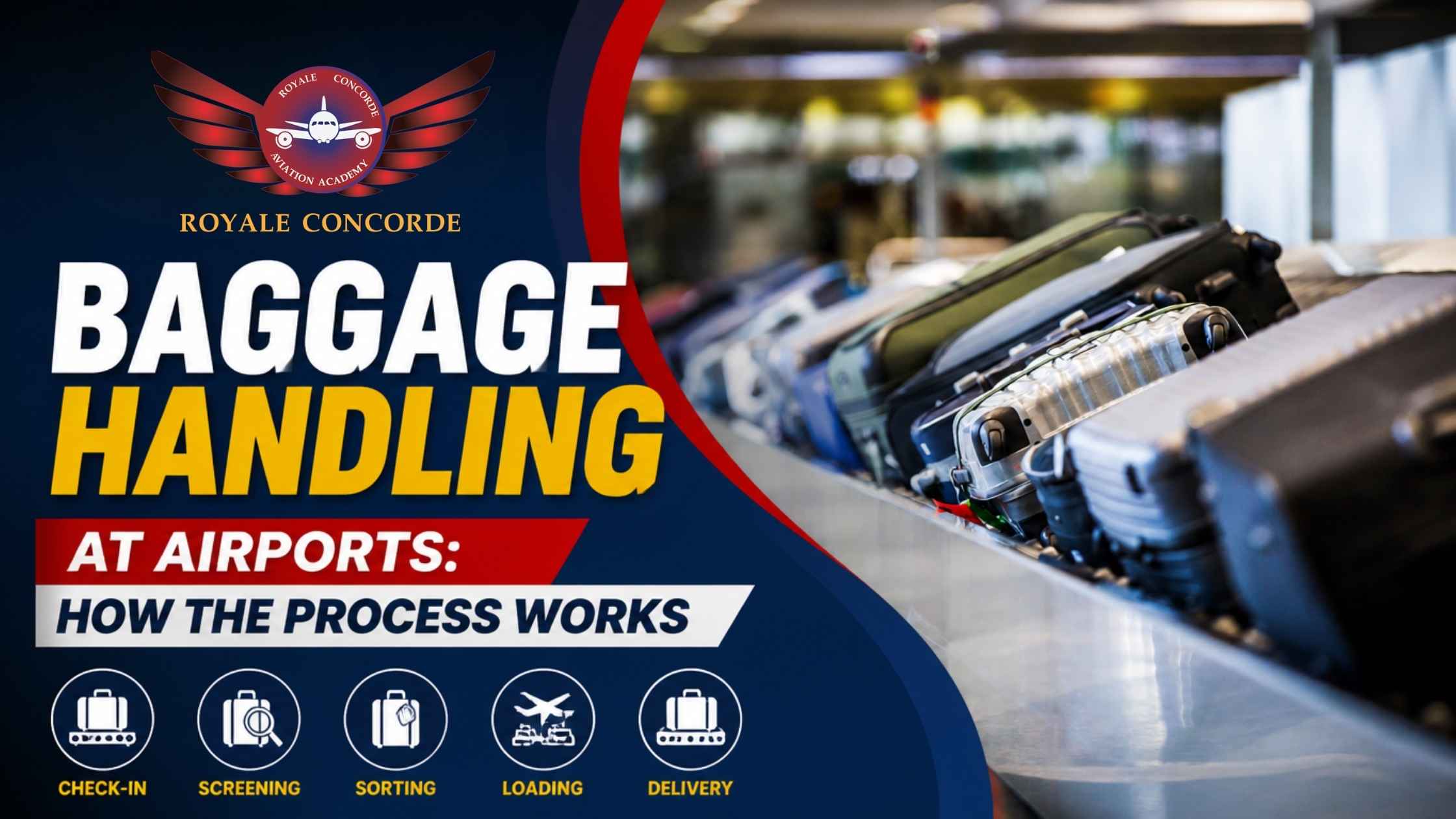
The baggage handling process involves multiple coordinated steps, sophisticated technology, and skilled airport ground staff to guarantee each bag reaches its destination securely and on time. Here is an overview:
- Check-in: Passengers hand over their checked baggage at airline counters, where it is weighed, tagged, and entered into the airport’s tracking system.
- Baggage Sorting: Luggage is routed through automated systems that identify the correct flight and destination by scanning the tag barcodes.
- Security Screening: Bags pass through advanced screening to check for prohibited items, ensuring compliance with aviation security standards.
- Baggage Transfer: Conveyor belts and specialized vehicles move bags from sorting areas to aircraft loading zones.
- Aircraft Loading: Trained baggage handlers load the luggage into the aircraft holds, following strict placement and safety protocols.
- Arrival & Reclaim: Upon landing, bags are unloaded, sorted by flight, and transferred to the appropriate baggage claim areas for passengers to collect.
Each stage requires seamless teamwork, real-time communication, and adherence to safety and security regulations — skills emphasized in Royale Concorde Aviation’s airport operations curriculum.
What Role Does Airport Ground Staff Play In Baggage Operations?
Airport ground staff are the backbone of efficient baggage operations. Their responsibilities include:
- Tagging and tracking checked baggage at check-in
- Operating baggage handling machinery and software
- Conducting security checks and reporting suspicious items
- Coordinating baggage sorting and transfers between connecting flights
- Ensuring timely delivery to and from aircraft
- Managing lost, delayed, or damaged luggage situations professionally
At Royale Concorde Aviation Academy, students are trained to handle these responsibilities with precision, empathy, and professionalism, reflecting the highest industry standards.
Step-by-step Guide: The Lifecycle Of Checked Baggage
Understanding the journey of checked baggage helps aspiring airport professionals appreciate the complexity and importance of their role. Here’s a detailed step-by-step flow:
- Check-in: Passengers submit luggage; bags are tagged with flight and destination details.
- Initial Screening: Bags pass through X-ray and security checks.
- Baggage Sorting: Automated systems or ground staff sort bags by destination and flight number.
- Baggage Transfer: Conveyor belts or carts move bags to aircraft loading areas.
- Aircraft Loading: Baggage is loaded into assigned holds, considering weight distribution and special handling for fragile or oversized items.
- Transit/Connection: For connecting flights, bags are rerouted via transfer belts or carts, minimizing delay and risk of misplacement.
- Arrival Unloading: Upon landing, ground staff unload and route bags to the reclaim area.
- Baggage Claim: Passengers collect their bags from the carousel, with staff available for assistance if luggage is missing or damaged.
| Stage | Technology/Equipment | Staff Involved |
|---|---|---|
| Check-in | Weighing scales, tag printers | Check-in agents |
| Sorting | Conveyor systems, barcode scanners | Sorters, operations supervisors |
| Screening | X-ray machines, explosive trace detectors | Security staff |
| Transfer & Loading | Belt loaders, baggage carts, ULDs | Baggage handlers, ramp agents |
| Arrival & Claim | Baggage carousels, tracking system | Arrival staff, customer service |
Why Is Efficient Baggage Handling Critical For Airport Operations?
Efficient airport baggage handling is vital for smooth airport operations, passenger satisfaction, and airline punctuality. Delays, lost baggage, and security breaches can disrupt schedules, erode customer trust, and impact an airport’s reputation.
- Passenger Experience: Fast, reliable baggage delivery enhances customer satisfaction and loyalty.
- Security: Proper screening and tracking reduce risks of prohibited items or unclaimed bags.
- Efficiency: Automated sorting and real-time tracking minimize handling time, reducing missed connections and operational costs.
- Safety: Trained staff ensure proper lifting, placement, and handling of special baggage to prevent injuries or accidents.
Royale Concorde Aviation Academy’s training emphasizes these dimensions, preparing students to excel in the high-stakes, fast-paced environment of global airport operations.
What Technologies Are Used In Modern Baggage Handling?
Today’s airports employ advanced technologies to streamline the baggage handling process:
- Barcode and RFID Tracking: Enables real-time monitoring and accurate bag identification.
- Automated Conveyor Systems: Efficiently move baggage from check-in to aircraft with minimal manual intervention.
- Explosive Detection Systems: Enhance security screening for checked baggage.
- Baggage Reconciliation Systems: Match bags to passengers, preventing unauthorized items from being loaded.
- Mobile Apps and Kiosks: Allow passengers to track baggage status and report issues instantly.
Students at Royale Concorde Aviation are introduced to these technologies through hands-on simulations and classroom modules, ensuring they are industry-ready upon graduation.
How Do Baggage Sorting And Baggage Transfer Work?
Baggage sorting is the process of directing luggage to the correct aircraft or transit vehicle, using automated systems and manual oversight to reduce errors. Baggage transfer involves moving bags between different flights or terminals, especially for connecting passengers.
- Automated systems scan baggage tags and direct bags via conveyor belts to the right loading bay.
- For transfers, ground staff coordinate rapid movement of bags to ensure connecting flights are not delayed.
- Exception handling is required for oversized, fragile, or misrouted bags, relying on staff expertise and communication.
Proper training in sorting and transfer logistics is key to minimizing lost baggage, a focus area at Royale Concorde Aviation Academy.
What Challenges Do Baggage Operations Face And How Are They Overcome?
Baggage operations encounter several challenges, including:
- High Passenger Volumes: Peaks during holidays and festivals can overwhelm systems and staff.
- Security Threats: Ensuring compliance with ever-evolving security regulations.
- Weather Disruptions: Heavy rain or fog can slow baggage transfer and increase risk of loss or damage.
- Human Error: Mistagged or mishandled bags can cause delays or losses.
Solutions include investing in technology, continuous staff training, and clear communication protocols. Royale Concorde Aviation Academy addresses these areas through simulation-based learning, scenario training, and emphasis on teamwork and communication.
How Does Royale Concorde Aviation Academy Prepare Students For Careers In Baggage Handling?
Royale Concorde Aviation Academy, a premier aviation training institute in Bangalore, is dedicated to equipping students with the skills, knowledge, and confidence required for successful airport careers, including baggage handling roles. The academy offers:
- Industry-aligned curriculum covering all aspects of baggage operations and airport ground staff duties
- Hands-on training with simulated airport and baggage handling environments
- Modules on communication, professionalism, and crisis response
- Mentorship from aviation experts with domestic and international experience
- Placement assistance to help graduates join leading airlines and airport operators
This comprehensive approach ensures graduates are prepared for the dynamic demands of airport baggage handling and broader airport operations.
Frequently Asked Questions About Baggage Handling At Airports
What happens if my checked baggage is lost?
If checked baggage is lost, airport staff use tracking systems to locate it quickly. Passengers should report missing bags at the baggage services counter. Most airlines and airports have protocols for compensation and will deliver recovered luggage to the passenger’s address.
How can baggage handling errors be prevented?
Errors can be minimized by using automated tracking, ensuring accurate tagging, regular staff training, and maintaining clear communication among all operational teams.
What skills are required for a career in baggage handling?
Key skills include attention to detail, physical fitness, teamwork, communication, problem-solving abilities, and adaptability to shift-based work schedules.
Does Royale Concorde Aviation Academy offer specialized baggage handling training?
Yes, RCAA’s airport operations curriculum covers baggage handling, security, ground staff duties, customer service, and hands-on simulations, preparing students for real-world challenges in airport environments.
About Royale Concorde Aviation Academy
Royale Concorde Aviation Academy is a leading aviation training institute based in Bangalore, Karnataka. Founded by Shri L. R. Shivarame Gowda and led by a team of industry experts, RCAA provides comprehensive training in cabin crew programs, airport ground operations, aviation hospitality, and personality development, with a strong emphasis on practical, simulation-based learning.
Phone: +91 7204805777 / +91 7204806777
Email: mail@royaleconcordeaviation.com
Website: royaleconcordeaviation.com
With a vision to nurture the next generation of aviation professionals, Royale Concorde Aviation Academy stands as a trusted launchpad for aspiring airline staff in India and beyond.
Frequently Asked Questions
What is the typical process for baggage handling at airports?
Baggage handling at airports involves a series of coordinated steps starting when you check your luggage at the counter. Your checked baggage is tagged and sent along a complex system of conveyor belts and scanners. The bags are sorted based on their destination using automated and manual methods, then delivered to the correct aircraft. Upon arrival, the process is reversed, ensuring your bags are sent to the right baggage claim area.
How does Royale Concorde Aviation improve airport baggage handling?
Royale Concorde Aviation enhances airport baggage handling by offering advanced tracking solutions, automated sorting technologies, and seamless integration with airport operations. Our systems enable real-time monitoring, accurate baggage sorting, and efficient baggage transfer, leading to fewer lost bags and faster turnaround times for passengers and airlines alike.
What role do airport ground staff play in the baggage handling process?
Airport ground staff are essential to the baggage handling process. They oversee loading and unloading checked baggage, manual sorting, and addressing any irregularities such as damaged or misrouted bags. With Royale Concorde Aviation’s solutions, ground staff are empowered with tools to streamline baggage operations and improve overall efficiency.
How are bags sorted to ensure they reach the correct destination?
Baggage sorting is performed using a combination of barcode or RFID scanning and automated conveyor systems. Each checked baggage item is scanned and routed to the appropriate loading area depending on flight details. Royale Concorde Aviation’s technology optimizes this process, minimizing errors and reducing the risk of misplaced luggage.
What happens to my baggage during a layover or connecting flight?
During layovers or connecting flights, baggage transfer is managed by systems that automatically redirect your checked baggage to the next aircraft. Royale Concorde Aviation provides tracking and coordination solutions to ensure timely and accurate transfers, reducing the chance of missed connections or delayed bags.
How does advanced technology impact airport baggage operations?
Advanced technologies, like those provided by Royale Concorde Aviation, automate and streamline airport baggage operations. This includes real-time tracking, predictive analytics, and integration with airport systems, all of which help reduce errors, enhance security, and improve the flow of baggage through each stage of the journey.
What benefits do airports gain from partnering with Royale Concorde Aviation?
Airports benefit from increased efficiency, reduced mishandling rates, and a better passenger experience. Royale Concorde Aviation’s comprehensive baggage handling solutions integrate smoothly with existing airport operations, enhance communication between teams, and provide actionable insights for continuous improvement.
How does Royale Concorde Aviation handle irregular baggage situations?
Irregular baggage situations, such as lost, delayed, or oversized items, are managed with proactive alerts and tracking provided by Royale Concorde Aviation’s systems. Our solutions enable airport ground staff to quickly identify and resolve issues, ensuring disruptions are minimized and passengers are kept informed.
Can Royale Concorde Aviation solutions be tailored for different airport sizes?
Absolutely. Royale Concorde Aviation offers scalable baggage handling process solutions suitable for airports of all sizes, from regional facilities to major international hubs. Our systems are designed to adapt to varying passenger volumes and operational complexities, ensuring reliable performance in diverse environments.