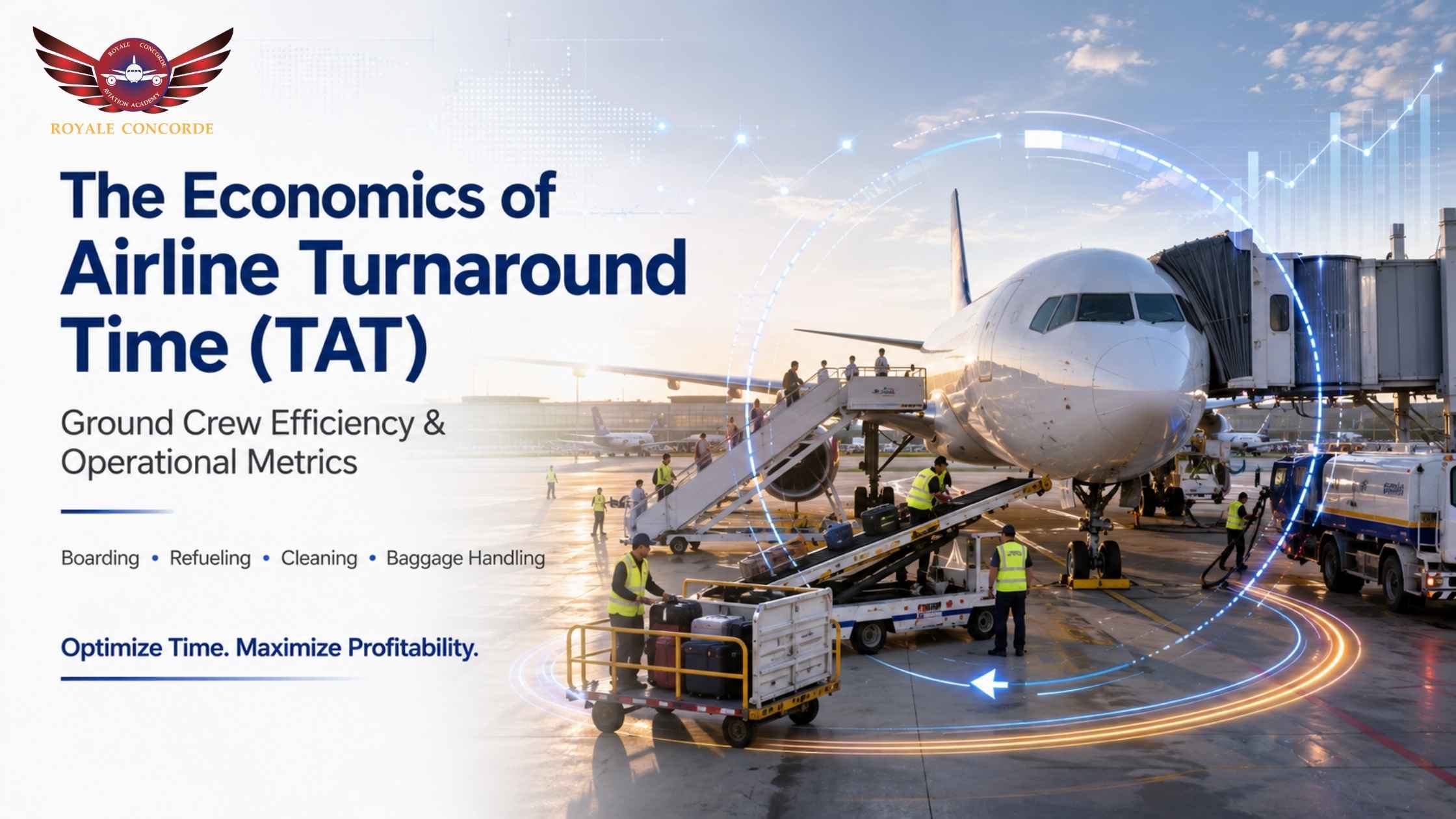
What is airline turnaround time economics and why does it matter? Airline turnaround time economics refers to the financial and operational impact associated with the duration between an aircraft’s arrival at the gate and its next departure. Reducing this time is essential for maximizing aircraft utilization, minimizing operational costs, and enhancing airline profitability. At Royale Concorde Aviation Academy in Bangalore, future aviation professionals are rigorously trained in optimizing these critical processes, making them industry-ready for both domestic and international airline operations.
How does turnaround time affect airline profitability?
The economics of airline turnaround time directly influence an airline’s bottom line. The faster an aircraft can be prepared for its next flight, the more flights it can operate per day, maximizing revenue. Conversely, inefficient turnarounds lead to increased ground delays, higher crew and maintenance costs, and dissatisfied passengers. Royale Concorde Aviation Academy’s curriculum ensures students deeply understand these connections and are equipped to implement best-in-class industry practices.
- Reduced aircraft idle time leads to higher daily aircraft utilization.
- Efficient crew scheduling minimizes overtime and associated costs.
- Improved passenger experience through on-time performance improves airline reputation and revenue.
What are TAT ground operations?
TAT ground operations encompass all activities performed between the arrival and departure of an aircraft at an airport gate. This includes passenger disembarkation, cleaning, de-catering, catering, security checks, baggage handling, refueling, and more. Each of these operations must be performed in strict coordination to optimize the turnaround time.
| Operation | Typical Duration | Potential Bottlenecks |
|---|---|---|
| Passenger Disembarkation | 10-15 mins | Jet bridge congestion |
| Cleaning & Cabin Prep | 10-20 mins | Staffing, equipment delays |
| De-catering | 5-10 mins | Late arrival of catering trucks |
| Refueling | 15-20 mins | Weather, fuel truck delay |
| Baggage Handling | 15-25 mins | Ramp congestion, equipment faults |
Royale Concorde Aviation Academy teaches students to master the orchestration of these processes, emphasizing both safety and efficiency.
What is block-to-block time and why is it critical?
Block-to-block time is the period from the moment an aircraft leaves its departure gate (blocks out) until it arrives at the arrival gate (blocks in). This metric is crucial for airlines as it impacts scheduling, crew duty times, and cost management. Efficient management of block-to-block time ensures reliable operations and optimal use of resources.
- Shorter block-to-block times can increase flight frequency and revenue.
- Delays in this metric often cascade into subsequent flight schedules, leading to operational disruption.
- Ground crew efficiency is a determining factor in minimizing block-to-block time, making this a key focus in Royale Concorde’s training modules.
How does de-catering fit into the turnaround process?
De-catering involves removing leftover food, beverages, and service items from the aircraft before new catering is loaded for the next flight. While this may seem routine, delays in de-catering can cause a ripple effect, impacting other ground operations and ultimately increasing turnaround time. At Royale Concorde Aviation Academy, students learn the importance of efficient de-catering as part of the critical path for TAT ground operations.
- Coordinated scheduling ensures de-catering and catering do not overlap or delay each other.
- Proper waste management and quick turnaround support both hygiene and punctuality.
What is parallel refueling and how does it optimize turnaround?
Parallel refueling refers to conducting fuel replenishment simultaneously with other ground tasks, such as baggage handling or cabin cleaning. This strategy is vital in minimizing overall turnaround time but requires strict safety procedures and coordination. Royale Concorde Aviation Academy trains its students to recognize when and how parallel refueling can be safely implemented to maximize ramp efficiency metrics.
- Reduces overall ground time by overlapping non-conflicting activities.
- Demands clear communication among ground teams to manage safety risks.
- Boosts airline competitiveness by improving on-time departure rates.
What is the critical path in airline turnaround?
The critical path represents the sequence of interdependent ground operations that determine the minimum turnaround time for an aircraft. Any delay in a critical path task directly delays the aircraft’s departure. Identifying and managing the critical path is a core component taught at Royale Concorde Aviation Academy, equipping students to prioritize high-impact activities.
- Disembarkation
- Cabin cleaning and safety checks
- De-catering and catering
- Refueling
- Baggage and cargo handling
- Boarding for next flight
How do ground delays impact airline turnaround time economics?
Ground delays can severely undermine the economics of airline turnaround time. Delays may be caused by equipment breakdown, late arrival of service vehicles, staff shortages, or weather disruptions. Each minute of delay not only increases operating costs but also risks passenger dissatisfaction and subsequent revenue loss. Royale Concorde Aviation Academy emphasizes proactive delay management and contingency planning in its training programs.
- Real-time monitoring and quick decision-making are key to minimizing ground delays.
- Students learn to conduct root cause analysis to prevent recurring issues.
What are ramp efficiency metrics and why are they important?
Ramp efficiency metrics are quantitative measures used to evaluate how effectively ground operations are managed on the airport ramp. These metrics include average turnaround time, percentage of on-time departures, resource utilization rates, and safety compliance rates. At Royale Concorde Aviation Academy, students are trained to interpret and act on ramp efficiency metrics to drive continuous improvement and operational excellence.
| Metric | Definition | Impact |
|---|---|---|
| Turnaround Time (TAT) | Time from arrival to departure | Shorter TAT = More flights, higher revenue |
| On-Time Departure Rate | % of flights leaving on schedule | Improves airline reputation, reduces costs |
| Resource Utilization | Efficiency of staff and equipment use | Reduces operational waste, controls cost |
| Safety Compliance | Adherence to safety protocols | Prevents accidents, maintains regulatory approval |
How does Royale Concorde Aviation Academy prepare students for TAT roles?
Royale Concorde Aviation Academy in Bangalore is a premier aviation training institution focused on preparing the next generation of professionals for roles in TAT ground operations, ground crew management, and airline operational excellence. Through a robust curriculum, state-of-the-art facilities, and mentorship from industry veterans, students build skills in:
- Operational coordination and teamwork
- Real-time communication and leadership
- Problem-solving and contingency planning
- Data-driven decision making using ramp efficiency metrics
- Industry-ready grooming and customer service
The academy’s simulated aircraft cabin, emergency response modules, and practical exposure ensure that every graduate is “airline-ready” from day one.
Frequently asked questions about airline turnaround time economics
What is the main goal of optimizing airline turnaround time economics?
The main goal is to maximize aircraft utilization, minimize operational costs, and ensure on-time performance, all of which drive airline profitability and customer satisfaction.
How does ground crew training at Royale Concorde Aviation Academy address TAT challenges?
Students are trained through simulations, real-world scenarios, and industry expert mentorship to handle ground crew roles efficiently, focusing on both speed and safety in TAT ground operations.
What are the most important ramp efficiency metrics for airlines?
Key metrics include turnaround time, on-time departure rate, staff and equipment utilization, and compliance with safety protocols.
Can a single delay in the turnaround process affect an airline’s entire schedule?
Yes, even a minor delay can cascade into subsequent flights, affecting the entire schedule, increasing costs, and potentially damaging the airline’s reputation.
Why is Bangalore a strategic location for aviation training?
Bangalore is a major aviation and technology hub, offering excellent connectivity, a growing aviation ecosystem, and access to leading airlines, making it ideal for hands-on aviation education.
About Royale Concorde Aviation Academy
Royale Concorde Aviation Academy (RCAA) is a premier aviation training institute in Bangalore, Karnataka, dedicated to shaping the next generation of aviation professionals. RCAA offers specialized training in cabin crew management, airport operations, aviation hospitality, and ground staff roles, ensuring graduates are ready to meet the highest airline recruitment standards. With a vision for global excellence and a mission to empower students with technical skills and professional confidence, Royale Concorde Aviation Academy stands as a beacon of quality aviation education in India.
- State-of-the-art simulated training environment
- Mentorship from women leaders with global airline experience
- Industry-aligned curriculum with strong focus on employability
- Strategic location in Bangalore for optimal industry exposure
- Comprehensive placement assistance and career guidance
For more information, visit Royale Concorde Aviation Academy or contact +91 7204805777 / +91 7204806777.
Frequently Asked Questions
What is airline turnaround time economics and why does it matter?
Airline turnaround time economics refers to the financial and operational impact of the time an aircraft spends on the ground between landing and its next departure. Every minute on the ground affects costs and revenue, making efficient turnarounds essential for profitability. Royale Concorde Aviation helps airlines optimize these processes, reducing unnecessary delays and maximizing aircraft utilization for improved economic outcomes.
How do TAT ground operations affect on-time performance?
TAT ground operations, or Turnaround Time ground operations, involve all the coordinated processes needed to prepare an aircraft for its next flight. Inefficiencies in these operations can lead to ground delays, impacting on-time performance and customer satisfaction. Royale Concorde Aviation delivers streamlined workflows and real-time monitoring to keep ground tasks on track and minimize disruptions.
What are block-to-block time and its implications for airlines?
Block-to-block time measures the period from when an aircraft first moves from its departure gate until it stops at the arrival gate. It is a critical metric for scheduling, crew management, and operational efficiency. Royale Concorde Aviation helps airlines analyze and improve block-to-block time by identifying bottlenecks and implementing best practices in ground handling.
How does de-catering fit into the turnaround process?
De-catering is the process of removing unused food and beverage items from an aircraft after arrival. Efficient de-catering ensures that catering crews do not delay other ground activities. Royale Concorde Aviation provides synchronized ground crew scheduling so that de-catering, cleaning, and re-catering happen smoothly, supporting a faster and more reliable turnaround.
What is parallel refueling, and how does it enhance ramp efficiency metrics?
Parallel refueling is the practice of refueling the aircraft simultaneously with other ground operations, rather than sequentially. This approach significantly improves ramp efficiency metrics by reducing total turnaround time. Royale Concorde Aviation trains ground crews in safety and coordination for parallel refueling, allowing multiple processes to run concurrently without compromising standards.
How does Royale Concorde Aviation identify and manage the critical path in turnarounds?
The critical path is the sequence of dependent ground operations that determine the minimum turnaround duration. Royale Concorde Aviation uses advanced analytics to map out the critical path for each turnaround, ensuring that no single bottleneck holds up the process. By addressing the critical path, airlines can minimize delays and improve overall ground performance.
What are common causes of ground delays, and how can they be reduced?
Common causes of ground delays include equipment malfunctions, miscommunication among teams, late catering, and inefficient baggage handling. Royale Concorde Aviation reduces these risks by implementing standardized procedures, digital checklists, and real-time coordination tools that enhance visibility and accountability across all ground operations.
How are ramp efficiency metrics tracked and improved?
Ramp efficiency metrics track the speed, accuracy, and safety of ground operations such as loading, fueling, and servicing. Royale Concorde Aviation employs digital tools to capture real-time data on these activities, generate actionable reports, and provide targeted training for continuous improvement in ramp performance.
What sets Royale Concorde Aviation apart in optimizing TAT ground operations?
Royale Concorde Aviation stands out by combining data-driven insights, automation, and expert training to optimize every aspect of TAT ground operations. Their tailored solutions focus on improving both speed and safety, enabling airlines to achieve industry-leading turnaround times and better financial results.